Art! Art! Art! › Works
Juno
 Rembrandt, 1660s
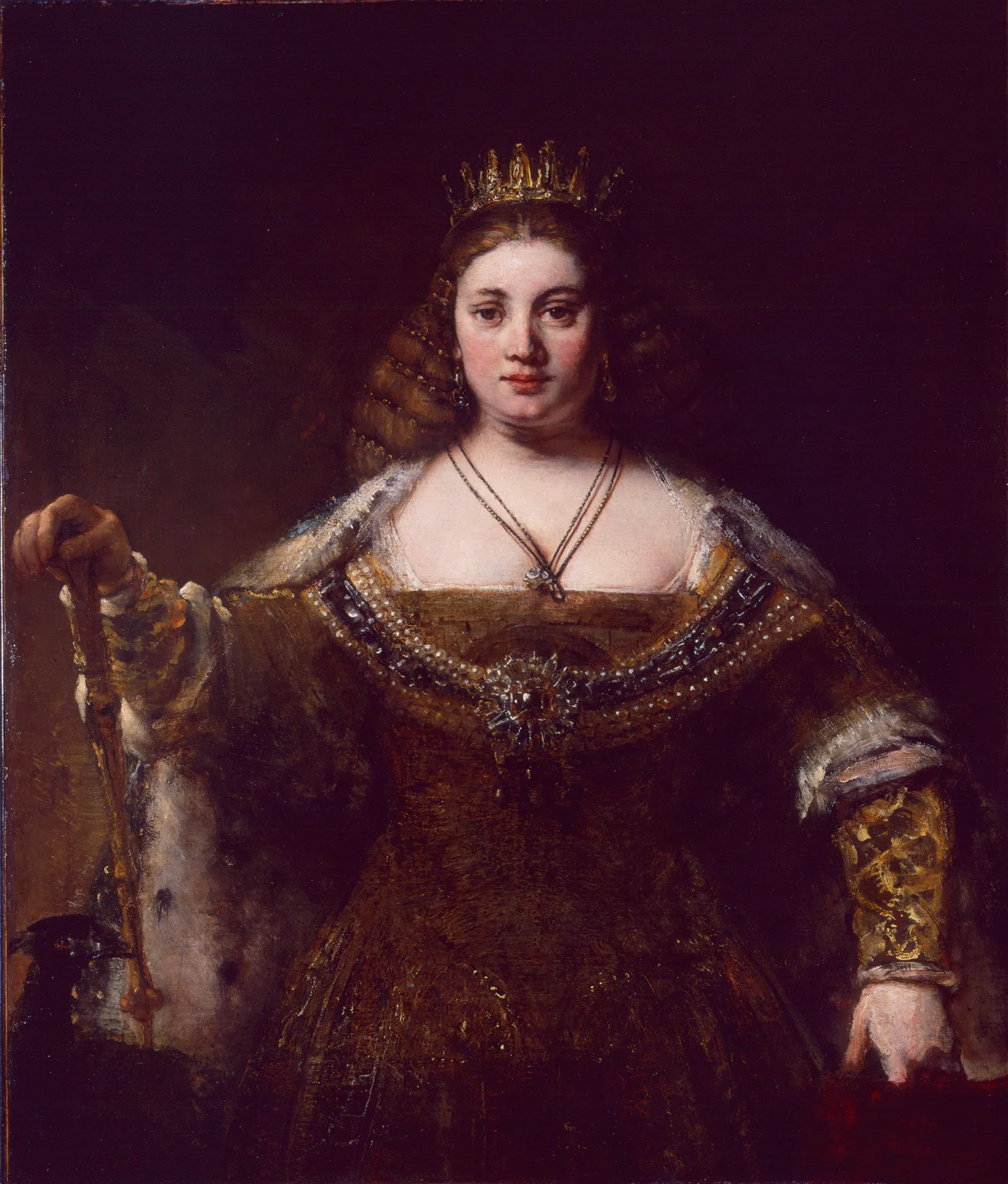
Rembrandt's Juno is a mythological painting from the 1660s that shows the Roman queen of the gods enthroned in majesty against a dark background. The oil-on-canvas work is held by the Hammer Museum in Los Angeles, California, where visitors can see a late Rembrandt at close range.
Where to see it
Juno is held by the Hammer Museum in Los Angeles, California. The collection record also lists the LVR-Landesmuseum Bonn, but the painting's stated location is the Hammer Museum. Display arrangements can change, so check the Hammer Museum's official website for current display status, opening hours and admission details before you visit.
What to look for in person
A goddess enthroned in majesty
Rembrandt presents Juno not in a story scene but as a seated figure of authority, enthroned and facing outward with the bearing of a ruler. In front of the canvas, notice how the composition is built around her alone: there is no crowd of attendants or busy landscape to distract from her presence. The effect is closer to a state portrait than to a narrative episode from mythology, and it invites you to stand back and take in the figure as a single, commanding image before moving closer to study the surface.
Light emerging from darkness
The goddess is set against a dark background, a device Rembrandt used throughout his career to concentrate attention. Look at where the light falls and where it fades: the brightest areas pull your eye toward the figure, while the edges of the composition dissolve into shadow. Spend a moment noticing how the transition between lit and unlit areas is handled, because this contrast does much of the work of giving Juno her weight and presence. Viewing from a few steps back and then up close reveals how differently the painting reads at each distance.
A large, nearly square canvas
The painting measures 127 by 123.8 cm, an almost square format that is worth noticing in person. A square field tends to feel stable and centred, which suits a seated, frontal figure of power. At this size the goddess appears at a scale that confronts the viewer directly rather than as a small cabinet picture. When you stand in front of it, consider how the near-equal height and width hold the figure in a balanced frame, and how the dark surroundings fill the space around her on every side.
About the painting
Juno was painted by Rembrandt in the 1660s, with sources placing it around 1662 to 1665, during the final decade of his career. It is executed in oil on canvas and measures 127 by 123.8 cm, giving it a nearly square format. The subject is mythological: Juno, the Roman goddess who in classical tradition was queen of the gods and wife of Jupiter. Rather than illustrating an episode from her myths, Rembrandt shows her enthroned in majesty, isolated against a dark background. This approach places the emphasis on presence and status rather than on action or storytelling. For visitors, the painting offers a chance to see how Rembrandt treated a classical subject late in life. Mythological themes were part of the repertoire of seventeenth-century painters, and here the goddess is given the solemn, frontal treatment of a figure of authority. The dark setting is characteristic of the artist, who often used shadow to frame and concentrate attention on a figure. The painting is held by the Hammer Museum in Los Angeles, California. The collection record also names the LVR-Landesmuseum Bonn alongside the Hammer Museum, while the location given is the Hammer Museum. When planning a visit, it is sensible to confirm on the museum's official website whether the work is currently on view. In the gallery, give yourself time to look from more than one distance: from further away the figure reads as a unified, imposing image, while closer viewing lets you study how the paint describes form and how the light and dark are balanced across the nearly square canvas.
Key facts
| Artist | Rembrandt |
|---|---|
| Date | 1660s |
| Size | 127 × 123.8 cm |
| Medium | oil paint, canvas |
| Collection | Hammer Museum / LVR-Landesmuseum Bonn |
How to visit: Hammer Museum
Los Angeles, United States
Hours and prices can change. Please check the official website before you go.
More by Rembrandt
 Rembrandt and Saskia in the parable of the Prodigal Son — Staatliche Kunstsammlungen Dresden
 Belshazzar's Feast — National Gallery
 Syndics of the Drapers' Guild — Rijksmuseum
 The Abduction of Europa — J. Paul Getty Museum
 The Night Watch — Rijksmuseum
 The Conspiracy of Claudius Civilis — Rijksmuseum
 The Storm on the Sea of Galilee
 Danaë
 Aristotle with a Bust of Homer — Metropolitan Museum of Art
 The Stoning of Saint Stephen
 The Mill — National Gallery of Art
 Bathsheba at Her Bath — Louvre Museum
Sources
- Wikidata Q21500872
- Wikipedia (fr) (CC BY-SA 4.0)