Art! Art! Art! › Works
The Stoning of Saint Stephen
 Rembrandt, 1624
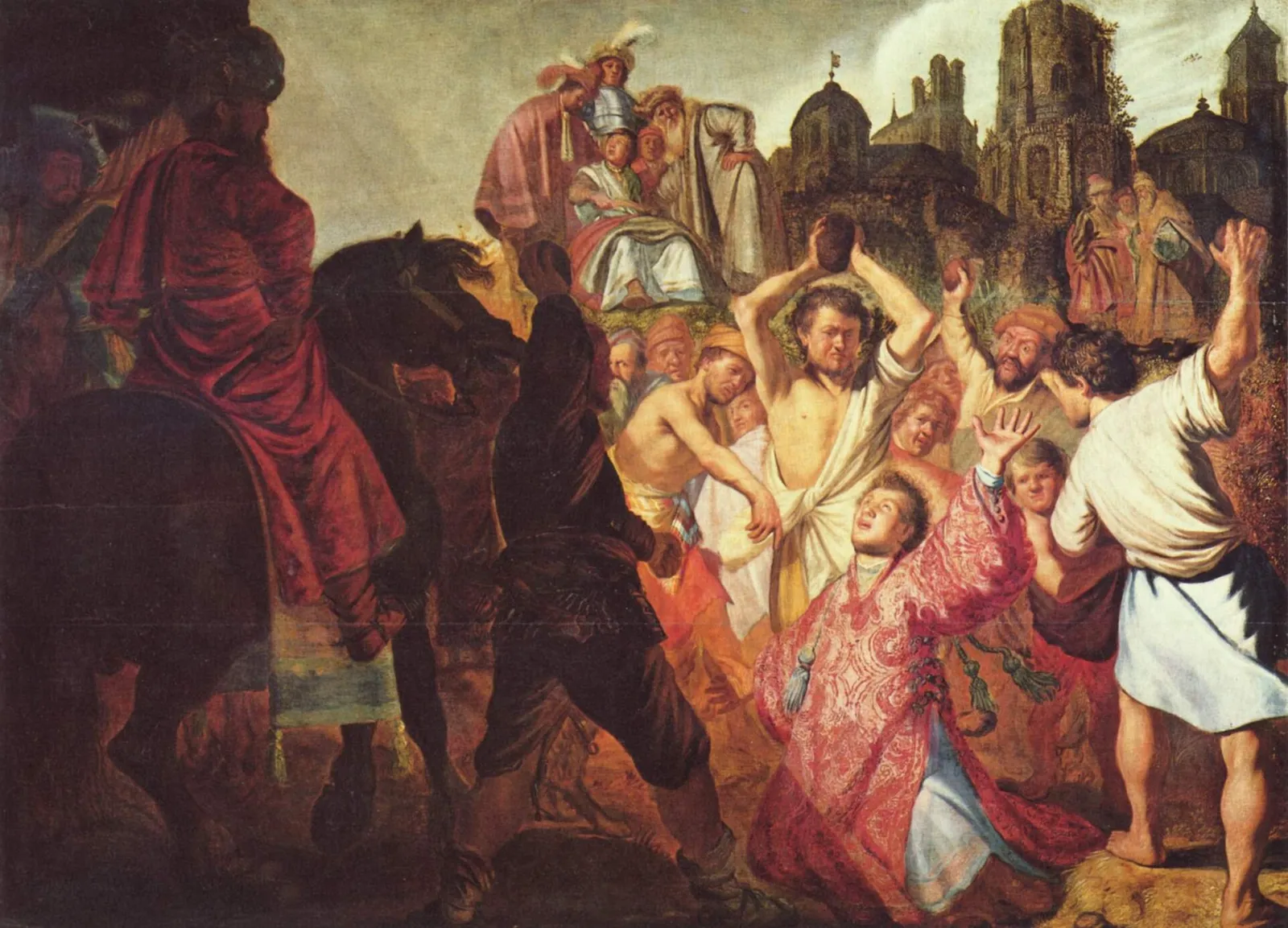
The Stoning of Saint Stephen is a very early painting by Rembrandt, dated 1624, and it belongs to the Museum of Fine Arts of Lyon. Measuring 89.5 by 123.6 cm, it shows the young artist working out a crowded, dramatic history scene with sharp contrasts of light and shadow.
Where to see it
The painting is in the collection of the Museum of Fine Arts of Lyon, which is also its listed location. Works in museum collections are sometimes moved, rehung, lent to exhibitions or taken off view for conservation, so check the Museum of Fine Arts of Lyon's official website for current display status, opening hours and ticket information before you visit.
What to look for in person
Stephen at the centre of the light
Start with the kneeling saint. Stephen is placed in the brightest part of the picture, his arms spread and his face turned upward, while the men around him raise stones to strike. The story comes from the Acts of the Apostles, where Stephen, the first Christian martyr, prays for his attackers as he dies. Notice how the light seems to fall on him alone, separating his calm gesture from the violent movement of the crowd pressing in from every side.
A dark foreground, a bright middle
Step back and look at how the composition is built in bands of light and dark. Figures closest to you are partly in deep shadow, which pushes the eye past them toward the illuminated centre. This use of strong contrast to stage a scene, often called chiaroscuro, became central to Rembrandt's work throughout his career. Here you can see an early, still experimental version of it, with the lighting arranged to guide your attention step by step into the drama.
A crowded young artist's history painting
Spend time with the many faces and bodies packed into a canvas of 89.5 by 123.6 cm. The tight grouping, varied expressions and lively costumes are typical of the ambitious history paintings Rembrandt made as a young man in Leiden, after training with the Amsterdam painter Pieter Lastman. Look closely at the individual heads, each given its own reaction, and at the onlookers watching from the edges. The painting rewards slow viewing rather than a quick glance.
About the painting
Rembrandt painted The Stoning of Saint Stephen at the very start of his independent career; the fact sheet gives its date as 1624. At this stage he was working in his home town of Leiden, having recently studied in Amsterdam with Pieter Lastman, a painter known for lively, crowded biblical and mythological scenes. The influence of that training is clear in the choice of a dramatic narrative subject, the theatrical gestures and the dense arrangement of figures. The subject comes from the Acts of the Apostles. Stephen, one of the early deacons of the Christian community in Jerusalem, was accused before the council, taken outside the city and stoned to death. According to the text, he saw the heavens open as he died and prayed that his killers be forgiven. A young man named Saul, who later became the apostle Paul, is described as looking after the cloaks of those throwing stones. Painters often included these details, and visitors can look for the gesture of prayer and the sense of a vision above. What makes the work valuable for visitors today is the chance to see Rembrandt before his mature style. The handling of light already does much of the storytelling: the saint is lit while much of the surrounding crowd falls into shadow, a principle he would refine for decades. At the same time, the composition is busier and more crowded than his later paintings, which helps viewers understand how his art developed. The painting belongs to the Museum of Fine Arts of Lyon. Before planning a trip specifically to see it, confirm on the museum's official website that it is currently on display.
Key facts
| Artist | Rembrandt |
|---|---|
| Date | 1624 |
| Size | 89.5 × 123.6 cm |
| Medium | oil paint, oak panel |
| Collection | Museum of Fine Arts of Lyon |
How to visit: Museum of Fine Arts of Lyon
Lyon, France
Hours and prices can change. Please check the official website before you go.
More by Rembrandt
 Rembrandt and Saskia in the parable of the Prodigal Son — Staatliche Kunstsammlungen Dresden
 Belshazzar's Feast — National Gallery
 Syndics of the Drapers' Guild — Rijksmuseum
 The Abduction of Europa — J. Paul Getty Museum
 Juno
 The Night Watch — Rijksmuseum
 The Conspiracy of Claudius Civilis — Rijksmuseum
 The Storm on the Sea of Galilee
 Danaë
 Aristotle with a Bust of Homer — Metropolitan Museum of Art
 The Mill — National Gallery of Art
 Bathsheba at Her Bath — Louvre Museum