Art! Art! Art! › Works
The Night Watch
 Rembrandt, 1642
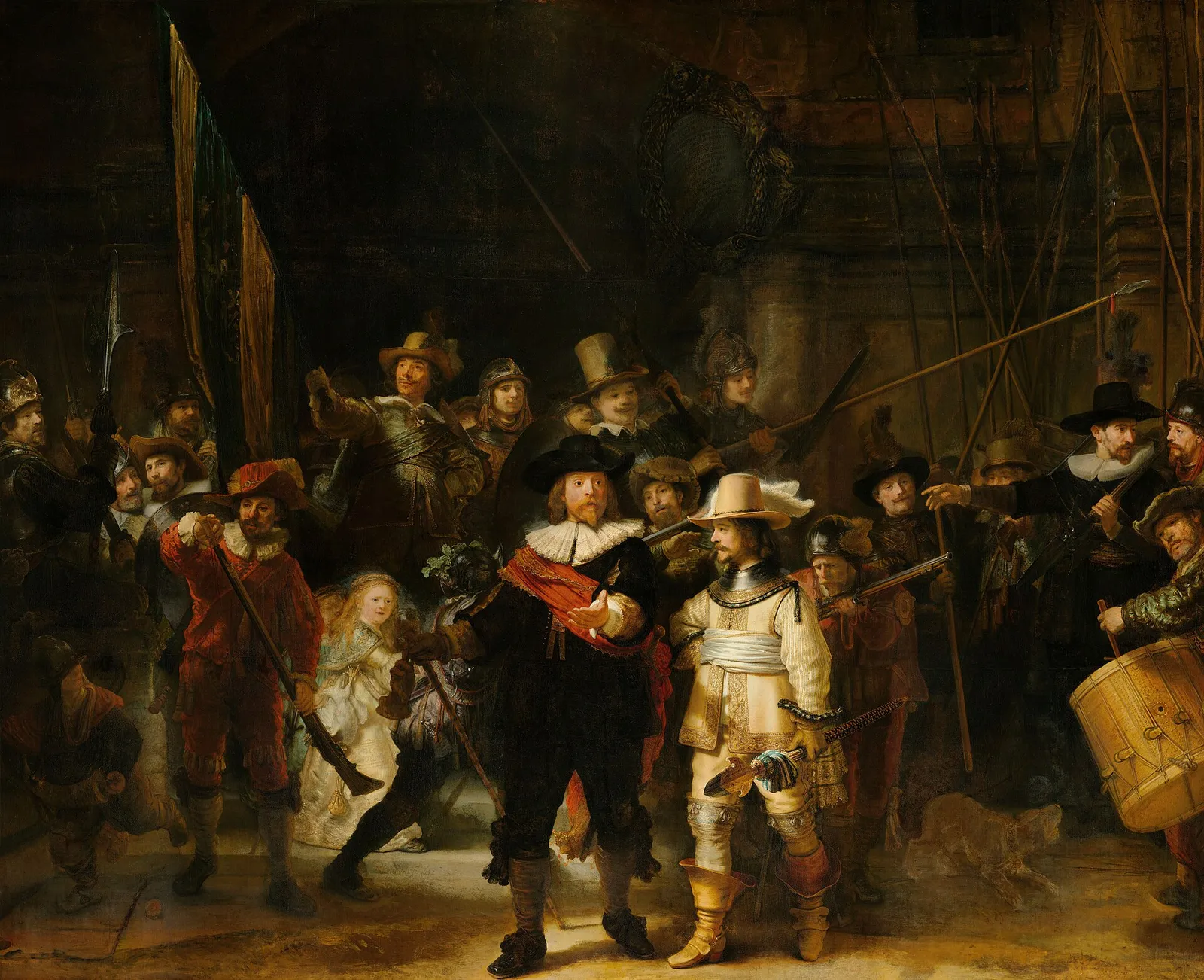
Rembrandt's The Night Watch, dated 1642, is a group portrait of a civic militia company painted as a scene in motion rather than a formal row of sitters. Its collection is recorded as the Amsterdam Museum and the Rijksmuseum, with the location listed as the Nightwatch hall. At 363 by 437 centimetres, it is a painting you take in from a distance first, then study detail by detail.
Where to see it
The fact sheet lists the painting's collection as the Amsterdam Museum and the Rijksmuseum, and its location as the Nightwatch hall. Before you plan a trip around this one painting, check the official website of the Rijksmuseum (and, if needed, the Amsterdam Museum) for current display status, opening hours and ticketing. Large works like this can occasionally be affected by conservation work or gallery changes, so confirming in advance is the safest way to make sure you see it.
What to look for in person
The captain and his lieutenant
Start at the centre foreground. The man in black with a red sash is the company's captain, Frans Banninck Cocq, his hand extended as if giving an order. Beside him, in pale yellow, is his lieutenant, Willem van Ruytenburch. Look at the lieutenant's coat: the shadow of the captain's hand falls across it, a small detail that ties the two figures together in space. Their contrasting colours, dark against light, make them the anchor of the whole composition, while everyone else seems to be moving around them.
Light, shadow and movement
Rather than lining the militiamen up evenly, Rembrandt shows the company stirring into action: a musket being loaded, another fired, a banner raised, a drummer at the right. Step back and notice how strong light picks out a few figures while others recede into darkness. This uneven lighting guides your eye through the crowd and creates a sense of depth and noise. The dark tone of the picture is also why it later became known as The Night Watch, although the scene is not set at night.
The girl in gold
To the left of the captain, slightly behind him, a small girl glows in golden light. Look for the dead chicken hanging from her belt, its claws clearly visible. Art historians generally read her as a symbolic figure for the militia company rather than a portrait of an actual member: the claw was an emblem of the Kloveniers, the arquebusiers' guild that commissioned the painting. She is one of the brightest spots on the canvas and a good example of how Rembrandt mixed portraiture with storytelling and symbolism.
About the painting
The Night Watch, dated 1642, is Rembrandt's large group portrait of a company of Amsterdam's civic militia, led by Captain Frans Banninck Cocq and Lieutenant Willem van Ruytenburch. Group portraits of militia companies were a familiar type in the Dutch Republic, usually commissioned by the members themselves to hang in their headquarters. Traditionally, such pictures arranged the sitters in tidy rows so each face received equal attention. Rembrandt took a different approach. He turned the commission into a moment of action, with men checking weapons, unfurling a flag and stepping forward, as if the company were about to march out. The painting was made for the Kloveniersdoelen, the meeting hall of the arquebusiers' militia. The familiar title is not the original one. Over time the varnish darkened, and the scene came to look like a night setting, which gave rise to the name used today. Cleaning has shown that the light is closer to daylight than the title suggests, though Rembrandt's strong contrasts of light and shadow remain central to the work. In front of the painting, its scale of 363 by 437 centimetres is part of the experience. Give yourself time to move between a far view, where the composition reads as a diagonal surge of figures, and a closer view, where you can pick out faces, weapons, the shield listing names near the archway, and the textures of costume and metal. It rewards slow looking more than a quick photo stop.
Key facts
| Artist | Rembrandt |
|---|---|
| Date | 1642 |
| Size | 363 × 437 cm |
| Medium | oil paint, canvas |
| Collection | Amsterdam Museum / Rijksmuseum |
How to visit: Rijksmuseum
Amsterdam, Netherlands · Museum guide
| Opening hours | Mon–Sun 09:00–17:00 (every day, incl. public holidays) Gardens 09:00–18:00 (summer only) |
|---|---|
| Closed | Open every day of the year, including public holidays. |
| Admission | Adults EUR 25 (from 2027: EUR 26.50) CJP / EYCA members (half price) EUR 11.25 (from 2027: EUR 13.25) 18 and under free |
| Free entry | Free for those aged 18 and under, Friends of the Rijksmuseum, Amsterdam City Card holders, and holders of ICOM, Vereniging Rembrandt, KOG, VVAK and VriendenLoterij VIP-KAART cards. The gardens are free. |
| Booking | Advance reservation is required, with timed entry. |
Official ticket page
Official website
View on map
Hours and prices can change. Please check the official website before you go. (Checked on: 2026-11-09)
More by Rembrandt
 Rembrandt and Saskia in the parable of the Prodigal Son — Staatliche Kunstsammlungen Dresden
 Belshazzar's Feast — National Gallery
 Syndics of the Drapers' Guild — Rijksmuseum
 The Abduction of Europa — J. Paul Getty Museum
 Juno
 The Conspiracy of Claudius Civilis — Rijksmuseum
 The Storm on the Sea of Galilee
 Danaë
 Aristotle with a Bust of Homer — Metropolitan Museum of Art
 The Stoning of Saint Stephen
 The Mill — National Gallery of Art
 Bathsheba at Her Bath — Louvre Museum