Art! Art! Art! › Works
The Mill
 Rembrandt, 1645
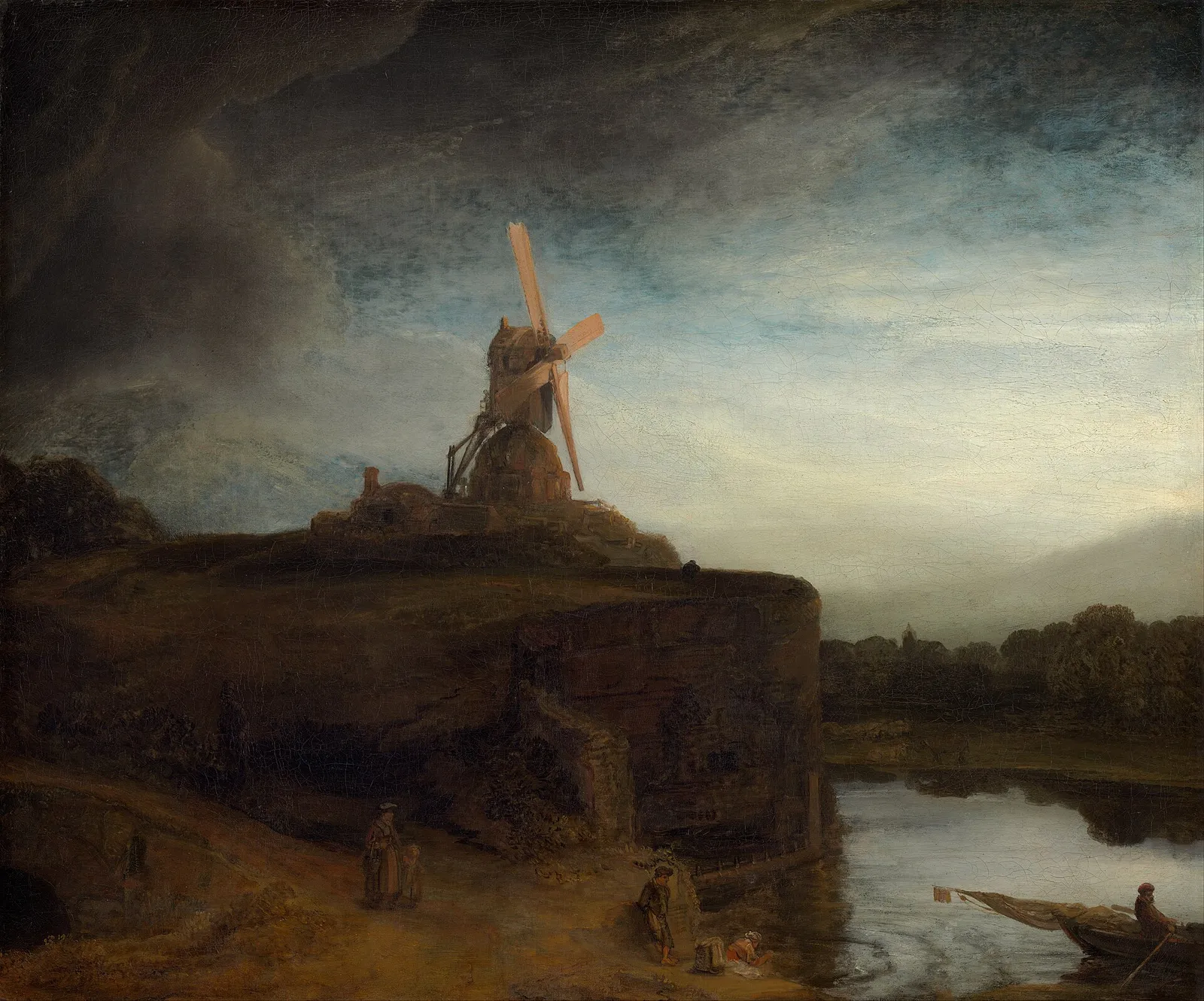
The Mill is a landscape dated 1645 and attributed to Rembrandt. It shows a windmill standing on high ground against a broad, changing sky. The painting measures 87.6 by 105.6 cm and once belonged to the Orleans Collection.
Where to see it
Our fact sheet identifies the current holder only by its Wikidata identifier, Q214867. It does not give a resolved museum name, so we cannot confirm the institution here. Before you plan a trip, look up Q214867 or the painting's Wikidata entry (https://www.wikidata.org/wiki/Q3224802) to see which museum holds it. Then check that museum's official website for current display status, opening hours and ticketing. Paintings can be moved, lent or taken off view for conservation.
What to look for in person
The windmill as a silhouette
Start with the mill itself. It rises on a rise of ground and is set against the lighter sky, so it reads almost as a dark shape. Step back a few paces and notice how the sails and the building stand out against the open sky. Then move closer and look for the touches of light that pick out its structure. Rembrandt builds drama here from contrasts of light and dark more than from detail, the same approach he used in his portraits and history paintings.
The sky and the light
A large part of the canvas is given to the sky, so take time with it. Follow how the light seems to break through the clouds and fall unevenly across the scene. Some areas glow while others sink into shadow. This uneven light gives the landscape its mood and leads your eye toward the mill. Watch how the painted atmosphere changes from one side of the picture to the other. It can help to view the work from more than one distance, because the effect of the light shifts as you move.
The water and the small details
Once you have taken in the mill and the sky, lower your gaze to the foreground and the water. Small details near the shore add scale and a sense of everyday life. They make the mill look larger and more imposing by comparison. Look at how the reflections and darker tones of the lower area anchor the composition and balance the bright sky above. These quieter passages reward slow looking. They are easy to miss if you only glance at the painting's dramatic upper half.
About the painting
The Mill is dated 1645 and measures 87.6 by 105.6 cm, a substantial size for a landscape. Rembrandt is known above all for portraits, self-portraits and biblical scenes. Painted landscapes form only a small part of his output, which makes this work a useful window onto a less familiar side of his art. Windmills were a common feature of the Dutch countryside and often appear in Dutch landscape painting of the seventeenth century. In this picture the mill is not a minor detail. It becomes the main subject, set high and shown against the sky, while light and shadow shape the whole scene.
The painting's history includes the Orleans Collection, the celebrated collection of paintings formed by the Dukes of Orléans in France. That collection was broken up and sold at the end of the eighteenth century, and its pictures went to many owners. A link to the Orleans Collection is one of the notable features of this painting's provenance.
When you visit, give yourself time to look at the painting from several distances. From farther away, the strong contrast between the dark mill and the bright sky dominates. Up close, you can study how the paint is handled in the clouds, the ground and the water. Rather than reading it as a precise record of a specific place, many viewers experience it as a study of mood, weather and light. For the holding institution and current display details, see the guidance above and consult the museum's official website before you go.
Key facts
| Artist | Rembrandt |
|---|---|
| Date | 1645 |
| Size | 87.6 × 105.6 cm |
| Medium | oil paint, canvas |
| Collection | Orleans Collection / Q214867 |
How to visit: National Gallery of Art
Washington, D.C., United States · Museum guide
| Opening hours | Mon–Sun 10:00–17:00 (open daily) |
|---|---|
| Closed | 25 December and 1 January |
| Admission | All visitors: free (including special exhibitions) |
| Free entry | Admission is always free. No passes or tickets are needed for the galleries, exhibitions or guided tours; some events require free registration. |
| Booking | No reservation is required and there is no timed entry. |
Hours and prices can change. Please check the official website before you go. (Checked on: 2026-11-11)
More by Rembrandt
 Rembrandt and Saskia in the parable of the Prodigal Son — Staatliche Kunstsammlungen Dresden
 Belshazzar's Feast — National Gallery
 Syndics of the Drapers' Guild — Rijksmuseum
 The Abduction of Europa — J. Paul Getty Museum
 Juno
 The Night Watch — Rijksmuseum
 The Conspiracy of Claudius Civilis — Rijksmuseum
 The Storm on the Sea of Galilee
 Danaë
 Aristotle with a Bust of Homer — Metropolitan Museum of Art
 The Stoning of Saint Stephen
 Bathsheba at Her Bath — Louvre Museum