Art! Art! Art! › Works
The Storm on the Sea of Galilee
 Rembrandt, 1633
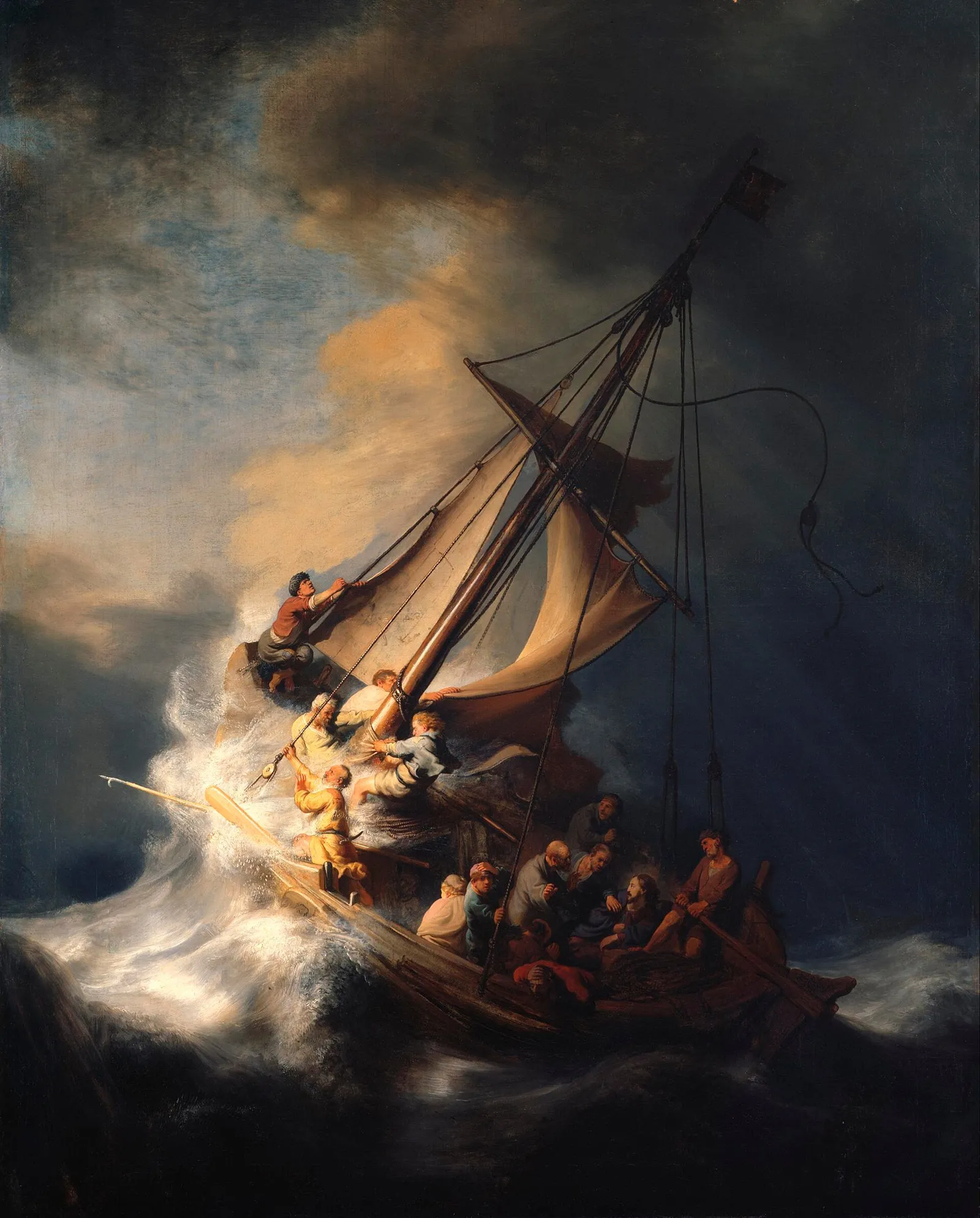
Rembrandt painted The Storm on the Sea of Galilee in 1633, and it belonged to the Isabella Stewart Gardner Museum in Boston. Since 18 March 1990 its whereabouts have been unknown, so it cannot be seen in person, though it remains part of the museum's collection record. This page explains where the painting was held and what to look for in reproductions.
Where to see it
The painting cannot currently be seen. Its last holder was the Isabella Stewart Gardner Museum, and its location has been unknown since 18 March 1990. The museum still lists it as part of its collection. If you plan to visit the Isabella Stewart Gardner Museum to learn about the work and its history, check the museum's official website first for current information on visiting and on how the missing works are presented. Until the painting is recovered, high-quality reproductions are the only way to study it.
What to look for in person
A boat divided between light and shadow
The composition is built on a strong diagonal. At the bow, lifted high on a breaking wave and lit by a break in the clouds, sailors struggle with a torn sail and rigging. Toward the stern, in deeper shadow, other passengers gather around Christ, some appealing to him as the storm rages. Rembrandt uses this contrast of light and dark to separate the frantic effort at the front of the boat from the human drama at the back. In a reproduction, trace the line of the mast and the crest of the wave to feel how steeply the vessel tilts.
Rembrandt's only seascape
This is generally described as the only seascape Rembrandt painted. The subject comes from the Gospels: Christ and his disciples are caught in a storm on the Sea of Galilee, and the frightened disciples wake him before he calms the wind and water. Rather than showing the calm that follows, Rembrandt chose the moment of greatest danger. Notice the churning water, the spray over the bow and the dark sky, which link the picture to Dutch marine painting while keeping the focus on the people aboard.
The gaze and the signature
Look among the passengers for a man who turns away from the chaos and looks straight out of the picture, toward the viewer. He holds onto a rope with one hand and his cap with the other, and his calm, direct look stands apart from the panic around him. Then look toward the stern: Rembrandt signed and dated the painting on the rudder. Finding these small details shows how much care the young painter put into a large canvas, which measures 160 by 128 cm in a tall, upright format.
About the painting
The Storm on the Sea of Galilee dates from 1633, when Rembrandt was establishing himself as a painter in Amsterdam. It is an oil painting of considerable size, 160 cm high and 128 cm wide, and its upright format helps convey the height of the wave and the steep angle of the boat. The subject is a well-known Gospel episode in which Christ, asleep in a boat during a sudden storm, is woken by his terrified disciples and then calms the sea. Rembrandt shows the moment before the miracle, when the crew is still fighting for control. The painting became part of the collection of the Isabella Stewart Gardner Museum in Boston. On 18 March 1990 it was among the works taken in a theft from the museum, and its location has been unknown since that date. The museum still counts it as part of its collection, and the case remains unsolved. For visitors, this means the painting can only be studied through photographs and reproductions. When looking at one, it is worth spending time on the way Rembrandt organises the scene: the bright, tilted bow with its straining sailors; the darker stern where figures crowd around Christ; and the varied reactions of individual passengers, from effort and fear to prayer and stillness. These contrasts of light, movement and expression are characteristic of Rembrandt's work in the early 1630s and make the picture readable as both a dramatic sea scene and a story about human responses to danger.
Key facts
| Artist | Rembrandt |
|---|---|
| Date | 1633 |
| Size | 160 × 128 cm |
| Medium | oil paint, canvas |
| Collection | Isabella Stewart Gardner Museum |
| Current location | Unknown since 1990-03-18 |
More by Rembrandt
 Rembrandt and Saskia in the parable of the Prodigal Son — Staatliche Kunstsammlungen Dresden
 Belshazzar's Feast — National Gallery
 Syndics of the Drapers' Guild — Rijksmuseum
 The Abduction of Europa — J. Paul Getty Museum
 Juno
 The Night Watch — Rijksmuseum
 The Conspiracy of Claudius Civilis — Rijksmuseum
 Danaë
 Aristotle with a Bust of Homer — Metropolitan Museum of Art
 The Stoning of Saint Stephen
 The Mill — National Gallery of Art
 Bathsheba at Her Bath — Louvre Museum