Art! Art! Art! › Works
The Virgin and Child with Saint Anne
 Leonardo da Vinci, 16th century
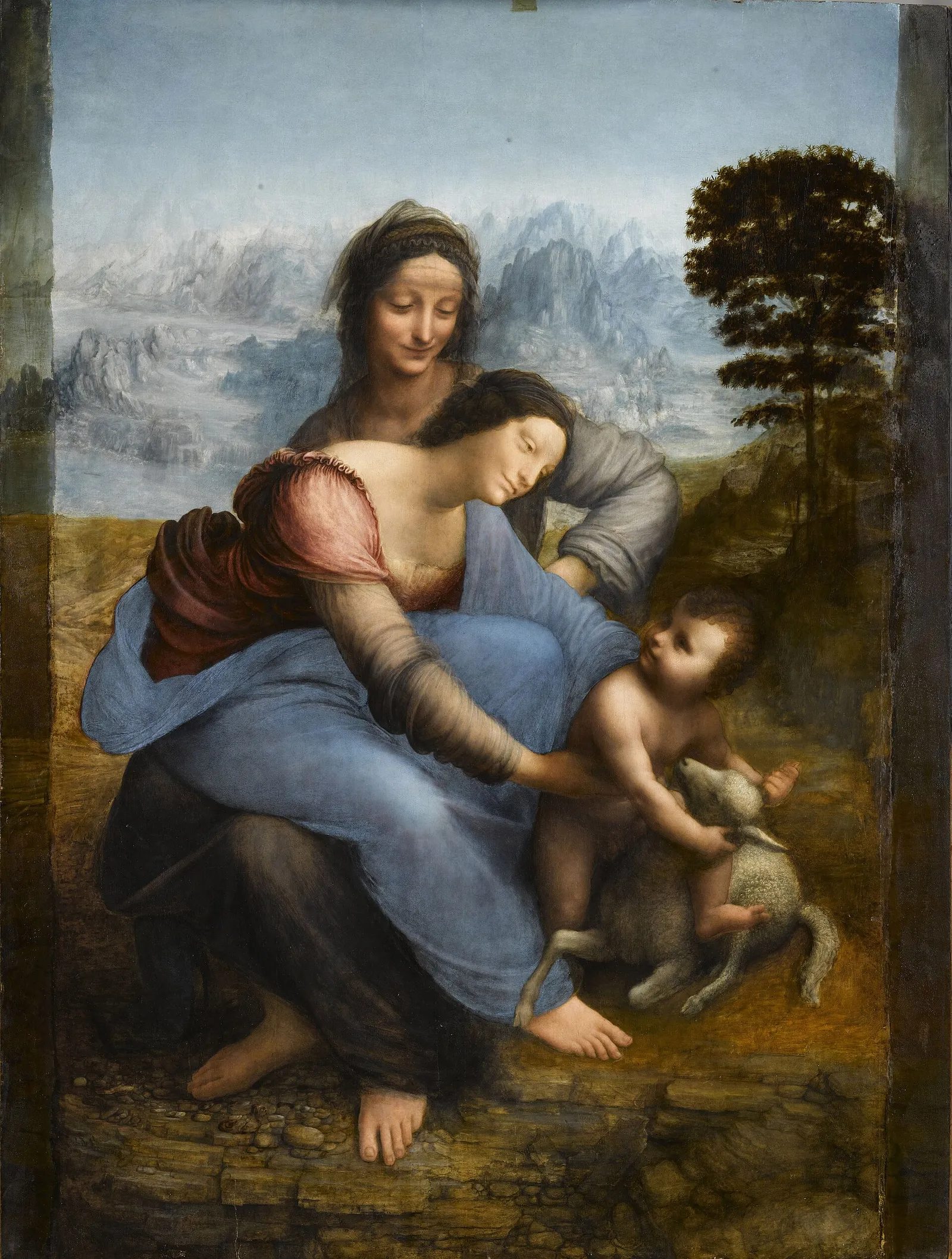
Leonardo da Vinci's The Virgin and Child with Saint Anne, a 16th-century painting, belongs to the Department of Paintings of the Louvre. Three generations, Saint Anne, her daughter Mary and the infant Christ, fold into a single interlocking group set against a hazy mountain landscape. It rewards slow looking, from the soft modelling of the faces to the small details at the figures' feet.
Where to see it
The painting is held by the Department of Paintings of the Louvre, and the fact sheet lists its location as Room 710. Displays at large museums change because of rehanging, conservation work and loans, so check the Louvre's official website for current display status before you visit. The panel measures 168 cm high by 130 cm wide, so it is large enough to view from a few steps back before moving closer for detail.
What to look for in person
A pyramid of three figures
Stand back first and take in the arrangement as a whole. Saint Anne, Mary and the Christ Child are combined into one tightly interlocking group that rises to a point at Anne's head. Mary sits on her mother's lap and leans down toward her son, while the child turns back to look up at her. Follow the arms, shoulders and glances and you will see how each figure leads your eye to the next. This compact, pyramid-like grouping is one of the main reasons the composition is studied so closely by historians of Renaissance painting.
The child and the lamb
Look to the lower right, where the Christ Child grips a lamb and seems to climb onto it. In Christian imagery the lamb points to Christ's future sacrifice. Read the gestures as a sequence: the child embraces the lamb, Mary reaches down as if to draw him back, and Anne looks on calmly from above. Many writers interpret this as a quiet drama about a known fate, with Anne's composure suggesting acceptance. Notice how the movement runs diagonally, from Anne down through Mary to the child and the animal at the edge of the scene.
Soft faces and a hazy distance
Move closer and study the faces, especially those of Anne and Mary. The gradual shifts between light and shadow, without hard outlines, are characteristic of the technique associated with Leonardo known as sfumato. Then look past the figures to the background, where pale, bluish mountains dissolve into haze, a way of suggesting depth through atmosphere. At the bottom, the rocky ground at the figures' feet repays close inspection. Some passages appear less resolved than others, which many viewers notice when comparing the finished-looking faces with other parts of the panel.
About the painting
The Virgin and Child with Saint Anne is a 16th-century painting by Leonardo da Vinci, measuring 168 by 130 centimetres, in the Department of Paintings of the Louvre. Its subject brings together three generations of the Holy Family: Saint Anne, the mother of the Virgin Mary; Mary herself; and the infant Christ. Images of Anne with Mary and Christ were familiar in religious art before Leonardo, but they were often stiff and frontal. Here the figures are joined in a single, fluid group, with Mary seated on her mother's lap and turning toward her child. For a visitor, the painting is a good place to see several ideas closely associated with Leonardo. One is the careful building of a composition from bodies that overlap and respond to one another, so that the group reads as a unit rather than as separate portraits. Another is the soft, smoky modelling of flesh, which gives the faces their gentle expressions. A third is the treatment of distance, with the far landscape fading into a blue haze. The theme is also widely read in symbolic terms. The lamb held by the Christ Child is a traditional sign of sacrifice, and the interplay of gestures among the three figures is often interpreted as a meditation on that destiny. When you visit, allow time to view the panel from a distance to grasp the overall shape, then approach to examine the faces, hands and the ground beneath the figures.
Key facts
| Artist | Leonardo da Vinci |
|---|---|
| Date | 16th century |
| Size | 168 × 130 cm |
| Medium | oil paint, poplar panel |
| Collection | Department of Paintings of the Louvre |
| Gallery | Room 710, Denon wing, level 1 Checked in the museum's open data on 2026-11-12 (galleries can change) Source |
How to visit: Louvre Museum
Paris, France · Museum guide
| Opening hours | Mon, Thu, Sat, Sun 09:00–18:00 Wed, Fri 09:00–21:00 (evening opening) Rooms are cleared 30 minutes before closing |
|---|---|
| Closed | Every Tuesday; 1 January, 1 May and 25 December. Other public holidays are open unless they fall on a Tuesday. |
| Last entry | 1 hour before closing |
| Admission | Adult (non-EEA visitors) EUR 32 Adult (EEA citizens and residents) EUR 22 Under 18 free (ID required) EEA citizens/residents under 26 free (photo ID; residents also need a residence permit of over 90 days) Audio guide rental EUR 6 (can be booked in advance online) Rates apply from 14 January 2026 |
| Free entry | Free for under-18s, EEA citizens/residents under 26, all visitors on the first Friday of the month after 18:00 (except July and August) and on 14 July, and disabled visitors plus one carer. Also free with proof for EEA art and art-history teachers, ICOM members, journalists, EEA job seekers and EEA residents on income support. |
| Booking | Entry is by timed slot, and booking in advance is recommended. |
The Cour Carrée entrance is currently closed. On Thursday 12 November 2026 the museum may open later and some exhibition rooms may remain closed.
Official ticket page
Official website
View on map
Hours and prices can change. Please check the official website before you go. (Checked on: 2026-11-11)
More by Leonardo da Vinci
 Benois Madonna
 Annunciation — Uffizi Gallery
 Mona Lisa — Louvre Museum
 Ginevra de' Benci — National Gallery of Art
 Madonna Litta
 Adoration of the Magi — Uffizi Gallery
 Salvator Mundi
 Portrait of a Musician
 Lady with an Ermine
 La Belle Ferronnière — Louvre Museum
 Saint John the Baptist — Louvre Museum
 Saint Jerome in the Wilderness