Art! Art! Art! › Works
Mona Lisa
 Leonardo da Vinci, 1500s
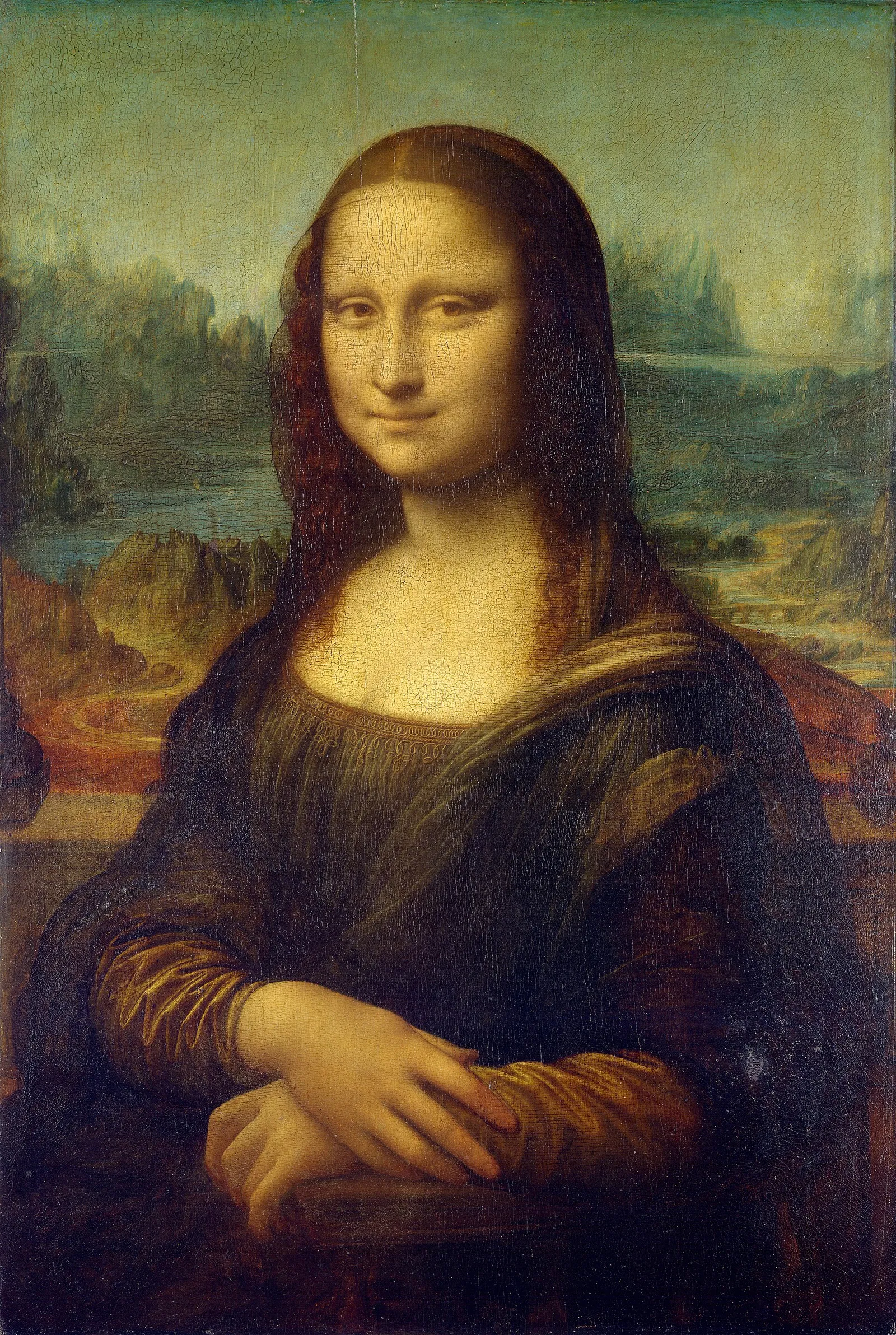
Leonardo da Vinci's Mona Lisa is a half-length portrait in oil on a poplar panel, held by the Department of Paintings of the Louvre. The work dates from the 1500s and measures 79.4 × 53.4 cm, smaller than many visitors expect. It is located in the Salle des États at the Louvre.
Where to see it
The Mona Lisa belongs to the Department of Paintings of the Louvre and is located in the Salle des États, the room the museum chose for it in 1966. Since 2005 it has been shown on its own inside a protective glass case that controls temperature and humidity. Display arrangements can change, so check the Louvre's official website for the painting's current display status before you visit.
What to look for in person
The face and the famous smile
Look closely at the corners of the mouth and eyes. Leonardo avoided crisp outlines there, letting light and shadow merge in soft, gradual transitions, a technique art historians call sfumato. Because the edges are blurred, the expression seems to shift depending on where your eye rests: look directly at the mouth and then at the eyes, and the smile can read differently. This effect is part of why the expression has been discussed for centuries, and it rewards a slow, patient look rather than a quick photograph.
The landscape behind the sitter
Behind the figure is an imagined landscape of winding paths, water, rocky forms and hazy distant mountains that fade into blue. On the right, near the sitter's shoulder, you can find a small arched bridge. Compare the horizon on each side of her head: the two halves do not appear to line up at the same height, a feature often pointed out by viewers. The misty distance contrasts with the warm, modelled figure in front, drawing your attention back to her face.
The pose, the hands and the panel
The sitter is shown half-length, turned slightly toward us, with her hands resting one over the other in front of her. The relaxed hands are painted with the same soft modelling as the face and are worth studying in their own right. Remember that this is an oil painting on a poplar wood panel, not a canvas. The panel has warped and cracked over time, which is why it is now kept behind glass in a controlled climate.
About the painting
The sitter is traditionally identified as Lisa Gherardini, the wife of the Florentine merchant Francesco del Giocondo, which is the basis of the portrait's familiar name. Useful early evidence came to light in 2005 at Heidelberg: in a printed 1477 volume of Cicero, the Florentine official Agostino Vespucci had added a note in the margin in 1503 recording that Leonardo was at that time working on a portrait of Lisa del Giocondo. Writing in 1550, Giorgio Vasari reported that Leonardo spent four years on the picture and never finished it. According to the Louvre, King François I acquired the painting from Leonardo in 1518, which is how it entered the French royal collection that later formed part of the museum. The panel has a long conservation history; the earliest and most extensive restoration on record was carried out in 1809 by Jean-Marie Hooghstoel, who cleaned, revarnished and retouched it. The painting's fame grew sharply in the twentieth century. On 21 August 1911 it was taken from the Louvre by Vincenzo Peruggia, a glazier who had previously worked at the museum; it was recovered after he attempted to sell it to an Italian art dealer. In 1966 the Louvre selected the Salle des États as its setting, and since 2005 it has hung alone in a climate-controlled protective case, a measure taken because the poplar support has warped and cracked. When you stand before it, expect a small panel seen at a distance, and allow time to let the details come forward.
Key facts
| Artist | Leonardo da Vinci |
|---|---|
| Date | 1500s |
| Size | 79.4 × 53.4 cm |
| Medium | oil paint, poplar panel |
| Collection | Department of Paintings of the Louvre |
| Gallery | Room 711, Denon wing, level 1 Checked in the museum's open data on 2026-11-12 (galleries can change) Source |
How to visit: Louvre Museum
Paris, France · Museum guide
| Opening hours | Mon, Thu, Sat, Sun 09:00–18:00 Wed, Fri 09:00–21:00 (evening opening) Rooms are cleared 30 minutes before closing |
|---|---|
| Closed | Every Tuesday; 1 January, 1 May and 25 December. Other public holidays are open unless they fall on a Tuesday. |
| Last entry | 1 hour before closing |
| Admission | Adult (non-EEA visitors) EUR 32 Adult (EEA citizens and residents) EUR 22 Under 18 free (ID required) EEA citizens/residents under 26 free (photo ID; residents also need a residence permit of over 90 days) Audio guide rental EUR 6 (can be booked in advance online) Rates apply from 14 January 2026 |
| Free entry | Free for under-18s, EEA citizens/residents under 26, all visitors on the first Friday of the month after 18:00 (except July and August) and on 14 July, and disabled visitors plus one carer. Also free with proof for EEA art and art-history teachers, ICOM members, journalists, EEA job seekers and EEA residents on income support. |
| Booking | Entry is by timed slot, and booking in advance is recommended. |
The Cour Carrée entrance is currently closed. On Thursday 12 November 2026 the museum may open later and some exhibition rooms may remain closed.
Official ticket page
Official website
View on map
Hours and prices can change. Please check the official website before you go. (Checked on: 2026-11-11)
More by Leonardo da Vinci
 Benois Madonna
 Annunciation — Uffizi Gallery
 Ginevra de' Benci — National Gallery of Art
 Madonna Litta
 Adoration of the Magi — Uffizi Gallery
 Salvator Mundi
 Portrait of a Musician
 Lady with an Ermine
 The Virgin and Child with Saint Anne — Louvre Museum
 La Belle Ferronnière — Louvre Museum
 Saint John the Baptist — Louvre Museum
 Saint Jerome in the Wilderness
Sources
- Wikidata Q12418
- Wikipedia (en) (CC BY-SA 4.0)
- Wikipedia (ja) (CC BY-SA 4.0)
- Wikipedia (it) (CC BY-SA 4.0)
- Wikipedia (fr) (CC BY-SA 4.0)
- Museum website (louvre.fr)
- www.louvre.fr
- contact.louvre.fr