Art! Art! Art! › Works
Saint Jerome in the Wilderness
 Leonardo da Vinci, 1480s
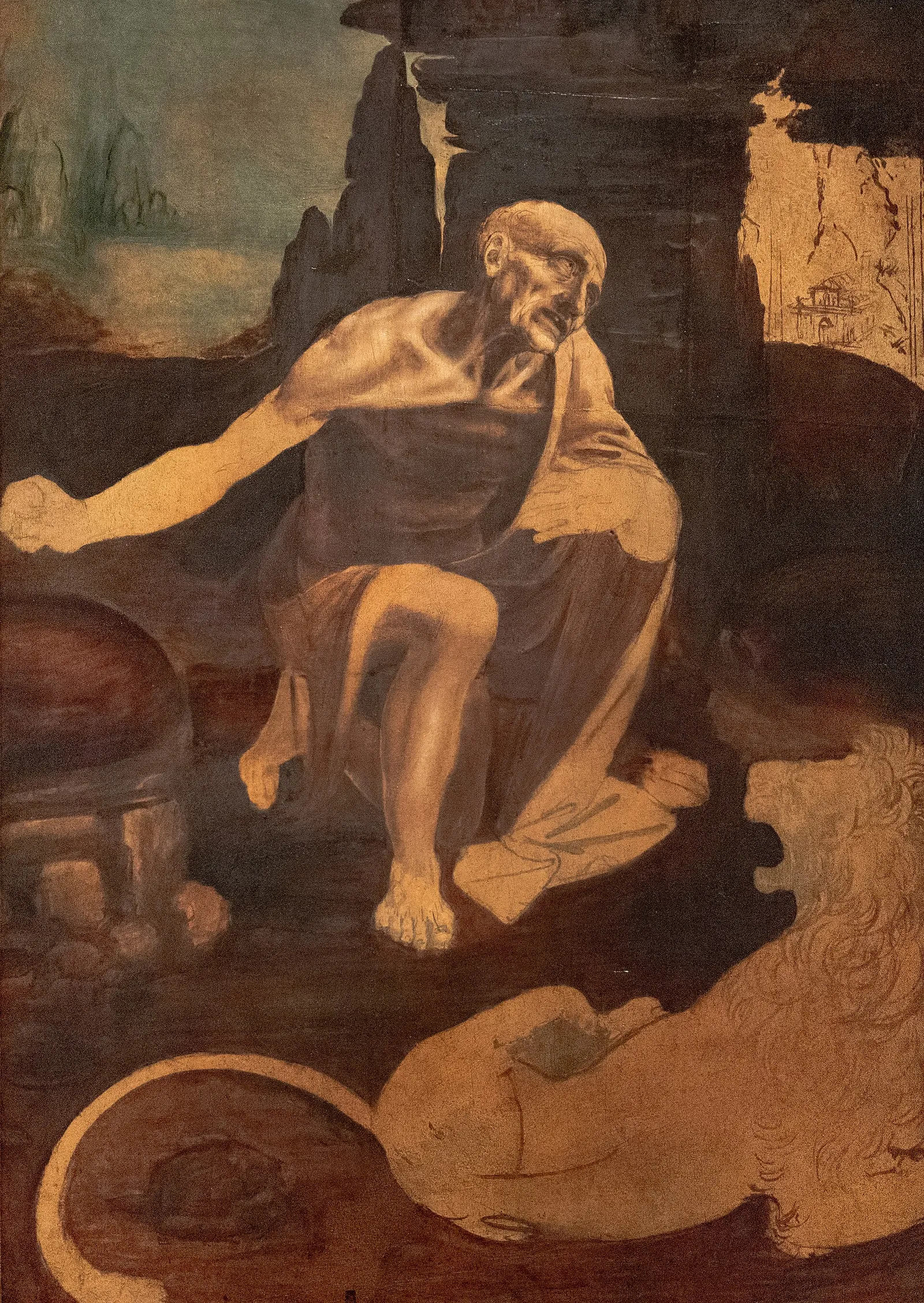
Leonardo da Vinci's Saint Jerome in the Wilderness, dated to the 1480s, is held by the Pinacoteca Vaticana, the Vatican's picture gallery. Left unfinished, it lets visitors see how Leonardo built a painting, from the first outlines to the modelling of a figure. At 103 by 75 cm, it rewards slow, close looking.
Where to see it
Saint Jerome in the Wilderness is in the collection of the Pinacoteca Vaticana. Works can be moved, lent or taken off view for conservation, so check the museum's official website for current display status, opening hours and ticketing before you plan your visit.
What to look for in person
The penitent saint's body
Start with Jerome himself. He kneels in a rocky landscape, gaunt and stripped of comfort, one arm stretched out and gripping a stone he uses to strike his chest in penance. Look closely at his neck and shoulder: the tendons and muscles are described with an attention that reflects Leonardo's lifelong interest in how the human body works. The face, with its sunken cheeks and open mouth, conveys strain and devotion rather than calm, and the twisting pose gives the figure a sense of movement within the still scene.
The lion in the foreground
Lower your eyes to the foreground, where a lion lies with its long tail curling across the ground. The lion is Jerome's traditional companion in art, linked to a legend in which the saint removed a thorn from its paw and earned its loyalty. Here the animal is only partly worked up, largely sketched in outline, so you can follow the lines Leonardo laid down before adding paint. Notice how the curve of its body and tail echoes the bending posture of the kneeling saint above it.
An unfinished painting as a window into method
Because the work was never completed, much of the surface remains at an early stage, laid in with brownish and monochrome tones rather than full colour. Step back to see the overall structure of light and shadow, then move closer to find areas at different levels of finish. To the upper right, through an opening in the rocks, look for the faint outline of a church building in the distance. Visible joins in the panel are also worth noting, as they suggest the picture was once divided and later reassembled.
About the painting
Saint Jerome was one of the most frequently depicted saints in Renaissance art. A scholar remembered for translating the Bible into Latin, he was also venerated for the years he spent as a hermit in the desert, and artists often showed him in that role: alone, penitent and surrounded by bare rock. Leonardo da Vinci took up this subject in the 1480s, and the result is the panel now in the Pinacoteca Vaticana.
What makes the painting especially valuable for visitors is that it was left unfinished. Instead of a polished surface, you see the scaffolding of a picture: drawn outlines, tonal underpainting and passages where modelling has begun. This makes it possible to observe Leonardo's priorities. He appears to have concentrated first on the figure's anatomy and on the overall play of light and dark, leaving details such as the lion and the landscape at a sketchier stage.
The composition is built around the contrast between the angular, kneeling saint and the dark, rugged setting. Jerome's outstretched arm and turned head create a diagonal movement, while the lion anchors the lower part of the panel. The distant church glimpsed through the rocks is often read as a reference to the Church that Jerome served.
At 103 by 75 cm, the work is of a moderate size, so it is best appreciated by alternating between a few steps back and a careful look at the surface. Take time with the shoulder and neck, the lion's outline and the seams in the panel, which speak to the object's long and complicated history.
Key facts
| Artist | Leonardo da Vinci |
|---|---|
| Date | 1480s |
| Size | 103 × 75 cm |
| Medium | oil paint, panel |
| Collection | Pinacoteca Vaticana |
How to visit: Pinacoteca Vaticana
Vatican City, Vatican City
Hours and prices can change. Please check the official website before you go.
More by Leonardo da Vinci
 Benois Madonna
 Annunciation — Uffizi Gallery
 Mona Lisa — Louvre Museum
 Ginevra de' Benci — National Gallery of Art
 Madonna Litta
 Adoration of the Magi — Uffizi Gallery
 Salvator Mundi
 Portrait of a Musician
 Lady with an Ermine
 The Virgin and Child with Saint Anne — Louvre Museum
 La Belle Ferronnière — Louvre Museum
 Saint John the Baptist — Louvre Museum