Art! Art! Art! › Works
Lady with an Ermine
 Leonardo da Vinci, 1490
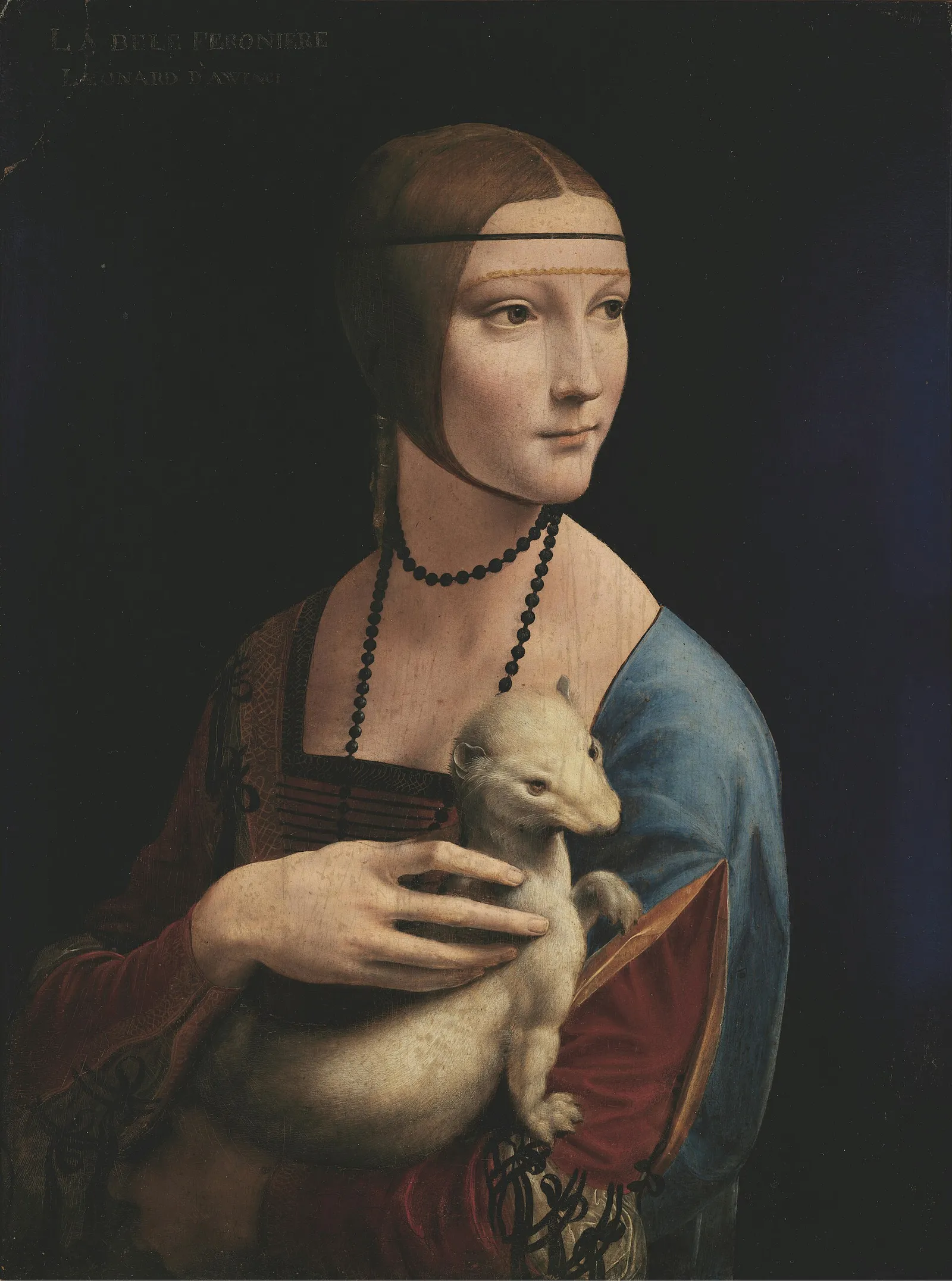
Leonardo da Vinci's Lady with an Ermine, dated 1490, is held by the Czartoryski Museum. This compact portrait of a young woman holding a pale, alert animal is one of the few surviving portraits of women by Leonardo. In front of it, the turning pose, the carefully observed hand and the quiet exchange between sitter and ermine reward slow looking.
Where to see it
Lady with an Ermine is in the collection of the Czartoryski Museum, which is also its recorded location. Display arrangements, opening hours and ticketing can change, so check the Czartoryski Museum's official website for the painting's current display status and visitor information before you travel. The panel measures 54 x 40.3 cm, so it is smaller than many visitors expect. Allow time to stand close enough to see the details of the face, hand and fur.
What to look for in person
A pose caught mid-turn
Start with the direction of the body. The sitter's shoulders are angled one way while her head turns the other, as if something beyond the frame has just caught her attention. The ermine echoes this movement, its head and gaze following the same direction as hers. This twisting, three-quarter arrangement was unusual for portraits of the period, which often showed sitters in strict profile. Step back and notice how the pose creates a sense of a passing moment rather than a fixed, formal record of someone's appearance.
The hand and the fur
Look closely at the sitter's right hand resting on the animal. The fingers are long and slightly bent, and Leonardo shows the knuckles and tendons with care, reflecting his close study of anatomy. The hand appears to stroke or steady the ermine, and the contact between skin and fur is rendered with attention to the different textures. Notice too the ermine's raised paw and the muscular curve of its body, which give the animal a lively, watchful presence that mirrors the poise of the woman holding it.
Light, shadow and later changes
Light falls on the sitter's face, neck and the ermine from one side, modelling forms with soft transitions from light into shadow rather than hard outlines. Against this, the background is now flat and very dark. Conservators and historians generally agree that the background was overpainted at a later date, so what you see is not entirely Leonardo's original setting. Look also at the inscription in an upper corner of the panel; it is widely considered a later addition, not part of Leonardo's own work.
About the painting
Lady with an Ermine was painted by Leonardo da Vinci and is dated 1490 in the fact sheet. Art historians widely place it in Leonardo's years in Milan, when he worked for the court of Ludovico Sforza. The sitter is generally identified as Cecilia Gallerani, a young woman associated with that court. This identification is accepted by most scholars, although the painting itself carries no contemporary label naming her.
The ermine is usually read on several levels. The animal was traditionally linked with purity, and it is also commonly connected to Ludovico Sforza, who was associated with the ermine as an emblem. Many historians also see a play on the sitter's surname, since an ancient Greek word for a weasel-like animal resembles Gallerani. These readings are often discussed together rather than as a single fixed meaning.
The painting is one of only a small number of portraits of women attributed to Leonardo. Compared with earlier conventions, it shows his interest in movement, in the way a person turns and reacts, and in describing anatomy and texture closely. At 54 x 40.3 cm, it is an intimate work, meant to be viewed at close range. When you visit, spend time with the relationship between the sitter's expression and the animal's alert posture, and consider how much of the effect depends on small details: the angle of the head, the tension in the fingers and the gentle modelling of light across the face. Keep in mind that parts of the surface, especially the background, have been altered since Leonardo's time.
Key facts
| Artist | Leonardo da Vinci |
|---|---|
| Date | 1490 |
| Size | 54 × 40.3 cm |
| Medium | tempera, oil paint, panel, walnut panel |
| Collection | Czartoryski Museum |
How to visit: Czartoryski Museum
Kraków, Poland
Hours and prices can change. Please check the official website before you go.
More by Leonardo da Vinci
 Benois Madonna
 Annunciation — Uffizi Gallery
 Mona Lisa — Louvre Museum
 Ginevra de' Benci — National Gallery of Art
 Madonna Litta
 Adoration of the Magi — Uffizi Gallery
 Salvator Mundi
 Portrait of a Musician
 The Virgin and Child with Saint Anne — Louvre Museum
 La Belle Ferronnière — Louvre Museum
 Saint John the Baptist — Louvre Museum
 Saint Jerome in the Wilderness