Art! Art! Art! › Works
Madonna Litta
 Leonardo da Vinci, 1490
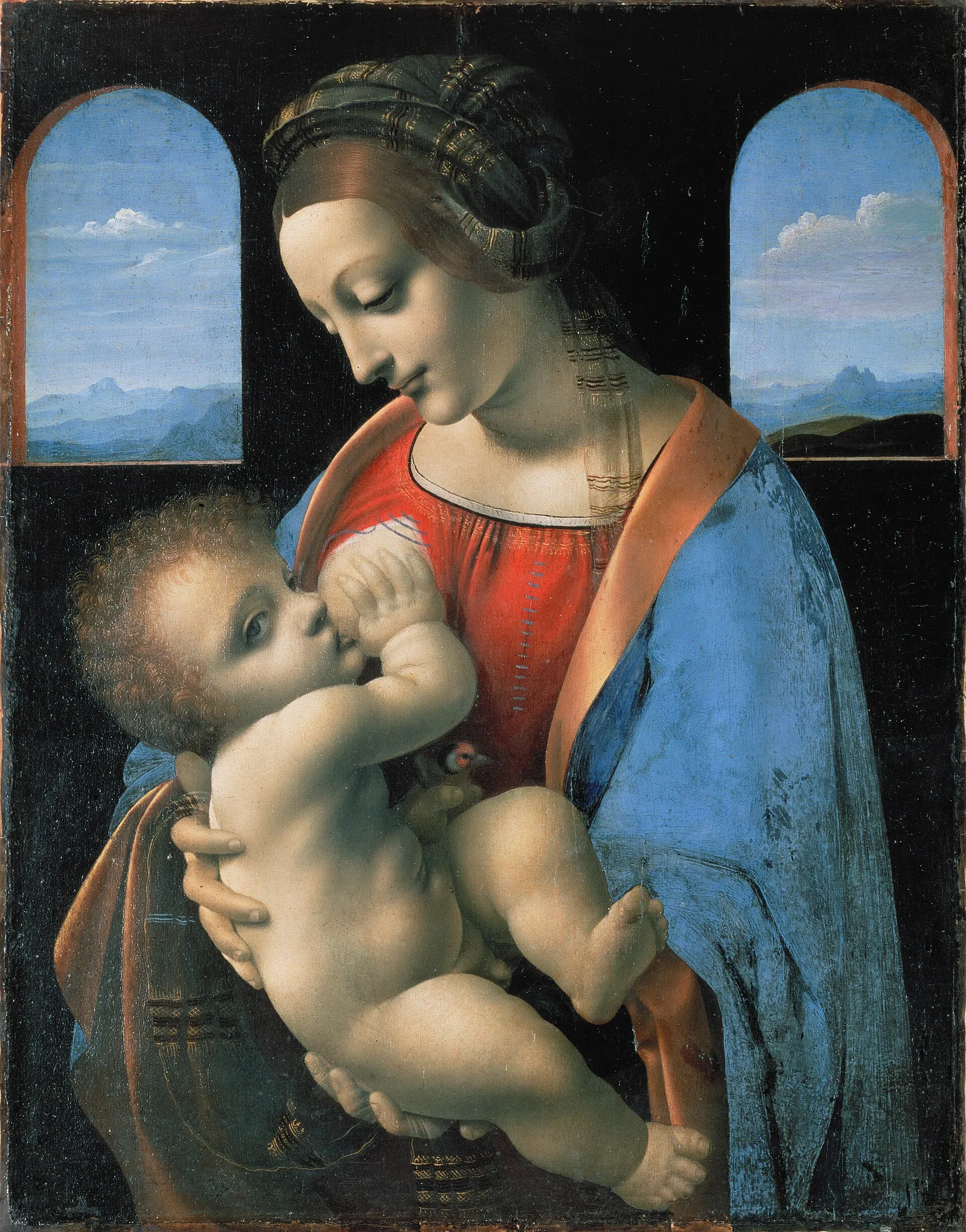
Madonna Litta is a small devotional painting of the Virgin nursing the Christ child, attributed by its holding museum to Leonardo da Vinci and dated to 1490. It belongs to the Hermitage Museum, where its intimate scale, quiet symbolism and glimpse of distant mountains reward a close, unhurried look.
Where to see it
Madonna Litta is in the collection of the Hermitage Museum and is located at the Hermitage Museum. The painting measures 42 x 33 cm, so it is easy to pass by quickly; plan to stand close. Display arrangements can change, so check the Hermitage Museum's official website for the current display status before you visit.
What to look for in person
A mother and child at close range
The painting shows the Virgin nursing the Christ child, a devotional theme known as the Madonna lactans. Notice how tightly the two figures are grouped: the Virgin bows her head toward the child, her face turned nearly in profile, while the child turns outward toward the viewer as he feeds. At just 42 by 33 centimetres, the work suits private prayer rather than public display, so give yourself time at close range to follow the soft passage from light to shadow across faces and skin.
The goldfinch in the child's hand
Look carefully at the child's left hand, where he grips a small goldfinch. In Renaissance religious painting this bird was a familiar sign of Christ's future Passion, so a gentle scene of feeding also carries a quiet reminder of the suffering to come. Because the bird is small and tucked into the composition, many visitors miss it on a first glance. Once you find it, compare it with the calm, tender mood of the faces and consider how the picture holds intimacy and foreboding together.
Two arched windows onto a distant landscape
Behind the figures, the room is dark, opened only by two arched windows. Through them a mountainous landscape recedes into the distance, its forms growing paler and hazier the farther away they are, an effect described as aerial perspective. The contrast between the shadowed interior and the bright view outside pushes the figures forward and gives a small picture a surprising sense of depth. Step back a little to see how the two openings frame the Virgin's head and balance the composition on either side.
About the painting
The painting takes its name from the Litta family, Milanese nobles who owned it for much of the nineteenth century. Its documented history begins in 1784, when Prince Alberico XII di Belgioioso bought it from Giuseppe Rho; this is the earliest firm date in its ownership record. After Belgioioso's death, the work passed into the hands of the Litta family. In 1865 Tsar Alexander II bought it from Count Antonio Litta for the Hermitage Museum, which has held it ever since. After it arrived at the Hermitage, the picture was transferred from its original wood panel to canvas, a conservation practice used on a number of older paintings at the time. The Hermitage regards Madonna Litta as an autograph work by Leonardo da Vinci and dates it to 1490. A metalpoint drawing of a young woman's face, seen almost in profile and attributed to Leonardo, survives in the Codex Vallardi at the Louvre and is considered a preparatory study for the Virgin's head. Seeing the two side by side is not usually possible, but keeping the drawing in mind helps when you look at how the painted face is turned and modelled. The painting has also travelled: it was presented as a work by Leonardo in the 2011-12 exhibition at the National Gallery, London, devoted to the artist's years in Milan. For visitors, the main pleasure lies in the details: the inclined head of the Virgin, the alert child, the hidden goldfinch and the cool blue distance glimpsed through the windows.
Key facts
| Artist | Leonardo da Vinci |
|---|---|
| Date | 1490 |
| Size | 42 × 33 cm |
| Medium | tempera, panel |
| Collection | Hermitage Museum |
How to visit: Hermitage Museum
Saint Petersburg, Russia
Hours and prices can change. Please check the official website before you go.
More by Leonardo da Vinci
 Benois Madonna
 Annunciation — Uffizi Gallery
 Mona Lisa — Louvre Museum
 Ginevra de' Benci — National Gallery of Art
 Adoration of the Magi — Uffizi Gallery
 Salvator Mundi
 Portrait of a Musician
 Lady with an Ermine
 The Virgin and Child with Saint Anne — Louvre Museum
 La Belle Ferronnière — Louvre Museum
 Saint John the Baptist — Louvre Museum
 Saint Jerome in the Wilderness
Sources
- Wikidata Q1327676
- Wikipedia (en) (CC BY-SA 4.0)
- Wikipedia (ja) (CC BY-SA 4.0)
- Wikipedia (it) (CC BY-SA 4.0)