Art! Art! Art! › Works
Saint John the Baptist
 Leonardo da Vinci, 1510s
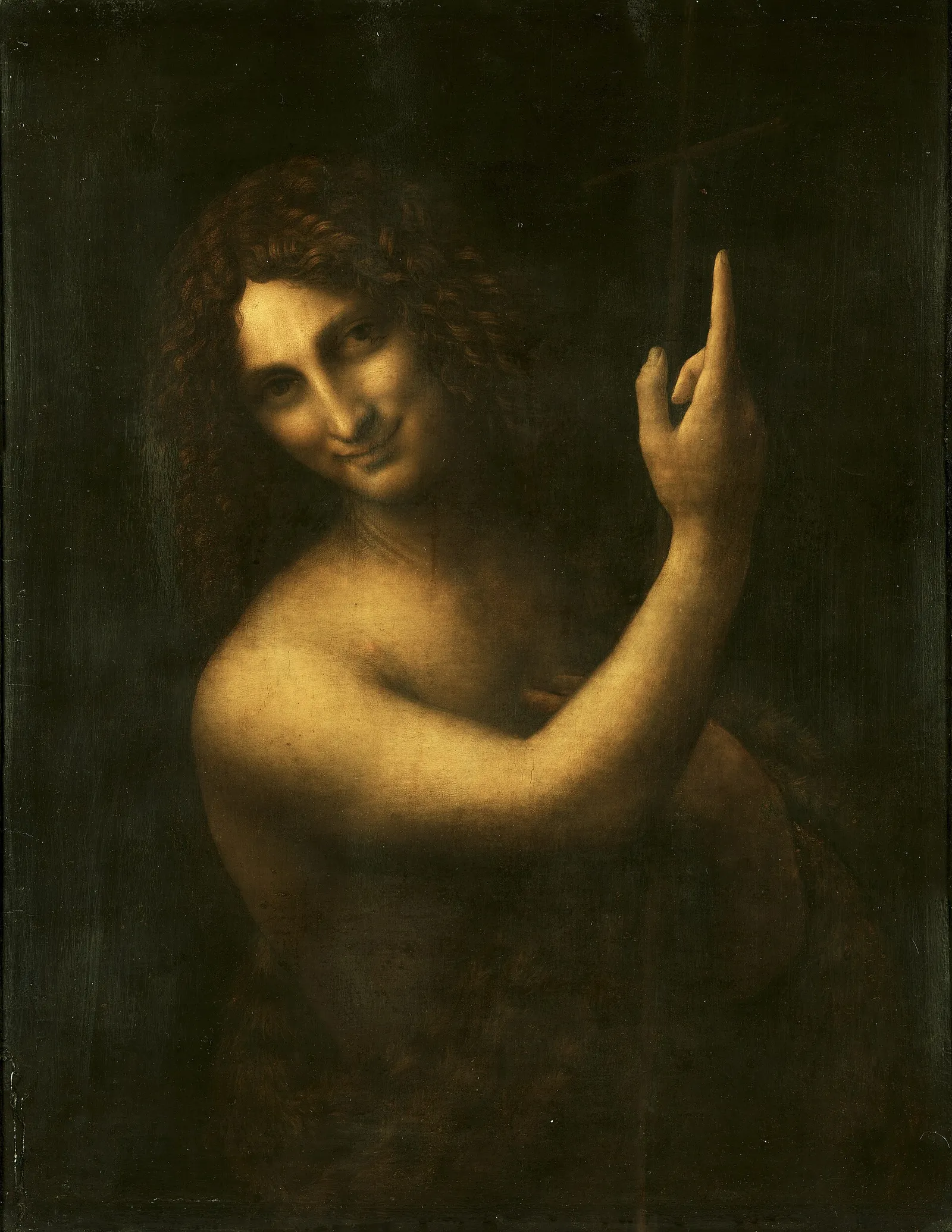
Leonardo da Vinci's Saint John the Baptist, dated to the 1510s, belongs to the Department of Paintings of the Louvre at the Louvre Museum. It shows a single smiling figure emerging from deep shadow, one hand raised toward the sky. It is a compact painting, 69 by 57 centimetres, that rewards a slow, close look.
Where to see it
Saint John the Baptist is in the collection of the Department of Paintings of the Louvre, at the Louvre Museum. Display arrangements can change because of rehanging, conservation or loans, so check the Louvre Museum's official website for current display status, opening hours and ticketing before you go. The painting measures 69 x 57 cm, which is smaller than many visitors expect. Allow time to stand close and let your eyes adjust to its dark tones.
What to look for in person
The raised, pointing hand
Begin with the right hand. John lifts his index finger upward, a gesture generally read as directing attention beyond himself, toward heaven and the coming of Christ, whose arrival the Baptist announced. Leonardo used a similar raised finger in other compositions, and it became closely associated with his work. Notice how the hand catches the light almost as strongly as the face, so your eye travels back and forth between them. Because the painting is only 69 by 57 centimetres, step close enough to follow the soft modelling of the fingers, knuckles and wrist.
A figure emerging from darkness
There is no landscape, architecture or setting here. The figure is placed against an almost uniform dark ground, and light falls on the face, shoulder, arm and chest while everything else sinks into shadow. Look at the edges of the body: rather than sharp outlines, Leonardo blends light into dark through very gradual transitions, the technique known as sfumato. The effect is that the figure seems to advance out of the darkness toward you. In a gallery setting, try viewing from a slight angle to reduce glare on the dark areas.
The smile, the gaze and the attributes
John looks directly out at the viewer with a faint, enigmatic smile that is often compared with other late faces by Leonardo. Then look for the traditional signs of the Baptist: the long curling hair, the animal-skin garment across his body, and the thin reed cross held in his other hand. The cross is slender and can be hard to make out against the dark background, so search for it deliberately. The soft, ambiguous character of the figure has long prompted discussion, and it is a big part of why the picture feels so different from earlier depictions of the saint.
About the painting
Saint John the Baptist is dated to the 1510s, placing it within the last decade or so of Leonardo da Vinci's life, and it is generally considered one of his late works. John the Baptist was the prophet who, according to the Gospels, prepared the way for Christ, and he was a popular subject in Renaissance art. He was often shown as a gaunt figure in the wilderness. Leonardo takes a very different approach. He removes the setting entirely, brings the saint close to the picture surface, and concentrates on gesture, expression and light. The result is an image built on a few elements: a face, a hand, a body turning out of shadow, and a gaze directed at the viewer. In his final years Leonardo moved to France at the invitation of King Francis I, and the painting is widely associated with this late period. It is now part of the Department of Paintings of the Louvre at the Louvre Museum. For visitors, the key thing is to slow down. The painting is relatively small at 69 by 57 centimetres, and much of its surface is very dark, so details such as the reed cross and the animal skin only become clear after a minute or two of looking. Compare how sharply the light strikes the raised hand with how gently the shadows close around the shoulder and hair. Many people pass by quickly. If you can, return to it at a quieter moment during your visit, and check the museum's official website beforehand to confirm whether it is currently on display.
Key facts
| Artist | Leonardo da Vinci |
|---|---|
| Date | 1510s |
| Size | 69 × 57 cm |
| Medium | oil paint, panel |
| Collection | Department of Paintings of the Louvre |
| Gallery | Room 710, Denon wing, level 1 Checked in the museum's open data on 2026-11-12 (galleries can change) Source |
How to visit: Louvre Museum
Paris, France · Museum guide
| Opening hours | Mon, Thu, Sat, Sun 09:00–18:00 Wed, Fri 09:00–21:00 (evening opening) Rooms are cleared 30 minutes before closing |
|---|---|
| Closed | Every Tuesday; 1 January, 1 May and 25 December. Other public holidays are open unless they fall on a Tuesday. |
| Last entry | 1 hour before closing |
| Admission | Adult (non-EEA visitors) EUR 32 Adult (EEA citizens and residents) EUR 22 Under 18 free (ID required) EEA citizens/residents under 26 free (photo ID; residents also need a residence permit of over 90 days) Audio guide rental EUR 6 (can be booked in advance online) Rates apply from 14 January 2026 |
| Free entry | Free for under-18s, EEA citizens/residents under 26, all visitors on the first Friday of the month after 18:00 (except July and August) and on 14 July, and disabled visitors plus one carer. Also free with proof for EEA art and art-history teachers, ICOM members, journalists, EEA job seekers and EEA residents on income support. |
| Booking | Entry is by timed slot, and booking in advance is recommended. |
The Cour Carrée entrance is currently closed. On Thursday 12 November 2026 the museum may open later and some exhibition rooms may remain closed.
Official ticket page
Official website
View on map
Hours and prices can change. Please check the official website before you go. (Checked on: 2026-11-11)
More by Leonardo da Vinci
 Benois Madonna
 Annunciation — Uffizi Gallery
 Mona Lisa — Louvre Museum
 Ginevra de' Benci — National Gallery of Art
 Madonna Litta
 Adoration of the Magi — Uffizi Gallery
 Salvator Mundi
 Portrait of a Musician
 Lady with an Ermine
 The Virgin and Child with Saint Anne — Louvre Museum
 La Belle Ferronnière — Louvre Museum
 Saint Jerome in the Wilderness