Art! Art! Art! › Works
Ginevra de' Benci
 Leonardo da Vinci, 1470s
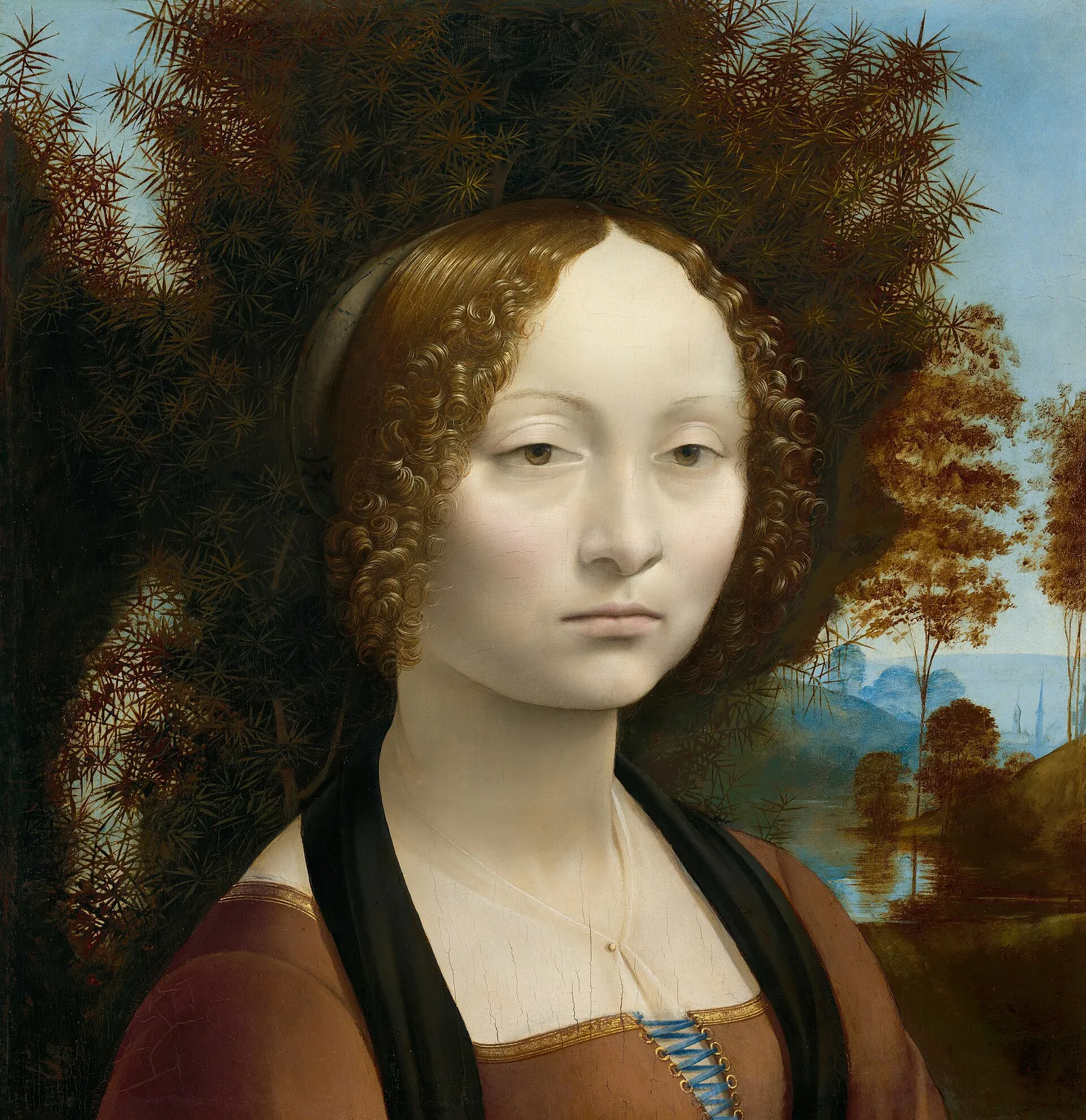
Ginevra de' Benci is a small portrait by Leonardo da Vinci, dated to the 1470s, of a young Florentine woman set against a juniper bush and a distant landscape. At 38.1 by 37 cm it is close to square and intimate in scale, so it rewards a slow, close look.
Where to see it
Our source fact sheet records the holding collection and location only by the Wikidata identifier Q214867, so we are not naming the museum here. Before you plan a trip, look up that identifier on Wikidata (or follow the artwork's own Wikidata entry, Q1267893) to confirm the institution. Then check that museum's official website for current display status, because paintings can be moved, taken off view for conservation, or lent to exhibitions.
What to look for in person
The juniper behind her head
Look at the dark, spiky foliage that fills the space around the sitter's head. It is a juniper bush, and art historians widely read it as a play on her name: the Italian word for juniper, ginepro, echoes Ginevra. The dense, almost black needles also do visual work. They make her pale skin and the coppery ringlets of her hair stand out sharply. Step back, then move closer, to see how the bush frames her face like a halo of shadow.
A landscape that fades into haze
On either side of the juniper, the background opens onto water, trees and slender spires that soften as they recede. This gradual blurring and cooling of colour toward the horizon is one of the early signs of Leonardo's interest in how air changes what we see at a distance. Compare the crisp detail of her curls with the softened forms far behind her. The contrast between near and far is a good place to spend a minute when you are in the gallery.
A face without a smile
Unlike the faint smile many visitors associate with Leonardo, Ginevra's expression is reserved and still. Her eyes do not quite meet yours, and her mouth is set. Notice how gently the light models her cheeks and chin, with very few hard edges, giving her face a smooth, porcelain-like surface. Also notice the cropped lower edge: the portrait ends abruptly just below her shoulders, which is part of why the panel today is almost square rather than upright.
About the painting
This portrait comes from the early part of Leonardo da Vinci's career, in the 1470s, when he was working in Florence. It is generally identified as a portrait of Ginevra de' Benci, a young woman from a prominent Florentine family, and it is one of the few paintings widely accepted as Leonardo's own work. Painted on a wooden panel, it measures 38.1 cm high by 37 cm wide. That nearly square format is unusual for a portrait of this period, and scholars broadly agree that the panel was cut down at the bottom at some point, so the composition you see today is not the original full picture. What remains is concentrated on the head and shoulders, the juniper bush and the landscape. The painting also has a decorated reverse, featuring a sprig of juniper encircled by branches and a scroll bearing a Latin motto usually translated as "Beauty adorns virtue." Whether the back is visible depends on how the museum displays the panel, so check before you go if this matters to you. For visitors, the picture is a chance to see an artist in the process of forming his approach: the careful observation of plants, the soft transitions of light on skin and the hazy treatment of distance all point toward concerns that would occupy Leonardo for decades. Because the work is small, allow time to stand close and look at the detail of the hair, the needles of the juniper and the delicate background, and then step back to take in the overall balance of dark foliage and pale face.
Key facts
| Artist | Leonardo da Vinci |
|---|---|
| Date | 1470s |
| Size | 38.1 × 37 cm |
| Medium | oil paint, panel |
| Collection | Q214867 |
| Gallery | West Building, Main Floor, Gallery 6 Checked in the museum's open data on 2026-11-12 (galleries can change) Source |
How to visit: National Gallery of Art
Washington, D.C., United States · Museum guide
| Opening hours | Mon–Sun 10:00–17:00 (open daily) |
|---|---|
| Closed | 25 December and 1 January |
| Admission | All visitors: free (including special exhibitions) |
| Free entry | Admission is always free. No passes or tickets are needed for the galleries, exhibitions or guided tours; some events require free registration. |
| Booking | No reservation is required and there is no timed entry. |
Hours and prices can change. Please check the official website before you go. (Checked on: 2026-11-11)
More by Leonardo da Vinci
 Benois Madonna
 Annunciation — Uffizi Gallery
 Mona Lisa — Louvre Museum
 Madonna Litta
 Adoration of the Magi — Uffizi Gallery
 Salvator Mundi
 Portrait of a Musician
 Lady with an Ermine
 The Virgin and Child with Saint Anne — Louvre Museum
 La Belle Ferronnière — Louvre Museum
 Saint John the Baptist — Louvre Museum
 Saint Jerome in the Wilderness
Sources
- Wikidata Q1267893
- Wikipedia (en) (CC BY-SA 4.0)
- Wikipedia (ja) (CC BY-SA 4.0)
- Wikipedia (it) (CC BY-SA 4.0)
- Wikipedia (fr) (CC BY-SA 4.0)
- www.nga.gov