Art! Art! Art! › Works
Annunciation
 Leonardo da Vinci, 1472
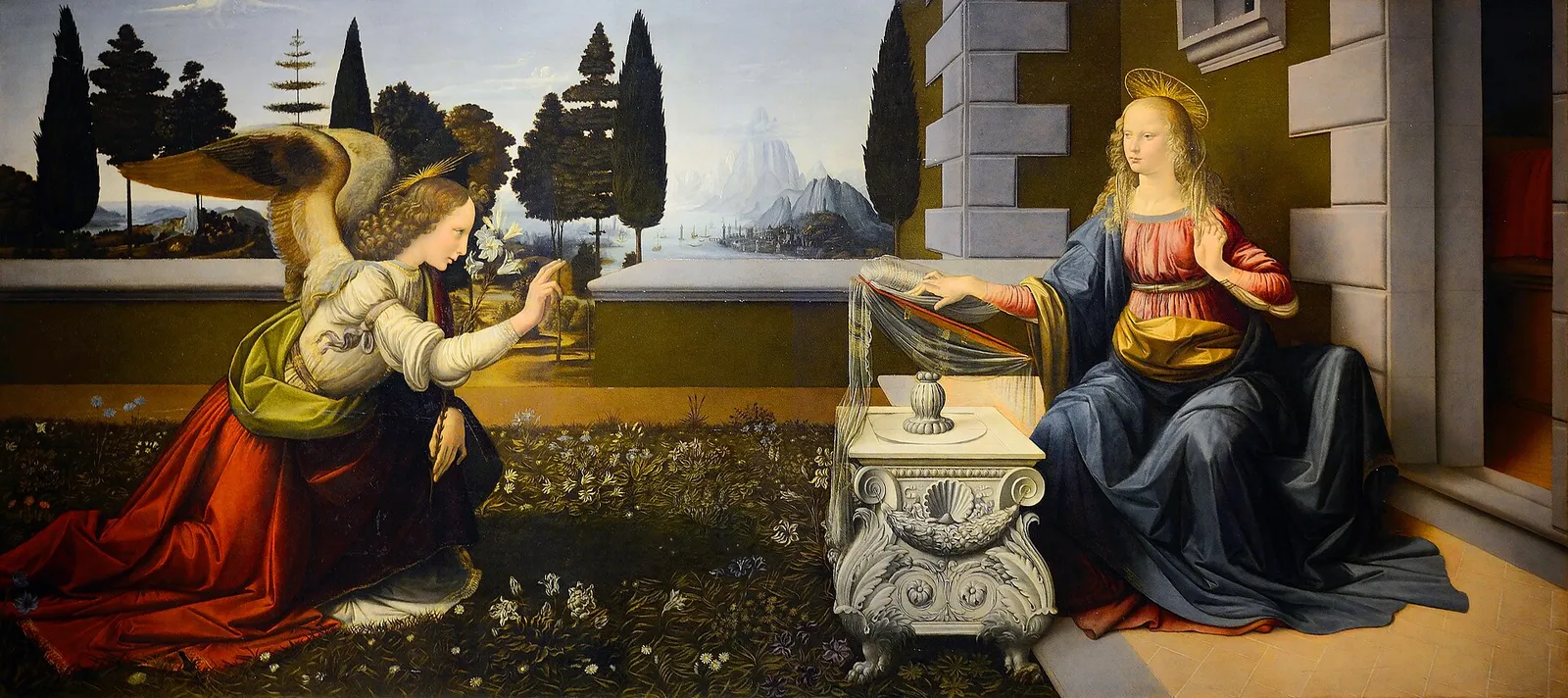
Leonardo da Vinci's Annunciation is an early work, dated to about 1472 and painted while he was still training in Andrea del Verrocchio's Florentine workshop. The wide panel, which measures 90 × 222 cm, belongs to the Uffizi Gallery. It rewards slow looking, from the angel's lily to the careful folds of the Virgin's drapery.
Where to see it
The Annunciation is in the collection of the Uffizi Gallery, where it has been since it was transferred there in 1867. Display arrangements, loans and conservation work can change, so check the Uffizi Gallery's official website for current display status, opening hours and ticketing before you plan your visit.
What to look for in person
Gabriel and the lily
Start on the left with the kneeling angel Gabriel, who brings Mary the news that she will bear the Son of God, the episode told in Luke's Gospel. In his hand he carries a lily. The flower had a double meaning for its first viewers: it stood for Mary's virginity and was also the emblem of Florence. Look closely at the wings as well. They did not begin at their present length. Another painter extended them later, so part of what you see today is not Leonardo's own work.
The Virgin and what lies beneath
Turn to Mary on the right and study the cloth that falls across her lap. Leonardo worked out drapery like this on paper first. A surviving drawing of fabric over the Virgin's legs is now at the Louvre, and a study of the angel's right sleeve is at Christ Church, Oxford. X-ray examination has shown that he changed his mind as he painted. Mary's head was once tilted further, her right hand was shorter, and a pendant chain hung on her forehead. None of these first ideas is visible on the surface today.
Reading the panel as an object
Step back and take in the long horizontal format. The picture is 90 cm high and 222 cm wide. Leonardo painted it in oil and tempera on poplar wood. The support is built from five boards glued together, each originally about 3.5 cm thick. In the 19th century their backs were planed down. If you move close, you may notice how smoothly the two figures and their setting blend across this joined surface. The panel was restored in 2000, so the colours and details you see reflect that treatment.
About the painting
The Annunciation dates from the early 1470s, when Leonardo da Vinci was an apprentice in the Florence workshop of Andrea del Verrocchio. Its subject is one of the most frequently painted scenes in Christian art: the moment the angel Gabriel tells the Virgin Mary that she will become the mother of the Son of God, as described in the first chapter of Luke's Gospel. The painting combines oil and tempera on a poplar panel. This mix of media suits a period when painters in Florence were still adapting to oil technique.
For much of its history the painting was not recognised as Leonardo's. It hung in the Olivetan monastery church of San Bartolomeo near Florence. In 1867 it was moved to the Uffizi, where it was first credited to Domenico Ghirlandaio. Two years later, in 1869, the scholar Karl Eduard von Liphart identified it as an early work by Leonardo, and that attribution is the basis for how the painting is understood today.
The panel also preserves evidence of how it was made and how it changed over time. Preparatory drawings in Oxford and Paris show Leonardo studying sleeves and drapery. X-rays reveal revisions to the Virgin's pose and ornament. The angel's lengthened wings are a later addition by another hand. The work was restored in 2000. In 2007 it travelled to the Tokyo National Museum, where about 800,000 people saw it between 20 March and 17 June.
Key facts
| Artist | Leonardo da Vinci |
|---|---|
| Date | 1472 |
| Size | 90 × 222 cm |
| Medium | oil paint, panel |
| Collection | Uffizi Gallery |
How to visit: Uffizi Gallery
Florence, Italy · Museum guide
| Opening hours | Tue–Sun 08:15–18:30 (visitors leave by 18:30) |
|---|---|
| Closed | Mondays, 1 January and 25 December. |
| Last entry | Ticket office closes at 17:30. |
| Admission | Regular, bought on the day EUR 25 Regular, bought in advance EUR 29 Regular, entry from 16:00 (from 1 January 2026) EUR 16 Reduced (EU citizens aged 18–25; citizens of Switzerland, Norway, Liechtenstein, Uruguay etc.; ID required) EUR 2 Under 18 free (under 12s must be accompanied) Uffizi + Vasari Corridor EUR 43 on the day / EUR 47 in advance; named ticket, reservation required, non-refundable PassePartout 5 days (Uffizi, Pitti Palace, Boboli) EUR 40 (EUR 58 with Vasari Corridor) Audio guide EUR 6 |
| Free entry | Free for under-18s; disabled visitors plus one companion; tour guides and interpreters, ICOM members, certain journalists, and university teachers/students on the official list. Admission is free on the first Sunday of each month (national museums), when reservations are not possible. |
| Booking | Reservation is not required, except for the Uffizi + Vasari Corridor ticket, which must be reserved. |
Restoration and rearrangement works mean some rooms are temporarily closed and some artworks are not on display. A staff assembly on 11–12 November 2026 may change opening times.
Official ticket page
Official website
View on map
Hours and prices can change. Please check the official website before you go. (Checked on: 2026-11-12)
More by Leonardo da Vinci
 Benois Madonna
 Mona Lisa — Louvre Museum
 Ginevra de' Benci — National Gallery of Art
 Madonna Litta
 Adoration of the Magi — Uffizi Gallery
 Salvator Mundi
 Portrait of a Musician
 Lady with an Ermine
 The Virgin and Child with Saint Anne — Louvre Museum
 La Belle Ferronnière — Louvre Museum
 Saint John the Baptist — Louvre Museum
 Saint Jerome in the Wilderness
Sources
- Wikidata Q1217213
- Wikipedia (en) (CC BY-SA 4.0)
- Wikipedia (ja) (CC BY-SA 4.0)
- Wikipedia (it) (CC BY-SA 4.0)
- Wikipedia (fr) (CC BY-SA 4.0)
- www.uffizi.it