Art! Art! Art! › Works
Adoration of the Magi
 Leonardo da Vinci, 1482
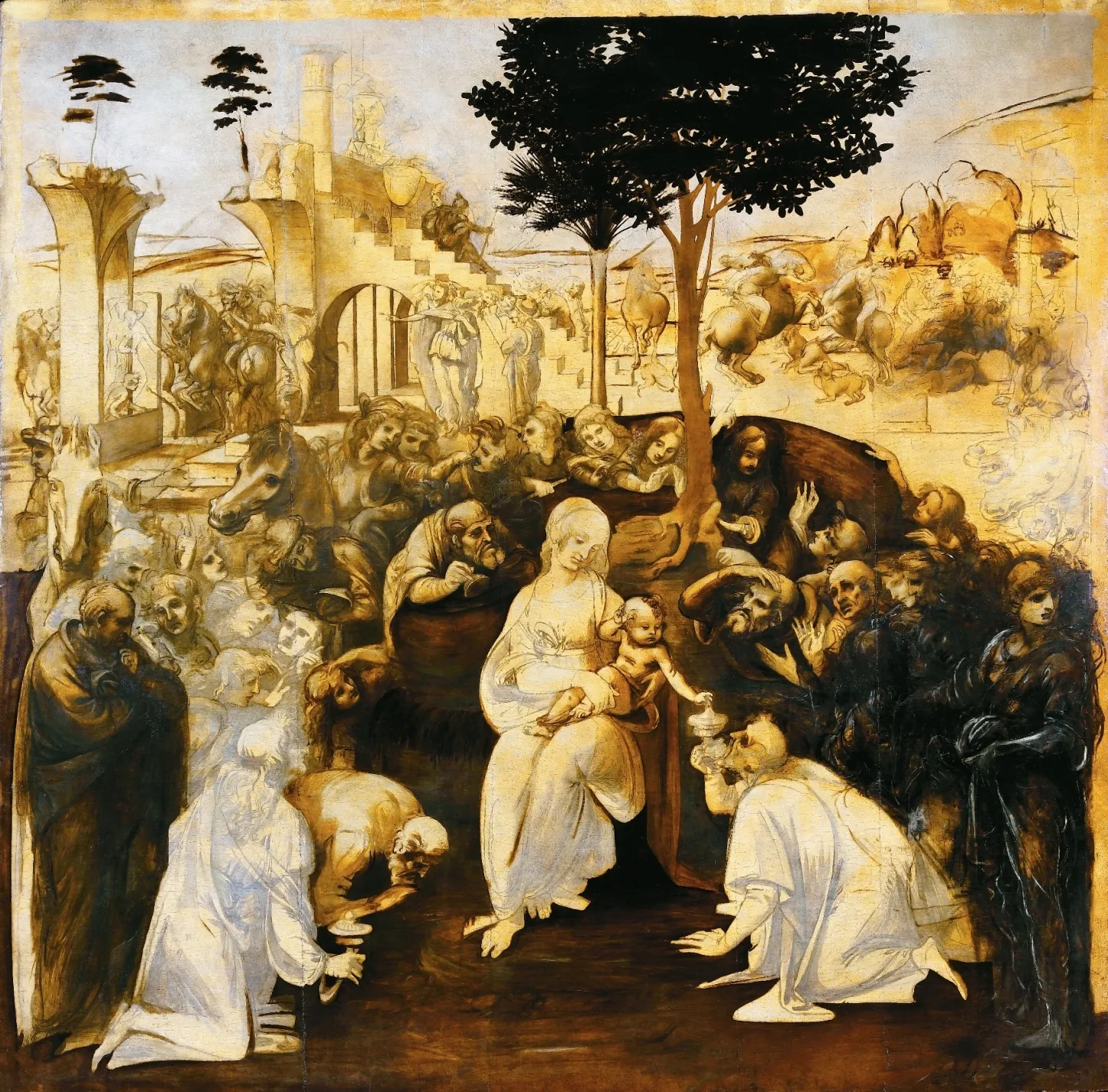
Leonardo da Vinci's Adoration of the Magi, dated 1482, is part of the collection of the Uffizi Gallery. The panel was left unfinished, so visitors can see Leonardo's working process: drawing, underpainting and early ideas laid down before final colour.
Where to see it
Adoration of the Magi is held by the Uffizi Gallery. Display arrangements can change, so check the Uffizi Gallery's official website for current display status and visitor information before you go.
What to look for in person
An unfinished picture you can read
Look closely at the surface and you will see that much of the panel is in brownish underpainting and drawing rather than finished colour. Leonardo left the work incomplete, and this lets you follow how he built a composition. Outlines, shading and corrections sit side by side. Some figures are solid and modelled, while others are only sketched shapes. Treat the panel as a window into a working method. Notice where forms are blocked in with light and dark tones before any detail or colour was added.
The crowd around the Virgin and Child
At the centre, the Virgin sits with the Christ Child on her lap, and the kneeling Magi offer their gifts. Around them, a dense ring of figures presses in. Faces turn, lean forward and gesture in surprise, devotion or curiosity. Leonardo arranges the crowd so that the gaze travels in an arc around the central group and always returns to the mother and child. Spend time on individual heads and hands. Each one shows a different reaction, which reflects his strong interest in expression and movement.
Ruins, stairs and horsemen in the background
Look past the central group to the upper half of the panel. There you will find a ruined building with arches and staircases, along with rearing horses and riders who seem to be in conflict. These restless scenes contrast with the calm devotion in the foreground. A tree rises near the centre and helps divide the space. The background is one of the most experimental parts of the work, with perspective lines and architectural forms that still show Leonardo's planning.
About the painting
Adoration of the Magi is a large panel by Leonardo da Vinci, dated 1482 and measuring 243 by 246 cm. Its almost square format gives the composition a broad, balanced field. Leonardo used that space to set a tightly packed foreground group against a wide and busy background. The subject is the traditional Christian scene in which the Magi come to honour the newborn Christ. Leonardo turns it into a study of human reaction. He surrounds the Holy Family with a crowd whose poses and expressions range from reverence to agitation.
The painting is widely understood to have been commissioned for a monastery near Florence. Leonardo did not complete it. He left the city to work in Milan, and the panel remained in its unfinished state. Because of this, it is especially valuable for understanding his methods. The layers that would normally be hidden under finished paint are exposed here, including drawing, tonal underpainting and adjustments to the design.
For visitors, the best approach is to step back first and take in the overall structure. Notice how the figures form a ring around the Virgin and Child, and how the background opens into ruins and movement. Then move closer to examine individual faces, hands and horses, where the sketch-like handling is easiest to see. The work rewards slow looking more than a quick glance. It also belongs to the Uffizi Gallery's holdings of Italian Renaissance painting, so it is worth placing it alongside other works you see during your visit.
Key facts
| Artist | Leonardo da Vinci |
|---|---|
| Date | 1482 |
| Size | 243 × 246 cm |
| Medium | drawing, ink, charcoal, oil paint, watercolor paint, panel |
| Collection | Uffizi Gallery |
How to visit: Uffizi Gallery
Florence, Italy · Museum guide
| Opening hours | Tue–Sun 08:15–18:30 (visitors leave by 18:30) |
|---|---|
| Closed | Mondays, 1 January and 25 December. |
| Last entry | Ticket office closes at 17:30. |
| Admission | Regular, bought on the day EUR 25 Regular, bought in advance EUR 29 Regular, entry from 16:00 (from 1 January 2026) EUR 16 Reduced (EU citizens aged 18–25; citizens of Switzerland, Norway, Liechtenstein, Uruguay etc.; ID required) EUR 2 Under 18 free (under 12s must be accompanied) Uffizi + Vasari Corridor EUR 43 on the day / EUR 47 in advance; named ticket, reservation required, non-refundable PassePartout 5 days (Uffizi, Pitti Palace, Boboli) EUR 40 (EUR 58 with Vasari Corridor) Audio guide EUR 6 |
| Free entry | Free for under-18s; disabled visitors plus one companion; tour guides and interpreters, ICOM members, certain journalists, and university teachers/students on the official list. Admission is free on the first Sunday of each month (national museums), when reservations are not possible. |
| Booking | Reservation is not required, except for the Uffizi + Vasari Corridor ticket, which must be reserved. |
Restoration and rearrangement works mean some rooms are temporarily closed and some artworks are not on display. A staff assembly on 11–12 November 2026 may change opening times.
Official ticket page
Official website
View on map
Hours and prices can change. Please check the official website before you go. (Checked on: 2026-11-12)
More by Leonardo da Vinci
 Benois Madonna
 Annunciation — Uffizi Gallery
 Mona Lisa — Louvre Museum
 Ginevra de' Benci — National Gallery of Art
 Madonna Litta
 Salvator Mundi
 Portrait of a Musician
 Lady with an Ermine
 The Virgin and Child with Saint Anne — Louvre Museum
 La Belle Ferronnière — Louvre Museum
 Saint John the Baptist — Louvre Museum
 Saint Jerome in the Wilderness