Art! Art! Art! › Works
Benois Madonna
 Leonardo da Vinci, 15th century
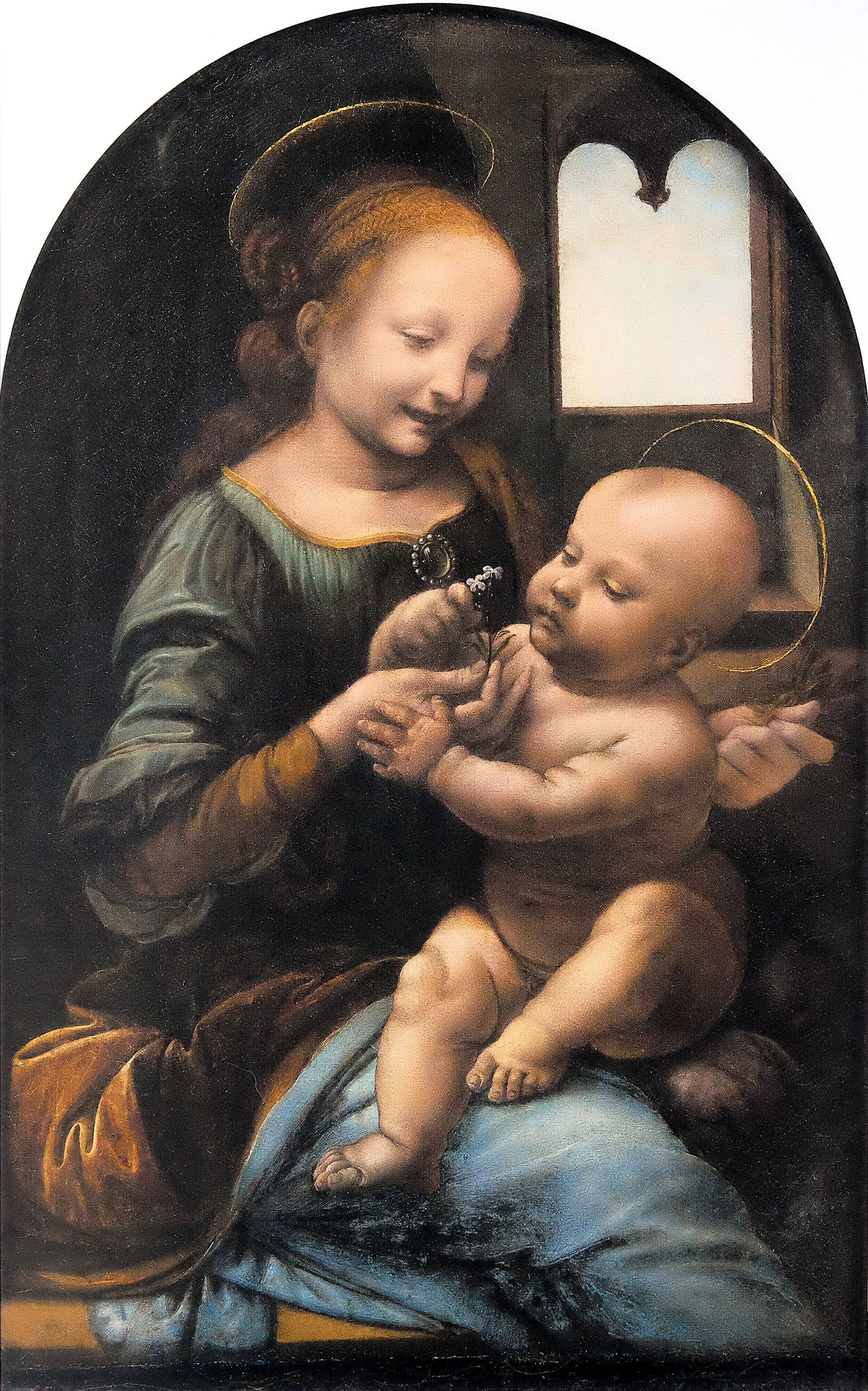
The Benois Madonna, also known as the Madonna and Child with Flowers, is a small devotional painting by Leonardo da Vinci from the 15th century. It belongs to the Hermitage Museum in Saint Petersburg, where it has been part of the collection since 1914. Its charm lies in a quiet, closely observed exchange between a young mother and her child.
Where to see it
The Benois Madonna is held by the Hermitage Museum in Saint Petersburg, Russia. Display arrangements can change because of conservation work, rehanging or temporary closures, so check the Hermitage Museum's official website for the painting's current display status and for opening hours and ticket information before you plan your visit.
What to look for in person
The flower and the Child's gaze
Start with the small flower at the centre of the composition, held between the Virgin's fingers. The Child grips her hand and studies the blossom with intense concentration, almost like a scientist examining a specimen, while she watches him with evident amusement. This exchange of attention is the heart of the picture and explains its other title, Madonna and Child with Flowers. Notice how the hands of mother and child meet at the very middle of the panel, so that a tiny gesture carries the whole story. The scene feels intimate and domestic rather than formal or ceremonial.
A young, smiling Virgin
Compare this Mary with the composed, distant Madonnas common in earlier altarpieces. Here she appears youthful and is caught mid-smile, leaning towards the Child as if sharing a private game. Look at how Leonardo builds the faces and the Child's rounded limbs through gradual shifts from light to shadow rather than crisp outlines, giving the figures weight and softness. The two bodies turn towards each other and form a compact, tightly knit group. Take a moment to follow the line of their glances: both are directed at the flower, which keeps your own eye circling back to the centre.
Reading the painting's condition
It helps to know that the work has changed since Leonardo painted it. It was made in oil on a wooden panel and was later transferred to canvas, a delicate procedure once used to rescue paintings on deteriorating wood. Several areas have also been repainted: the sky seen through the window, the zone around the Virgin's mouth, her neck and the black background. Keep this in mind when you look at the plain window opening and the dark surround, and when judging the expression of her lips. The interplay of the figures remains the clearest guide to the original conception.
About the painting
The painting takes its common name from the Benois family, who owned it for a period before it entered the Hermitage. It is one of two Madonnas that Leonardo began around the same time; the other, the Madonna of the Carnation, is in the Alte Pinakothek in Munich, and a visitor who has seen both can compare how he treated a similar theme. Two preparatory sketches by Leonardo connected with this composition are kept in the British Museum, showing that he worked out the group on paper before painting it. The work measures 49.5 by 33 cm, an intimate size suited to private devotion. Its documented history begins in the 1790s, when the Russian general and collector Aleksei Ivanovich Korsakov acquired it in Italy. After his death, his son sold it for 1,400 roubles to Alexander Petrovich Sapozhnikov, a merchant from Astrakhan. It then came into the Benois family when Maria Sapozhnikova married the architect Leon Benois. In the early twentieth century the painting was exhibited publicly in Saint Petersburg, drawing attention to a work that had been largely unknown. In 1912 the London dealer Joseph Duveen valued it at 500,000 francs, a sign of the international interest it had attracted. The Hermitage purchased it in 1914, with curator Ernst Friedrich von Liphart playing a key role in the acquisition; payments were made in installments that continued after the 1917 revolution. It has remained in the museum's collection ever since.
Key facts
| Artist | Leonardo da Vinci |
|---|---|
| Date | 15th century |
| Size | 49.5 × 33 cm |
| Medium | oil paint, panel, transferred on canvas |
| Collection | Hermitage Museum |
How to visit: Hermitage Museum
Saint Petersburg, Russia
Hours and prices can change. Please check the official website before you go.
More by Leonardo da Vinci
 Annunciation — Uffizi Gallery
 Mona Lisa — Louvre Museum
 Ginevra de' Benci — National Gallery of Art
 Madonna Litta
 Adoration of the Magi — Uffizi Gallery
 Salvator Mundi
 Portrait of a Musician
 Lady with an Ermine
 The Virgin and Child with Saint Anne — Louvre Museum
 La Belle Ferronnière — Louvre Museum
 Saint John the Baptist — Louvre Museum
 Saint Jerome in the Wilderness
Sources
- Wikidata Q1142058
- Wikipedia (en) (CC BY-SA 4.0)
- Wikipedia (ja) (CC BY-SA 4.0)
- Wikipedia (it) (CC BY-SA 4.0)
- Wikipedia (fr) (CC BY-SA 4.0)