Art! Art! Art! › Works
La Belle Ferronnière
 Leonardo da Vinci, 1495
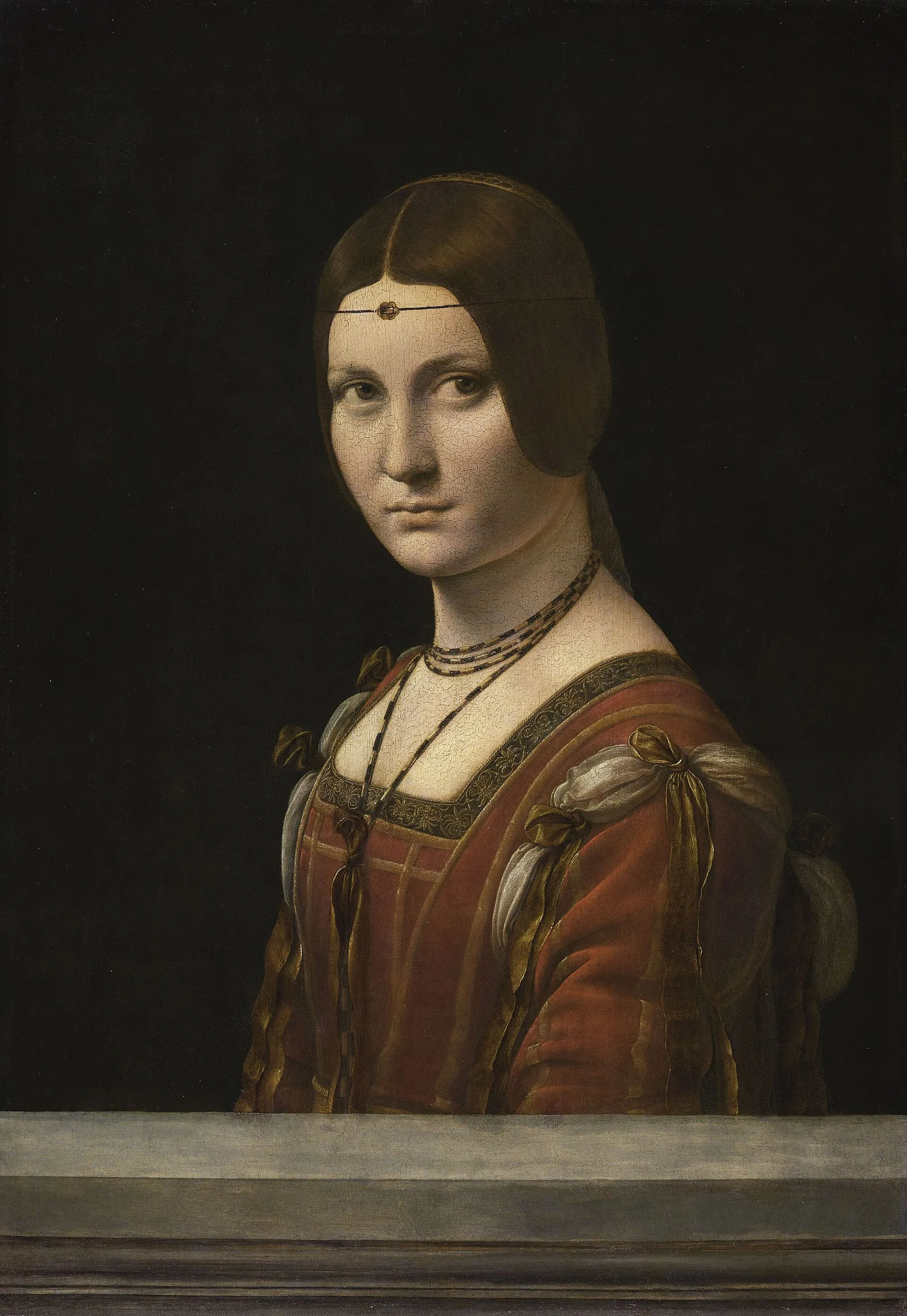
La Belle Ferronnière is a portrait of an unidentified woman by Leonardo da Vinci, dated 1495 and held by the Department of Paintings of the Louvre in Paris. It is a compact panel, 63 by 45 cm, that rewards close looking at the sitter's sideways glance and her finely painted jewellery.
Where to see it
The painting belongs to the Department of Paintings of the Louvre in Paris, and the fact sheet lists its location as Room 710. Displays can change because of rehanging, conservation or loans, so check the Louvre's official website for current display status and ticketing before you visit. The panel measures 63 by 45 cm, smaller than many visitors expect, so allow time to step close and look at the details.
What to look for in person
A gaze that slips past you
Start with the pose. The woman is shown half-length against a dark ground, set behind a parapet that runs along the bottom of the picture. Her body turns to the left, her head faces forward, yet her eyes slide off to one side rather than meeting yours. Stand slightly off-centre and then directly in front to notice how this small mismatch between body, face and glance gives the portrait its watchful, reserved character. The parapet places a quiet barrier between viewer and sitter.
Jewellery painted with care
Look closely at the neck and forehead. A two-coloured necklace loops three times around her throat, and each strand is picked out so you can follow it as it wraps. Across her brow runs a slender band set with a small ruby at the centre. These details are tiny on a panel only 63 by 45 cm, so move in as close as the gallery allows. Notice how the ornaments catch light against the soft modelling of the skin and the darkness of the background.
A panel with a famous sibling
The portrait is painted in oil on walnut panel. Technical analysis found that its wood and the panel of Leonardo's Lady with an Ermine were cut from the same tree trunk, a physical link between two portraits from his Milanese years. The surface you see today also reflects a restoration carried out in 2015, when a varnish layer applied in 1952 was removed. When looking, pay attention to the transitions of tone on the face, which the cleaning was intended to make easier to read.
About the painting
The sitter's name is not known, which is why the work is also called Portrait of an Unknown Woman. Its usual title, La Belle Ferronnière, refers to the wife or daughter of an ironmonger, and it was already attached to the painting by the seventeenth century. That label does not identify a real person. The earliest known record dates from 1642, when the portrait was listed in the royal collections at Fontainebleau as a Leonardo showing a duchess of Mantua. It continued to appear in inventories of the French royal collection before the Revolution, the route by which it reached the Louvre. Who the woman is remains open. When the National Gallery in London showed the portrait in its 2011–2012 exhibition Leonardo da Vinci: Painter at the Court of Milan, it suggested she might be Beatrice d'Este, wife of Ludovico Sforza, presenting this as a possibility rather than a firm identification. The question of who painted it has also been debated. Bernard Berenson gave the portrait to Bernardino de' Conti, and Herbert Cook once proposed Giovanni Antonio Boltraffio before withdrawing that view in 1904 and accepting it as Leonardo's own work. The museum records it as by Leonardo da Vinci. The image has been copied more than once. A 19th-century copy is in the Musée des beaux-arts in Chambéry. A canvas version owned by Andrée Lardoux Hahn, which Joseph Duveen judged a copy in 1920, was sold at Sotheby's on 28 January 2010 for $1.5 million as the work of a follower of Leonardo. Seeing the Louvre panel in person lets you judge its quality for yourself.
Key facts
| Artist | Leonardo da Vinci |
|---|---|
| Date | 1495 |
| Size | 63 × 45 cm |
| Medium | oil paint, panel |
| Collection | Department of Paintings of the Louvre |
How to visit: Louvre Museum
Paris, France · Museum guide
| Opening hours | Mon, Thu, Sat, Sun 09:00–18:00 Wed, Fri 09:00–21:00 (evening opening) Rooms are cleared 30 minutes before closing |
|---|---|
| Closed | Every Tuesday; 1 January, 1 May and 25 December. Other public holidays are open unless they fall on a Tuesday. |
| Last entry | 1 hour before closing |
| Admission | Adult (non-EEA visitors) EUR 32 Adult (EEA citizens and residents) EUR 22 Under 18 free (ID required) EEA citizens/residents under 26 free (photo ID; residents also need a residence permit of over 90 days) Audio guide rental EUR 6 (can be booked in advance online) Rates apply from 14 January 2026 |
| Free entry | Free for under-18s, EEA citizens/residents under 26, all visitors on the first Friday of the month after 18:00 (except July and August) and on 14 July, and disabled visitors plus one carer. Also free with proof for EEA art and art-history teachers, ICOM members, journalists, EEA job seekers and EEA residents on income support. |
| Booking | Entry is by timed slot, and booking in advance is recommended. |
The Cour Carrée entrance is currently closed. On Thursday 12 November 2026 the museum may open later and some exhibition rooms may remain closed.
Official ticket page
Official website
View on map
Hours and prices can change. Please check the official website before you go. (Checked on: 2026-11-11)
More by Leonardo da Vinci
 Benois Madonna
 Annunciation — Uffizi Gallery
 Mona Lisa — Louvre Museum
 Ginevra de' Benci — National Gallery of Art
 Madonna Litta
 Adoration of the Magi — Uffizi Gallery
 Salvator Mundi
 Portrait of a Musician
 Lady with an Ermine
 The Virgin and Child with Saint Anne — Louvre Museum
 Saint John the Baptist — Louvre Museum
 Saint Jerome in the Wilderness
Sources
- Wikidata Q656434
- Wikipedia (en) (CC BY-SA 4.0)
- Wikipedia (it) (CC BY-SA 4.0)
- Wikipedia (fr) (CC BY-SA 4.0)
- www.louvre.fr
- contact.louvre.fr