Art! Art! Art! › Works
Salvator Mundi
 Leonardo da Vinci, 1490
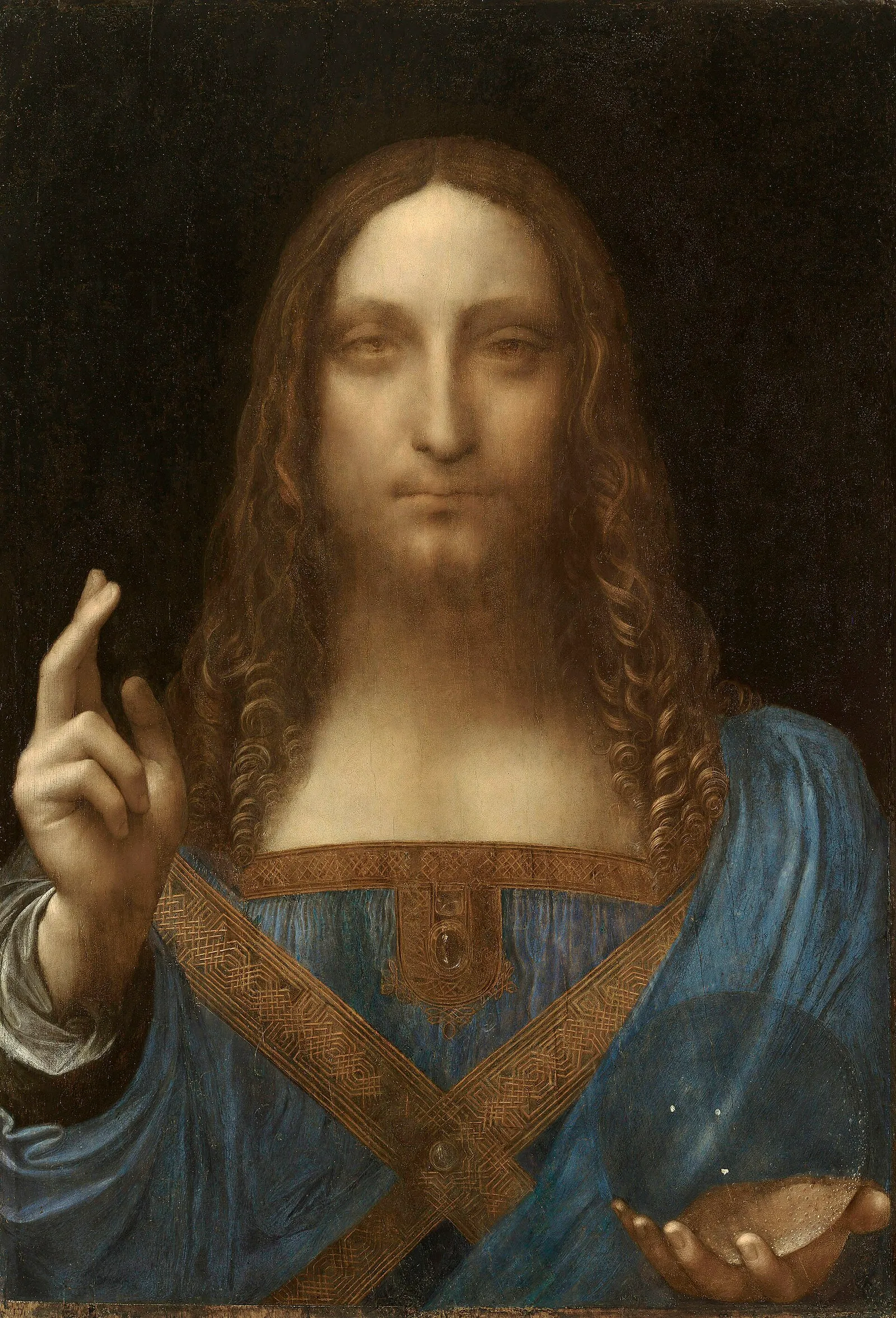
Salvator Mundi, a small panel showing Christ as Saviour of the World and attributed to Leonardo da Vinci, is recorded in the collection of the Louvre Abu Dhabi. It measures just 65.7 by 45.4 cm, so any viewing is a close-up encounter with a frontal, blessing figure holding a clear orb. Its attribution and public visibility have both been widely debated, so plan carefully before travelling to see it.
Where to see it
The fact sheet lists the painting's collection and location as the Louvre Abu Dhabi. Before you plan a trip around this work, check the Louvre Abu Dhabi's official website or contact the museum directly to confirm whether Salvator Mundi is currently on public display. Do not assume it will be on view simply because it is listed in the collection. The painting's public availability has been the subject of uncertainty, as noted below, so written confirmation from the museum is the safest basis for a visit.
What to look for in person
The blessing hand and the crystal orb
Start with the two hands, which carry the meaning of the image. Christ's right hand is raised in a gesture of blessing, the fingers crossed in a traditional sign. His left hand holds a transparent sphere that stands for the world he is said to save. Look closely at the orb. It shows small highlights and inclusions, but the figure behind it is not visibly distorted in the way a solid glass ball would distort it optically. Writers on the painting often discuss this detail, and it rewards a slow look.
The softly modelled face
The face is built from gradual transitions of light and shadow rather than hard outlines. This smoky blending, known as sfumato, is closely associated with Leonardo and his followers. Notice how the eyes, nose and mouth seem to emerge from shadow, and how the curls of hair fall in loose spirals around the head. Keep in mind that the panel suffered serious damage over the centuries and was extensively restored. Parts of what you see, especially in the face, reflect modern conservation as well as the original paint.
Robes, embroidery and knotwork
Shift your attention to the clothing. Christ wears a blue robe with folds falling diagonally across the chest, and a band crosses the chest. Both carry intricate interlaced knot patterns, a kind of ornament that interested Leonardo and his circle. These geometric bands contrast with the soft modelling of the face and hands. Technical studies have reported a pentimento, or painted-over earlier position, in the blessing hand's thumb. It is often cited in discussions of the work, though it is not easy to see with the naked eye.
About the painting
Salvator Mundi, Latin for 'Saviour of the World', is a long-established devotional subject in European art. It shows Christ facing the viewer, blessing with one hand and holding a globe or orb in the other. This version is painted in oil on a small walnut panel. The fact sheet records its size as 65.7 by 45.4 cm and gives an inception date of 1490.
For much of its history the painting was little known. It was considered a later copy and was heavily overpainted. After it resurfaced in the mid-2000s, it was cleaned and extensively restored. A number of specialists then attributed it to Leonardo da Vinci. It was shown under his name in the National Gallery, London's exhibition on Leonardo's years in Milan in 2011 to 2012. In 2017 it was sold at auction at Christie's in New York for about 450 million US dollars, a sale that drew worldwide attention. It was subsequently announced as destined for the Louvre Abu Dhabi, which the fact sheet lists as its collection and location.
The attribution remains debated among scholars. Some accept the painting as Leonardo's own work. Others see substantial workshop involvement, or regard it as a work by a follower. Several other versions of the composition by Leonardo's pupils and circle exist, which shows that the design itself was copied and admired in his time.
For visitors, the main points of interest are the frontal composition, the blessing gesture, the transparent orb and the soft modelling of the face. Viewing it with the history of damage and restoration in mind will help you understand the surface you are looking at.
Key facts
| Artist | Leonardo da Vinci |
|---|---|
| Date | 1490 |
| Size | 65.7 × 45.4 cm |
| Medium | oil paint, Juglans, walnut panel |
| Collection | Louvre Abu Dhabi |
How to visit: Louvre Abu Dhabi
Abu Dhabi, United Arab Emirates
Hours and prices can change. Please check the official website before you go.
More by Leonardo da Vinci
 Benois Madonna
 Annunciation — Uffizi Gallery
 Mona Lisa — Louvre Museum
 Ginevra de' Benci — National Gallery of Art
 Madonna Litta
 Adoration of the Magi — Uffizi Gallery
 Portrait of a Musician
 Lady with an Ermine
 The Virgin and Child with Saint Anne — Louvre Museum
 La Belle Ferronnière — Louvre Museum
 Saint John the Baptist — Louvre Museum
 Saint Jerome in the Wilderness