Art! Art! Art! › Works
The Polish Rider
 Rembrandt, 1655
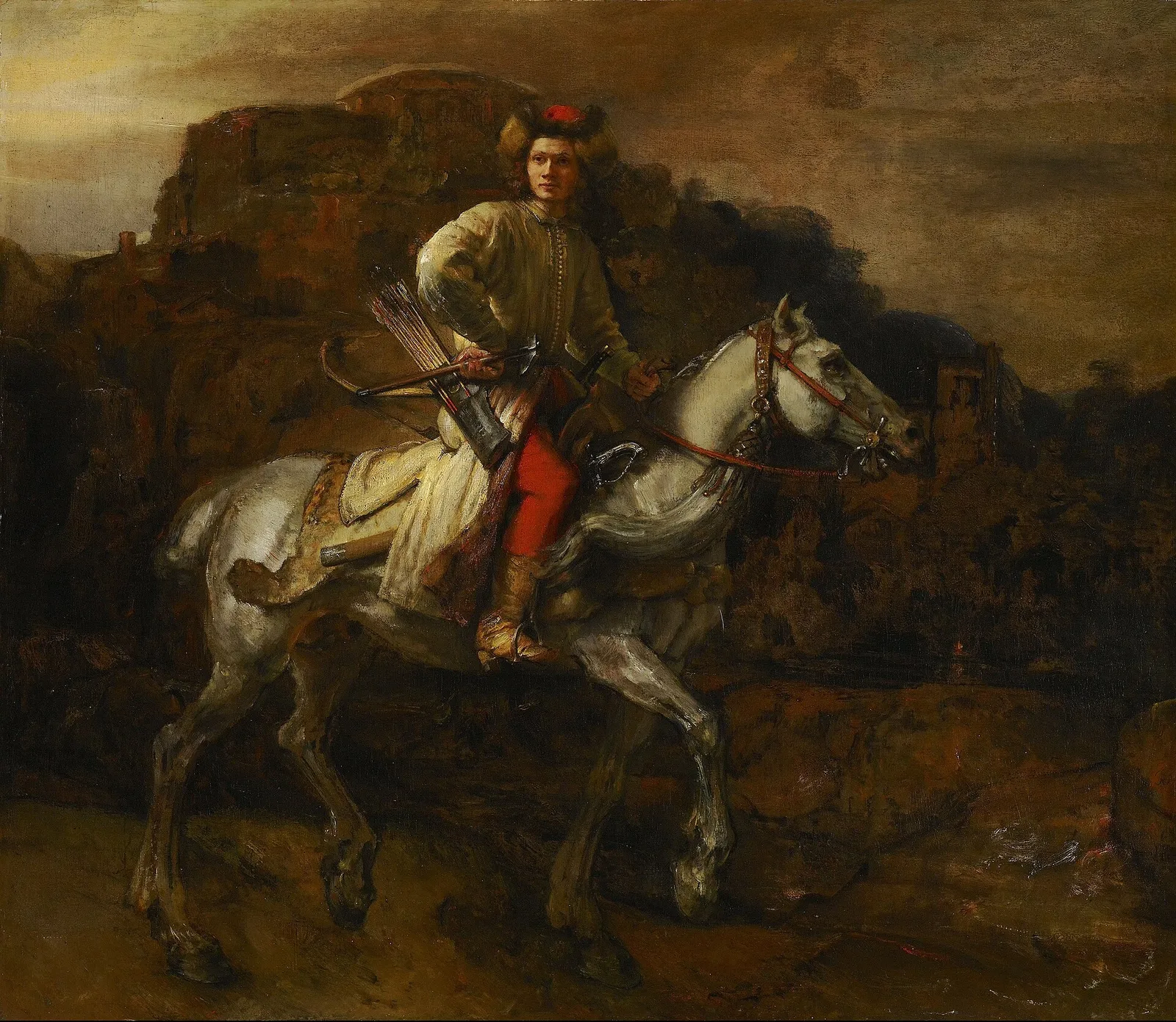
The Polish Rider is a painting by Rembrandt, dated 1655, in The Frick Collection. It shows a young horseman riding through a dim, rocky landscape, and it is one of the most discussed works associated with the artist. In front of it, look at how the light falls on the rider and his horse, and at how loosely parts of the scene are painted.
Where to see it
The Polish Rider is held by The Frick Collection. Display arrangements can change, so check The Frick Collection's official website for current display status, opening hours and ticketing before you visit.
What to look for in person
The rider and his equipment
Start with the young man himself. He sits upright and turns slightly toward the viewer, carrying a set of weapons: a bow and quiver of arrows, a sabre at his side and a war hammer in his hand. His costume, with its tall fur cap and close-fitting coat, has long been linked with Eastern European light cavalry, which is where the painting's familiar title comes from. Notice how his face is the most carefully finished part of the figure, while his clothing is handled more broadly.
The horse and the fall of light
The pale horse moves across the picture from left to right, and its lean, bony build is one of the first things many visitors notice. Light comes from the left and picks out the horse's head, neck and flank, along with the rider's face and the red of his clothing, against a much darker setting. Step back to see how this contrast makes horse and rider stand out from the landscape, then move closer to see how the highlights are built up.
The landscape and the brushwork
Behind the rider, the landscape is dark and hard to read at first. Look for a large building on a hill in the background and a stretch of water lower down, where a faint glow of light appears. Much of this setting is painted with loose, broad strokes rather than fine detail, a contrast with the more defined figure in the foreground. The canvas is wider than it is tall, which gives the sense of a figure travelling across a broad space rather than posing in front of it.
About the painting
The Polish Rider is dated 1655 and measures 116.8 cm high by 134.9 cm wide, a sizeable canvas that lets the horse and rider appear close to life-size in the viewer's imagination as they move across the scene. It belongs to The Frick Collection.
The painting is unusual within Rembrandt's work. He painted many portraits, history scenes and studies of figures in costume, but large images of a single rider set in a landscape are rare among works associated with him. This makes the picture hard to classify. It can be seen as a portrait, as an imaginary figure dressed in exotic costume, or as a scene drawn from history or literature, and writers have argued for each reading without reaching a consensus.
The attribution of the painting has also been discussed by specialists, and questions have been raised over the years about how much of it is by Rembrandt himself and whether some areas were left unfinished or worked on by others. Such debates are common for paintings from the busy workshops of the period, and they are part of what keeps scholars looking closely at this canvas.
For visitors, the best approach is to look slowly. Notice the contrast between the detailed face and the freely painted surroundings, the way warm reds stand out against browns and greys, and the quiet, steady movement of the horse. The mood is calm and serious rather than dramatic, and the uncertainty about who the rider is and where he is going is part of the painting's lasting appeal.
Key facts
| Artist | Rembrandt |
|---|---|
| Date | 1655 |
| Size | 116.8 × 134.9 cm |
| Medium | oil paint, canvas |
| Collection | The Frick Collection |
How to visit: The Frick Collection
New York City, United States · Museum guide
| Opening hours | Mon 10:30–17:30 Wed 10:30–17:30 (pay what you wish 13:30–17:30) Thu–Sun 10:30–17:30 First Friday of each month (except Jan and Sep) 17:30–21:00 (Louis Vuitton First Fridays, free, reservation required) |
|---|---|
| Closed | Tuesday |
| Last entry | 16:30 |
| Admission | Adults USD 30 Seniors (65+) USD 22 Visitors with disabilities USD 22 Students (with ID) USD 17 Ages 10–18 free Members free (no reservation required) |
| Free entry | Free for ages 10–18 and members. ROAM, NARM, AAM, ICOM and Museums Council of NYC members receive two complimentary tickets at the Admissions Desk for the next time slot. Pay what you wish on Wednesdays 13:30–17:30 (reserve online; limited onsite tickets, not guaranteed). Free Louis Vuitton First Fridays 17:30–21:00 on the first Friday of each month except January and September. Only children aged 10 and over are admitted. Tickets include all current special exhibitions. |
| Booking | Entry is by timed ticket. Free tickets for First Fridays must also be reserved in advance. |
Online ticketing is currently experiencing technical difficulties; please email admissions@frick.org.
Official ticket page
Official website
View on map
Hours and prices can change. Please check the official website before you go. (Checked on: 2026-11-12)
More by Rembrandt
 Rembrandt and Saskia in the parable of the Prodigal Son — Staatliche Kunstsammlungen Dresden
 Belshazzar's Feast — National Gallery
 Syndics of the Drapers' Guild — Rijksmuseum
 The Abduction of Europa — J. Paul Getty Museum
 Juno
 The Night Watch — Rijksmuseum
 The Conspiracy of Claudius Civilis — Rijksmuseum
 The Storm on the Sea of Galilee
 Danaë
 Aristotle with a Bust of Homer — Metropolitan Museum of Art
 The Stoning of Saint Stephen
 The Mill — National Gallery of Art