Art! Art! Art! › Works
The Jewish Bride
 Rembrandt, 1660s
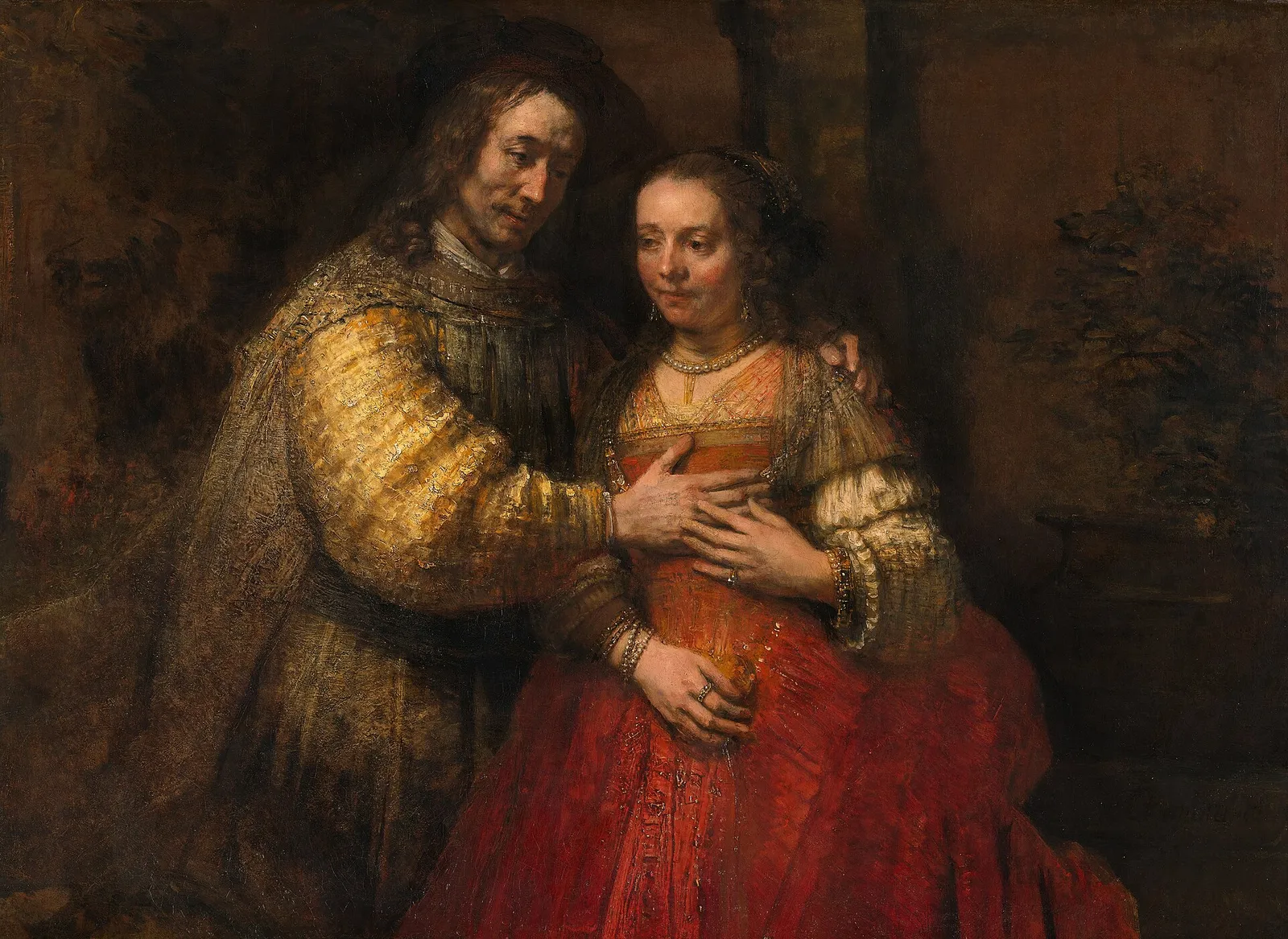
Rembrandt's The Jewish Bride, painted in the 1660s, is held by the Rijksmuseum. It shows a couple in a quiet, close embrace, and it is known for the thick, sculpted paint of its red and gold clothing and for the tenderness of the two figures' hands.
Where to see it
The Jewish Bride is held by the Rijksmuseum. The museum lists its location as the Gallery of Honour, and the painting is associated with the collection of Adriaan van der Hoop and with the Amsterdam Museum. Hanging arrangements can change because of conservation, rehanging or special exhibitions, so check the Rijksmuseum's official website for current display status before you visit. The canvas measures 121.5 × 166.5 cm. It is wider than it is tall and large enough that the figures appear close to life-size, so step back first to take in the whole composition, then move closer to study the brushwork.
What to look for in person
The hands at the centre
Begin with the hands, which sit near the middle of the picture. The man rests one hand on the woman's chest, and she lays her fingertips lightly on top of it. Her other hand rests low against her dress. The gesture is protective and intimate rather than theatrical, and it carries much of the painting's emotional weight. Notice how softly the fingers are modelled compared with the heavy paint around them. Neither face looks directly at the other. Both expressions are inward and calm, which gives the scene its quiet, private mood.
Paint you can almost touch
Move in close to the man's broad golden sleeve. Here Rembrandt built up the paint in thick ridges and lumps, and the surface catches light from the gallery itself. From a distance these strokes read as folds of shimmering fabric. Up close they become an almost abstract relief of yellows, ochres and browns. Many art historians believe that some passages were applied with a palette knife as well as brushes. This kind of raised, textured handling is typical of Rembrandt's late work, and seeing it in person reveals what reproductions cannot show.
Red, gold and shadow
Look at how few colours dominate the canvas. The woman's deep red dress and the man's warm gold garments glow against a dark, loosely painted background. Traces of architecture and foliage are only hinted at and blend into shadow. That restraint keeps your eye on the couple. Notice too the pearls and jewellery at the woman's neck and wrist, picked out with small, bright touches of paint. Compare the soft, glazed treatment of the faces with the rough texture of the clothing. Rembrandt varies his technique to separate flesh from fabric.
About the painting
The Jewish Bride is one of the paintings Rembrandt made in the 1660s, the final decade of his career. During these years his handling of paint grew broader and more physical, and he often concentrated on a small number of figures shown with great psychological depth. The canvas measures 121.5 by 166.5 centimetres, and the two figures fill most of it, so the viewer stands close to the couple.
The familiar title is not Rembrandt's own. It was given to the painting long after his death, and it reflects a later interpretation of the scene rather than any documented identity of the sitters. Who the couple are remains an open question. Scholars have proposed that the painting may show a biblical couple, often suggested to be Isaac and Rebecca from the Book of Genesis, or that it could be a portrait of a real Amsterdam couple in historical or biblical costume. It may combine portrait and history painting, a mix found elsewhere in Rembrandt's work.
Whatever its subject, the painting is widely admired for the way it pairs a deeply tender human moment with daring paintwork. The thickly built-up sleeve and the glowing reds have long drawn the attention of painters as well as historians.
The work is linked to the collection of Adriaan van der Hoop and to the Amsterdam Museum, and it is held by the Rijksmuseum, which lists it in its Gallery of Honour. Visitors who plan ahead can look for it there, after confirming its current display on the museum's official website.
Key facts
| Artist | Rembrandt |
|---|---|
| Date | 1660s |
| Size | 121.5 × 166.5 cm |
| Medium | oil paint, canvas |
| Collection | collection Adriaan van der Hoop / Amsterdam Museum / Rijksmuseum |
How to visit: Rijksmuseum
Amsterdam, Netherlands · Museum guide
| Opening hours | Mon–Sun 09:00–17:00 (every day, incl. public holidays) Gardens 09:00–18:00 (summer only) |
|---|---|
| Closed | Open every day of the year, including public holidays. |
| Admission | Adults EUR 25 (from 2027: EUR 26.50) CJP / EYCA members (half price) EUR 11.25 (from 2027: EUR 13.25) 18 and under free |
| Free entry | Free for those aged 18 and under, Friends of the Rijksmuseum, Amsterdam City Card holders, and holders of ICOM, Vereniging Rembrandt, KOG, VVAK and VriendenLoterij VIP-KAART cards. The gardens are free. |
| Booking | Advance reservation is required, with timed entry. |
Official ticket page
Official website
View on map
Hours and prices can change. Please check the official website before you go. (Checked on: 2026-11-09)
More by Rembrandt
 Rembrandt and Saskia in the parable of the Prodigal Son — Staatliche Kunstsammlungen Dresden
 Belshazzar's Feast — National Gallery
 Syndics of the Drapers' Guild — Rijksmuseum
 The Abduction of Europa — J. Paul Getty Museum
 Juno
 The Night Watch — Rijksmuseum
 The Conspiracy of Claudius Civilis — Rijksmuseum
 The Storm on the Sea of Galilee
 Danaë
 Aristotle with a Bust of Homer — Metropolitan Museum of Art
 The Stoning of Saint Stephen
 The Mill — National Gallery of Art