Art! Art! Art! › Works
The Fif
 Édouard Manet, 1866
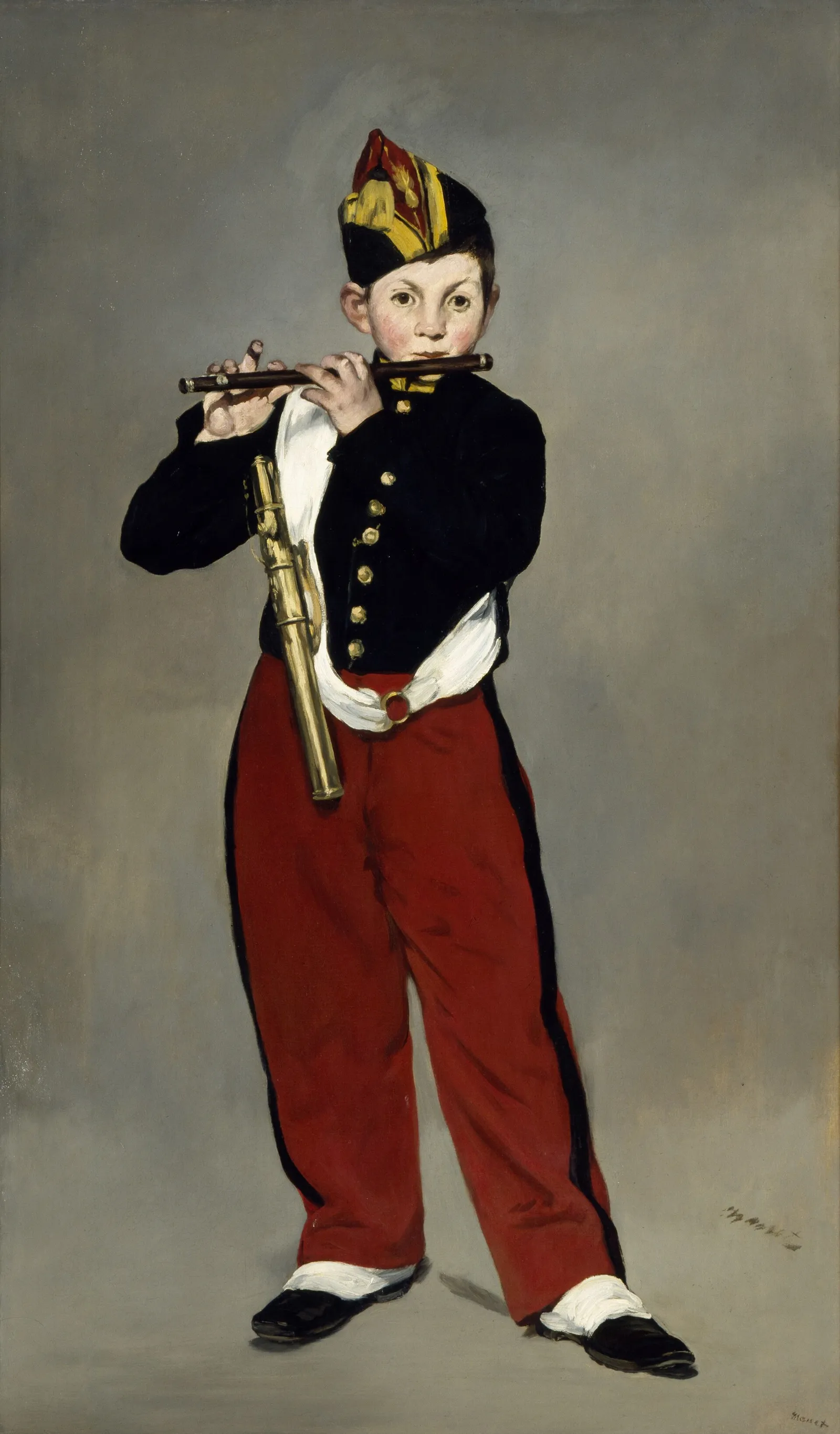
Édouard Manet's The Fifer, painted in 1866, is in the collection of the Musée d'Orsay. It shows a young military musician standing alone against a plain, almost featureless background, a bold and simple image that shocked many of its first viewers.
Where to see it
The Fifer is held by the Musée d'Orsay, which is also listed as its location. Works in museum collections are sometimes moved, rehung, lent or temporarily taken off view, so check the Musée d'Orsay's official website for current display status before you visit.
What to look for in person
A figure with no setting
Look first at what is missing. There is no floor line, no room and no landscape behind the boy. The background is a soft, even grey, and the figure seems to stand in an undefined space, held in place only by a small shadow at his feet. This emptying of the setting is one of the boldest choices in the picture. It owes a widely recognised debt to Velázquez, whose work Manet admired in Spain, and it pushes all of your attention onto the boy's shape, pose and colour.
Flat areas of strong colour
Step back and notice how the uniform is built from broad, flat areas of paint: the red trousers with their black stripe, the dark jacket, the white gaiters and strap. Manet uses very little modelling to suggest volume, and he often separates shapes with firm dark edges. Critics of the time found this flatness crude, comparing it to a playing card, but it is now seen as a key part of Manet's modern approach. Up close, you can see how economically the brushstrokes describe folds and buttons.
Scale and presence
At 160.5 by 97 centimetres, the canvas presents the young musician at an imposing size, so standing in front of it feels close to meeting a real person. Pay attention to the boy's steady, direct gaze and the careful placement of his fingers on the fife. The pose is upright and calm rather than dramatic. Rather than telling a story or illustrating an event, the painting presents an ordinary young soldier with the seriousness traditionally reserved for portraits of important sitters.
About the painting
Édouard Manet painted The Fifer in 1866, shortly after a trip to Spain where he studied paintings by Velázquez in the Prado. That experience is widely seen as shaping this work, especially the idea of setting a single standing figure against a neutral background with no clear sense of place. The subject is a young fife player of the kind who served in the military bands of the French army, shown in full uniform.
Manet submitted the painting to the official Salon of 1866, and it was rejected. The decision became part of the wider debate about his work in the 1860s. The young writer Émile Zola defended Manet publicly that year, praising his directness and his refusal to follow academic conventions. The Fifer came to stand for Manet's new way of painting: simplified forms, flat colour, strong contrasts and an unidealised view of everyday modern subjects.
For visitors, the painting rewards both distance and close looking. From across the room, the red, black and white of the uniform read almost like a graphic sign against the grey. Closer in, the quick, confident handling of the paint becomes visible, especially in the face, the hands and the shiny details of the uniform. The work is often discussed alongside other Manet paintings of the 1860s, and it helps explain why he is regarded as a central figure in the shift toward modern painting in France. Seeing it at the Musée d'Orsay also allows you to compare it with works by painters of the following generation who learned from his example.
Key facts
| Artist | Édouard Manet |
|---|---|
| Date | 1866 |
| Size | 160.5 × 97 cm |
| Medium | oil paint, canvas |
| Collection | Musée d'Orsay |
How to visit: Musée d'Orsay
Paris, France · Museum guide
| Opening hours | Tue–Wed, Fri–Sun 09:30–18:00 (galleries close at 17:30) Thu 09:30–21:45 (late opening; galleries close at 21:15) |
|---|---|
| Closed | Every Monday, 1 May and 25 December. |
| Last entry | 17:00 (exhibitions 17:15); Thursdays 21:00 |
| Admission | Full rate, online EUR 16 Full rate, at the museum EUR 14 Reduced rate (on site only) EUR 11 Enfant & Cie, online EUR 13 Enfant & Cie, at the museum EUR 11 Night rate (Thursday), online EUR 12 Night rate (Thursday), at the museum EUR 10 Under 18s; EEA residents under 26 free |
| Free entry | Free for under 18s and residents of the European Economic Area under 26. Free on the first Sunday of the month, with booking required. |
| Booking | Booking is strongly recommended. Entry is by timed slot. |
The museum stays open and all collections and exhibitions remain accessible, but entrances have changed: timed-ticket holders use Entrance 1 (Quay); priority visitors, reseller voucher holders, visitors without tickets and groups use Entrance 2 (Forecourt). Arrive at least 15 minutes before your time slot.
Official ticket page
Official website
View on map
Hours and prices can change. Please check the official website before you go. (Checked on: 2026-11-11)
More by Édouard Manet
 A Bar at the Folies-Bergère — Courtauld Gallery
 Luncheon on the Grass — Musée d'Orsay
 Portrait of Stéphane Mallarmé — Musée d'Orsay
 A Bundle of Asparagus
 Music in the Tuileries — National Gallery
 Emile Zola — Musée d'Orsay
 Argenteuil
 Berthe Morisot with a Bouquet of Violets — Musée d'Orsay
 Nana
 Olympia — Musée d'Orsay
 The Balcony — Musée d'Orsay