Art! Art! Art! › Works
Music in the Tuileries
 Édouard Manet, 1862
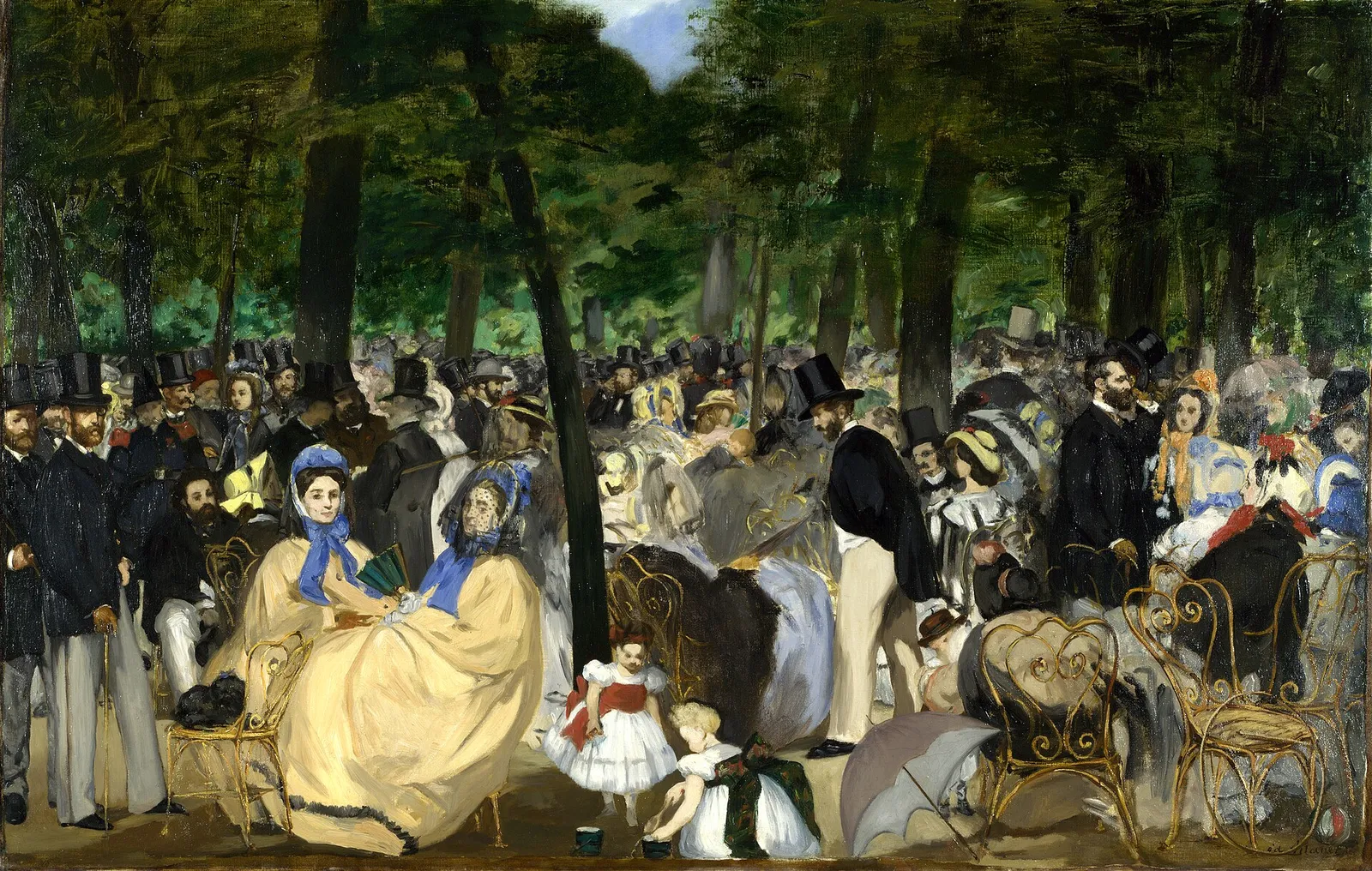
Édouard Manet's Music in the Tuileries, painted in 1862, shows a crowd of fashionable Parisians gathered under the trees of the Tuileries Gardens. The painting is listed as located at the National Gallery, and its collection is recorded as shared between the Hugh Lane Gallery and the National Gallery. It is a key early picture for anyone interested in how painters began to record modern city life.
Where to see it
According to our fact sheet, Music in the Tuileries is located at the National Gallery, and its collection is recorded as the Hugh Lane Gallery and the National Gallery. Because the work is associated with two institutions, where it hangs at a given time may vary. Before you travel, check the official websites of the National Gallery and the Hugh Lane Gallery for current display status, opening hours and any ticketing requirements. The canvas measures 76.2 cm high by 118.1 cm wide, a wide horizontal format that rewards standing back first and then moving in close.
What to look for in person
A crowd of recognisable faces
Look across the band of figures in the middle ground and you will find a gathering of top hats, dark coats and bonnets. Manet filled the scene with people from his own circle of artists and writers, so the picture works partly as a group portrait of Parisian cultural life. Rather than lining them up formally, he lets them overlap, turn away and chat. Notice how few faces are given full detail: some are carefully described, while others dissolve into quick strokes, as if your eye is skimming the crowd.
The painter at the edge
Move to the far left of the canvas. Near the edge stands a figure widely identified as Manet himself, partly cut off by the frame. Placing himself at the margin, almost as an onlooker, is a quiet touch: the artist is both part of this society and its observer. Compare his position with the women seated in the foreground, who sit closer to you and draw attention first. The cropped figures at the edges make the scene feel like a glimpse of a larger event continuing beyond the frame.
Loose, sketch-like paint
Step in close to the lower part of the picture and the foreground. Here the handling becomes broad and quick, with chairs, dresses and children suggested rather than finished. Then look up at the trees, whose pale trunks and dark foliage form a screen across the top of the composition. The contrast between areas of careful detail and passages of open brushwork was striking for its time. Stepping back again, notice how the patches of black clothing set a rhythm across the whole width of the canvas.
About the painting
Music in the Tuileries dates from 1862, early in Édouard Manet's career, when he was establishing himself as a painter of contemporary Paris. Instead of a historical, religious or mythological subject, he chose an ordinary social occasion: people gathering in the Tuileries Gardens, in the centre of the city, to hear an open-air concert. The music itself is barely visible; what interests Manet is the audience, the clothes, the conversation and the sense of being in a crowd.
The painting is often discussed as an early example of the idea that modern life could be a serious subject for art. Its mix of portraiture and everyday scene, its cropped edges and its loose brushwork all point toward concerns that would later be taken up by the Impressionists, many of whom admired Manet. For visitors, the painting is a useful starting point for thinking about how artists in the 1860s began to look at their own time and their own social world.
The canvas is 76.2 cm high and 118.1 cm wide. Its wide, frieze-like format suits the subject: the eye travels from left to right along a line of figures, much as you might scan a crowded park. Take time to move between near and far views. Up close, the surface reveals quick, confident strokes; from a distance, these resolve into a lively, coherent scene. Pay attention also to the use of black, a colour Manet used with particular confidence, which anchors the composition and ties the many figures together.
Key facts
| Artist | Édouard Manet |
|---|---|
| Date | 1862 |
| Size | 76.2 × 118.1 cm |
| Medium | oil paint, canvas |
| Collection | Hugh Lane Gallery / National Gallery |
How to visit: National Gallery
London, United Kingdom · Museum guide
| Opening hours | Mon–Thu, Sat, Sun 10:00–18:00 Fri 10:00–21:00 (Friday late) |
|---|---|
| Closed | 24–26 December and 1 January. |
| Admission | General admission (collection) free; donations invited Some exhibitions are charged (e.g. Renoir and Love, until 31 Jan 2027) |
| Free entry | General admission is always free. |
| Booking | No reservation or timed entry is required. Free timed booking gives fast-track entry. |
Building work and improvements are under way: some rooms are closed and some paintings have moved, so check the floorplans or collection search before visiting. A new Research Centre is due to open in 2028. On 17 November only, some east wing rooms and the Espresso Bar close from 16:00.
Official ticket page
Official website
View on map
Hours and prices can change. Please check the official website before you go. (Checked on: 2026-11-11)
More by Édouard Manet
 A Bar at the Folies-Bergère — Courtauld Gallery
 Luncheon on the Grass — Musée d'Orsay
 Portrait of Stéphane Mallarmé — Musée d'Orsay
 A Bundle of Asparagus
 Emile Zola — Musée d'Orsay
 The Fif — Musée d'Orsay
 Argenteuil
 Berthe Morisot with a Bouquet of Violets — Musée d'Orsay
 Nana
 Olympia — Musée d'Orsay
 The Balcony — Musée d'Orsay