Art! Art! Art! › Works
Nana
 Édouard Manet, 1877
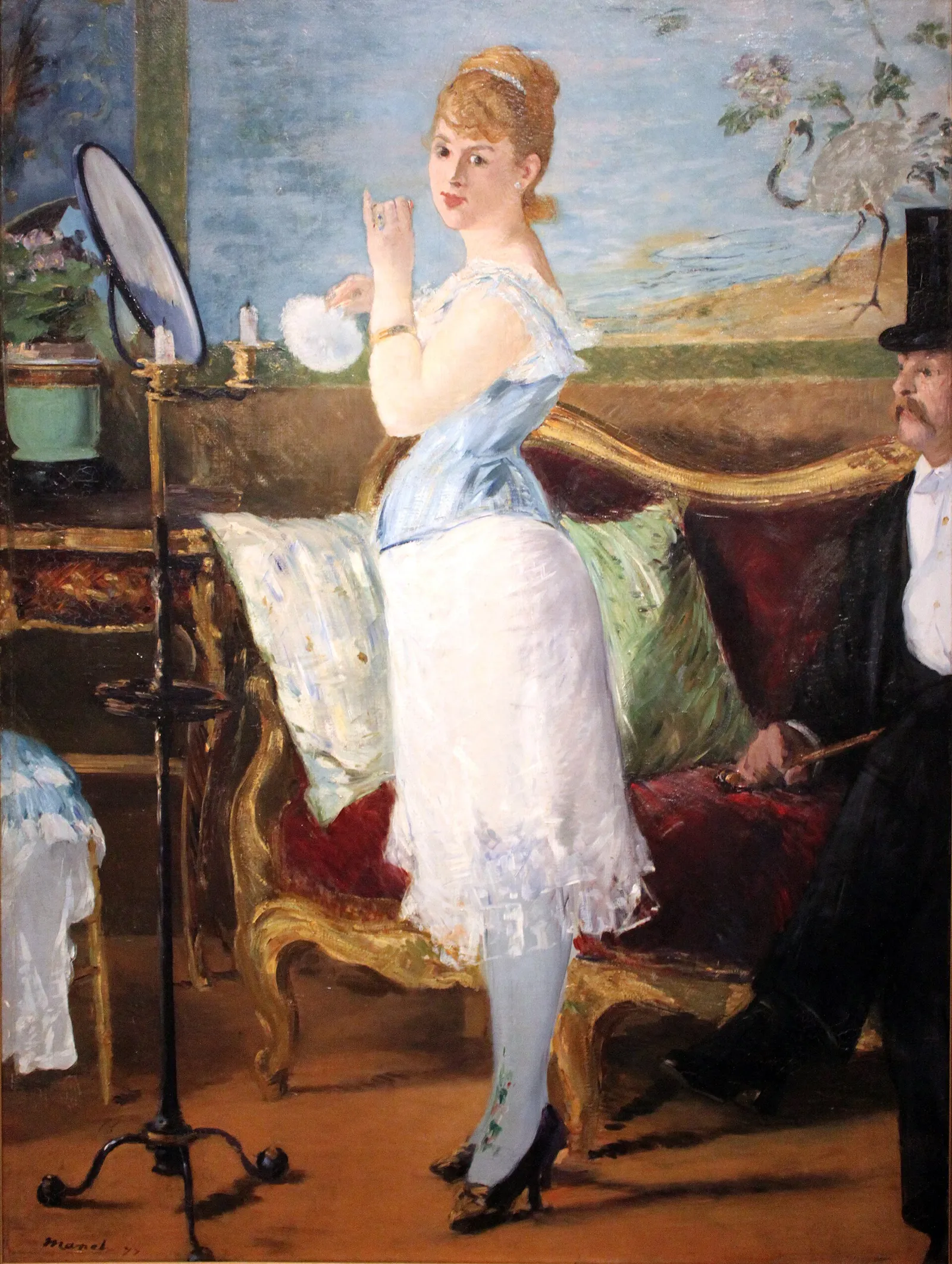
Édouard Manet's Nana, dated 1877, is in the collection of the Hamburger Kunsthalle. The canvas shows a young woman pausing at her make-up while a man in evening dress waits nearby, a scene of modern Parisian life that Manet set down with open, rapid brushwork.
Where to see it
Nana is held by the Hamburger Kunsthalle, which is listed as both its collection and its location. Display arrangements at any museum can change because of rehangs, conservation work or loans, so check the Hamburger Kunsthalle's official website for current display status before you plan your visit. The painting measures 154 cm high by 115 cm wide, a large format that lets the standing figure read at close to human scale.
What to look for in person
The woman who looks back
Start with the central figure. She stands in a white chemise, a corset and blue stockings, caught in the middle of her toilette at a mirror. Instead of staying absorbed in her reflection, she turns her head and meets the viewer's eye with a calm, slightly amused expression. Notice how that glance changes the scene: you are not secretly observing a private moment but being acknowledged by her. Much of the painting's directness, and the unease it provoked in its own time, comes from this frank, unembarrassed look.
The man cut off by the frame
Look to the right edge. A man in a top hat and dark evening clothes sits on a sofa, but the frame slices through him, so only part of his body is visible. His dark form is a sober counterweight to the pale figure of the woman. Manet's cropping feels close to a snapshot, as if the scene simply continues beyond the canvas. Note too how the man is placed as a waiting observer, which hints at the relationship between the two figures without spelling it out.
Brushwork and colour up close
Step close, then step back. Near the surface, the chemise, skin and fabrics break into broad, quick strokes, with little smoothing or fine finish. From a few paces away these marks resolve into light on linen, the sheen of the corset and the softness of powdered skin. Watch the colour as well: the cool blue of the stockings and corset against warm flesh tones and bright whites. At 154 by 115 centimetres, the canvas gives these loose, confident strokes room to read clearly.
About the painting
Édouard Manet painted Nana in 1877, during the years when he was devoted to scenes of contemporary Paris rather than history or mythology. The subject is a young woman of the city's demi-monde, shown in her dressing room with an admirer in attendance. Manet treats the situation without moralising: there is no sign of judgment in the picture, only an everyday moment observed with cool attention. That neutrality was part of what made the work provocative. Manet submitted the painting to the official Paris Salon of 1877, and it was rejected. The title points to the literary world of Émile Zola, a supporter of Manet. A character named Nana appears in Zola's novel L'Assommoir, and Zola later made her the heroine of his novel Nana, published in 1880, after Manet's canvas was painted. The painting and the novels share an interest in the realities of modern urban life, including the economics of desire and display. For a visitor, the work rewards slow looking. The composition sets the pale, upright woman against the dark, partially hidden man, and balances deliberate staging with a sense of the casual and unposed. The unfinished-looking surface, once seen by critics as careless, is now generally read as part of Manet's modern approach, recording the look of a moment rather than polishing it away. Standing in front of the canvas in the Hamburger Kunsthalle, you can see how Manet uses scale, cropping and an outward gaze to draw the viewer into the scene's quiet tension.
Key facts
| Artist | Édouard Manet |
|---|---|
| Date | 1877 |
| Size | 154 × 115 cm |
| Medium | oil paint, canvas |
| Collection | Hamburger Kunsthalle |
How to visit: Hamburger Kunsthalle
Hamburg, Germany
Hours and prices can change. Please check the official website before you go.
More by Édouard Manet
 A Bar at the Folies-Bergère — Courtauld Gallery
 Luncheon on the Grass — Musée d'Orsay
 Portrait of Stéphane Mallarmé — Musée d'Orsay
 A Bundle of Asparagus
 Music in the Tuileries — National Gallery
 Emile Zola — Musée d'Orsay
 The Fif — Musée d'Orsay
 Argenteuil
 Berthe Morisot with a Bouquet of Violets — Musée d'Orsay
 Olympia — Musée d'Orsay
 The Balcony — Musée d'Orsay