Art! Art! Art! › Works
Luncheon on the Grass
 Édouard Manet, 1863
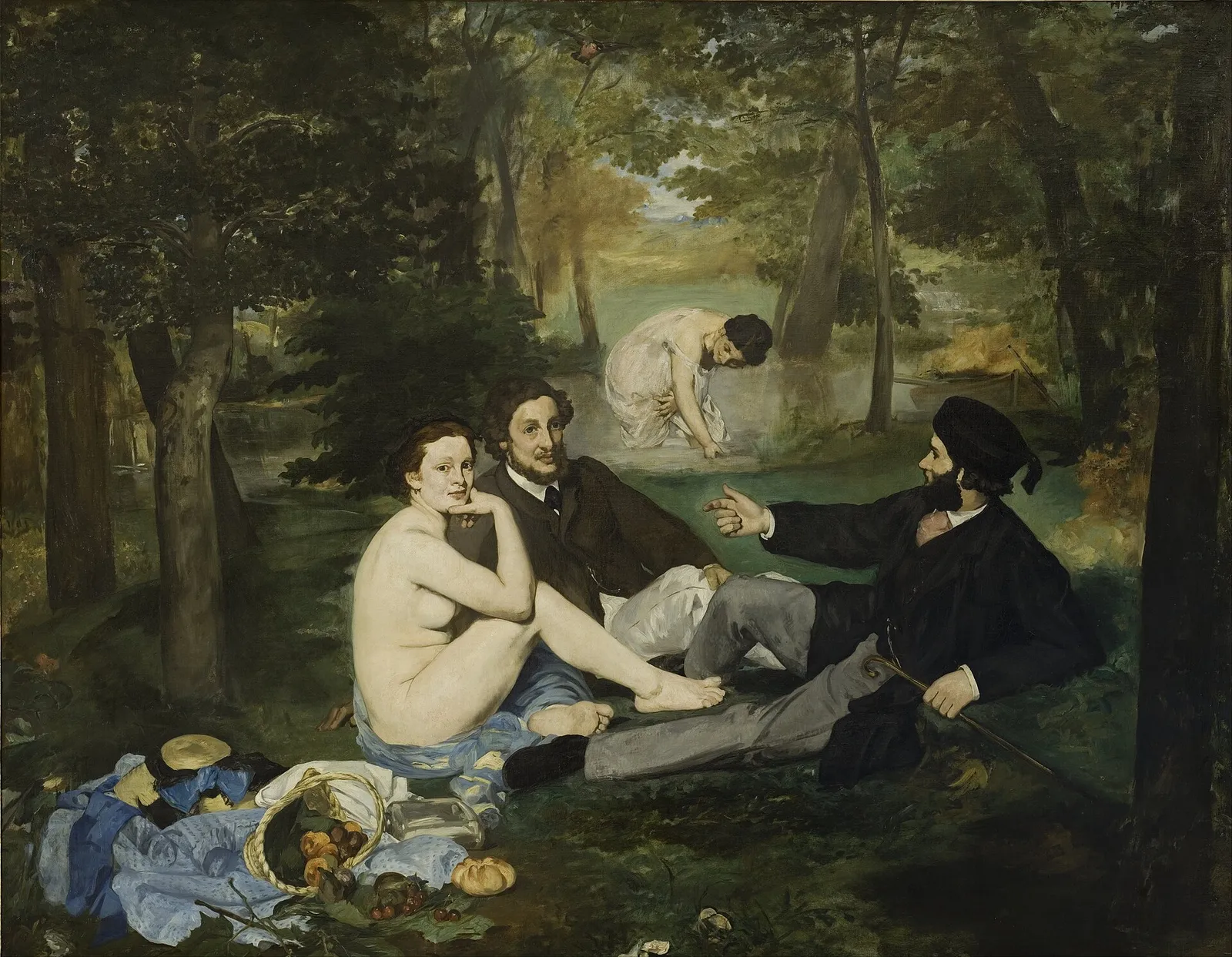
Édouard Manet's Luncheon on the Grass, dated 1863, is in the collection of the Musée d'Orsay. A nude woman picnicking with two fully dressed men in a wooded setting, it caused an uproar when first exhibited and remains one of the key works in the story of modern painting. At 208 × 264.5 cm, it is a canvas that fills your field of view.
Where to see it
Luncheon on the Grass is held by the Musée d'Orsay, which is listed as both its collection and its location. Works can be moved, lent or taken off view for conservation, so check the Musée d'Orsay's official website for current display status, opening hours and ticketing before you plan your visit.
What to look for in person
The direct gaze
The seated nude woman turns her head and looks straight out at you, while the two clothed men beside her seem absorbed in their own conversation. Stand back and notice how that gaze closes the usual distance between painting and viewer. Her pale body is lit evenly and frankly, with little of the soft, idealising modelling that academic painters used for nudes. The contrast between her bare skin and the men's dark, contemporary clothes is the core of the picture's provocation, and it is still easy to feel in front of the canvas.
The still life in the corner
In the lower left, the woman's discarded clothing, a basket spilling fruit and a round loaf of bread form a self-contained still life. Move closer and look at how freely it is painted: the fabric is laid down in broad strokes of blue and white, the fruit in a few confident touches of colour. Manet was a gifted still-life painter, and this corner shows his handling of paint at its most visible. It also anchors the composition, balancing the bright figures against the darker woodland behind them.
The bather and the flattened space
Behind the group, a second woman in a light shift bends over in the water. She looks too large for her apparent distance from the foreground, so the space seems to tilt toward you rather than recede smoothly. The trees and background are summarily painted, almost like a stage backdrop. Many critics in 1863 read this as clumsiness; today it is often understood as a break with conventional perspective. Step back across the room to see how the figures, the bather and the foliage stack up on the picture surface.
About the painting
Manet painted Luncheon on the Grass in 1863 and submitted it to the official Paris Salon, which rejected it. It was then shown at the Salon des Refusés, the exhibition organised that year for works turned away by the Salon jury, where it drew ridicule and outrage. Its original title was Le Bain (The Bath). What troubled viewers was not nudity in itself, which was common in Salon painting, but its setting: an unidealised nude woman sitting beside men in modern dress, with no mythological or allegorical story to explain her presence. The painting's size, 208 × 264.5 cm, added to the offence, because canvases on this scale were traditionally reserved for history painting rather than scenes of contemporary life. Manet built the picture on respected sources. The pose of the three main figures is drawn from Marcantonio Raimondi's engraving after Raphael's Judgment of Paris, and the theme of clothed men with nude women in a landscape recalls the Pastoral Concert in the Louvre, attributed to Titian or Giorgione. The seated woman was modelled by Victorine Meurent, who also posed for Manet's Olympia. By putting old-master compositions into a modern setting, and painting them with flat light and visible brushwork, Manet challenged how pictures were expected to look and what they were allowed to show. Younger artists took note: Claude Monet later painted his own large Luncheon on the Grass in response. For visitors, the painting rewards both a distant view of its bold composition and a close look at its loose, direct paint.
Key facts
| Artist | Édouard Manet |
|---|---|
| Date | 1863 |
| Size | 208 × 264.5 cm |
| Medium | oil paint, canvas |
| Collection | Musée d'Orsay |
How to visit: Musée d'Orsay
Paris, France · Museum guide
| Opening hours | Tue–Wed, Fri–Sun 09:30–18:00 (galleries close at 17:30) Thu 09:30–21:45 (late opening; galleries close at 21:15) |
|---|---|
| Closed | Every Monday, 1 May and 25 December. |
| Last entry | 17:00 (exhibitions 17:15); Thursdays 21:00 |
| Admission | Full rate, online EUR 16 Full rate, at the museum EUR 14 Reduced rate (on site only) EUR 11 Enfant & Cie, online EUR 13 Enfant & Cie, at the museum EUR 11 Night rate (Thursday), online EUR 12 Night rate (Thursday), at the museum EUR 10 Under 18s; EEA residents under 26 free |
| Free entry | Free for under 18s and residents of the European Economic Area under 26. Free on the first Sunday of the month, with booking required. |
| Booking | Booking is strongly recommended. Entry is by timed slot. |
The museum stays open and all collections and exhibitions remain accessible, but entrances have changed: timed-ticket holders use Entrance 1 (Quay); priority visitors, reseller voucher holders, visitors without tickets and groups use Entrance 2 (Forecourt). Arrive at least 15 minutes before your time slot.
Official ticket page
Official website
View on map
Hours and prices can change. Please check the official website before you go. (Checked on: 2026-11-11)
More by Édouard Manet
 A Bar at the Folies-Bergère — Courtauld Gallery
 Portrait of Stéphane Mallarmé — Musée d'Orsay
 A Bundle of Asparagus
 Music in the Tuileries — National Gallery
 Emile Zola — Musée d'Orsay
 The Fif — Musée d'Orsay
 Argenteuil
 Berthe Morisot with a Bouquet of Violets — Musée d'Orsay
 Nana
 Olympia — Musée d'Orsay
 The Balcony — Musée d'Orsay