Art! Art! Art! › Works
Portrait of Stéphane Mallarmé
 Édouard Manet, 1876
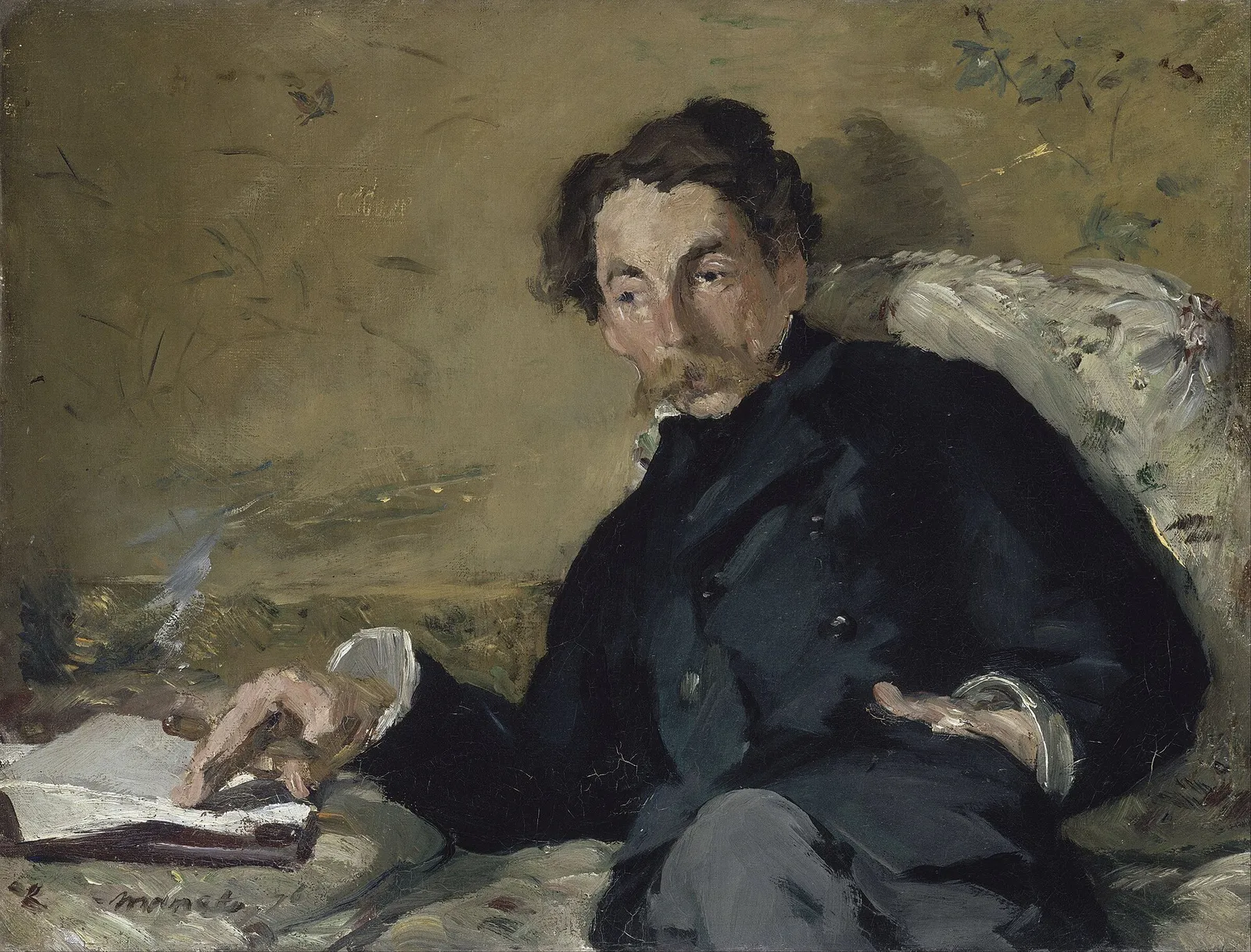
Édouard Manet painted his friend, the poet Stéphane Mallarmé, in 1876, catching him in a moment of relaxed thought rather than formal display. The portrait is held by the Musée d'Orsay, and it rewards a slow, close look at its quick, confident brushwork.
Where to see it
Portrait of Stéphane Mallarmé is in the collection of the Musée d'Orsay, which is also its listed location. Works in large collections can be moved between galleries, rotated off view, lent to other institutions or taken down for conservation, so check the Musée d'Orsay's official website for current display status, opening hours and ticketing before you visit. If seeing this particular painting is the main reason for your trip, consider contacting the museum directly to confirm it will be on view on your chosen date.
What to look for in person
An informal, unposed sitter
Start with the pose. Mallarmé leans back into cushions, half-reclining, his body angled away while his face turns slightly toward us. His eyes do not lock onto the viewer; he seems absorbed in his own thoughts. This is not the upright, dignified posture of a formal commissioned portrait. Instead it reads as a glimpse of a friend at ease, the kind of moment Manet might have observed during a conversation. Step back and notice how this relaxed diagonal sets the mood of the whole picture.
The hand and the cigar
Look closely at Mallarmé's hand, resting near papers with a cigar held between his fingers. Manet builds the fingers and the curl of smoke with remarkably few strokes, leaving the forms suggested rather than fully described. The paper beneath the hand hints at the sitter's life as a writer without turning the detail into an obvious symbol. Moving between a close and a more distant viewing position shows how loose marks resolve into a convincing hand and how much the painting relies on economy and suggestion.
Brushwork and contrast
Notice the visible, rapid brushstrokes across the whole surface. Manet does not smooth away the evidence of his hand; the paint stays lively and open, especially in the background and the clothing. The dark mass of Mallarmé's jacket stands against a lighter, patterned backdrop, so the figure reads clearly even from across the room. This sketch-like handling, combined with careful attention to the face, is typical of Manet's work in the 1870s and helps explain why viewers often describe the portrait as fresh and immediate.
About the painting
Édouard Manet and Stéphane Mallarmé were close friends in Paris during the 1870s. Mallarmé, later recognized as one of the central poets of French Symbolism, is generally said to have visited Manet's studio frequently, and the two shared an interest in new ways of making art that broke with academic convention. Manet painted this portrait in 1876, a year in which their friendship was especially productive. Mallarmé published a substantial essay that year discussing Manet and the Impressionist painters, offering a thoughtful defense of the artist at a time when critics and official juries often treated his work with hostility. The two also collaborated on books: Manet provided illustrations for Mallarmé's French translation of Edgar Allan Poe's poem The Raven and for Mallarmé's own poem The Afternoon of a Faun. Seen against this background, the portrait is less a public statement than a record of an artistic friendship. Manet shows the poet without grand props or a formal setting, choosing a casual, intimate pose and a free, suggestive technique. That approach fits Manet's broader interest in painting modern people as they actually appeared, rather than in idealized or theatrical terms. For visitors, the painting offers a useful counterpoint to Manet's larger and more famous canvases. Where those works often provoked debate, this one is quieter, concentrating on character, gesture and the handling of paint. Spending a few minutes with it gives a sense of how Manet worked when painting someone he knew well, and of the creative circle of writers and artists that surrounded him in Paris during this period.
Key facts
| Artist | Édouard Manet |
|---|---|
| Date | 1876 |
| Size | 270 × 360 cm |
| Medium | oil paint, canvas |
| Collection | Musée d'Orsay |
How to visit: Musée d'Orsay
Paris, France · Museum guide
| Opening hours | Tue–Wed, Fri–Sun 09:30–18:00 (galleries close at 17:30) Thu 09:30–21:45 (late opening; galleries close at 21:15) |
|---|---|
| Closed | Every Monday, 1 May and 25 December. |
| Last entry | 17:00 (exhibitions 17:15); Thursdays 21:00 |
| Admission | Full rate, online EUR 16 Full rate, at the museum EUR 14 Reduced rate (on site only) EUR 11 Enfant & Cie, online EUR 13 Enfant & Cie, at the museum EUR 11 Night rate (Thursday), online EUR 12 Night rate (Thursday), at the museum EUR 10 Under 18s; EEA residents under 26 free |
| Free entry | Free for under 18s and residents of the European Economic Area under 26. Free on the first Sunday of the month, with booking required. |
| Booking | Booking is strongly recommended. Entry is by timed slot. |
The museum stays open and all collections and exhibitions remain accessible, but entrances have changed: timed-ticket holders use Entrance 1 (Quay); priority visitors, reseller voucher holders, visitors without tickets and groups use Entrance 2 (Forecourt). Arrive at least 15 minutes before your time slot.
Official ticket page
Official website
View on map
Hours and prices can change. Please check the official website before you go. (Checked on: 2026-11-11)
More by Édouard Manet
 A Bar at the Folies-Bergère — Courtauld Gallery
 Luncheon on the Grass — Musée d'Orsay
 A Bundle of Asparagus
 Music in the Tuileries — National Gallery
 Emile Zola — Musée d'Orsay
 The Fif — Musée d'Orsay
 Argenteuil
 Berthe Morisot with a Bouquet of Violets — Musée d'Orsay
 Nana
 Olympia — Musée d'Orsay
 The Balcony — Musée d'Orsay