Art! Art! Art! › Works
Argenteuil
 Édouard Manet, 1874
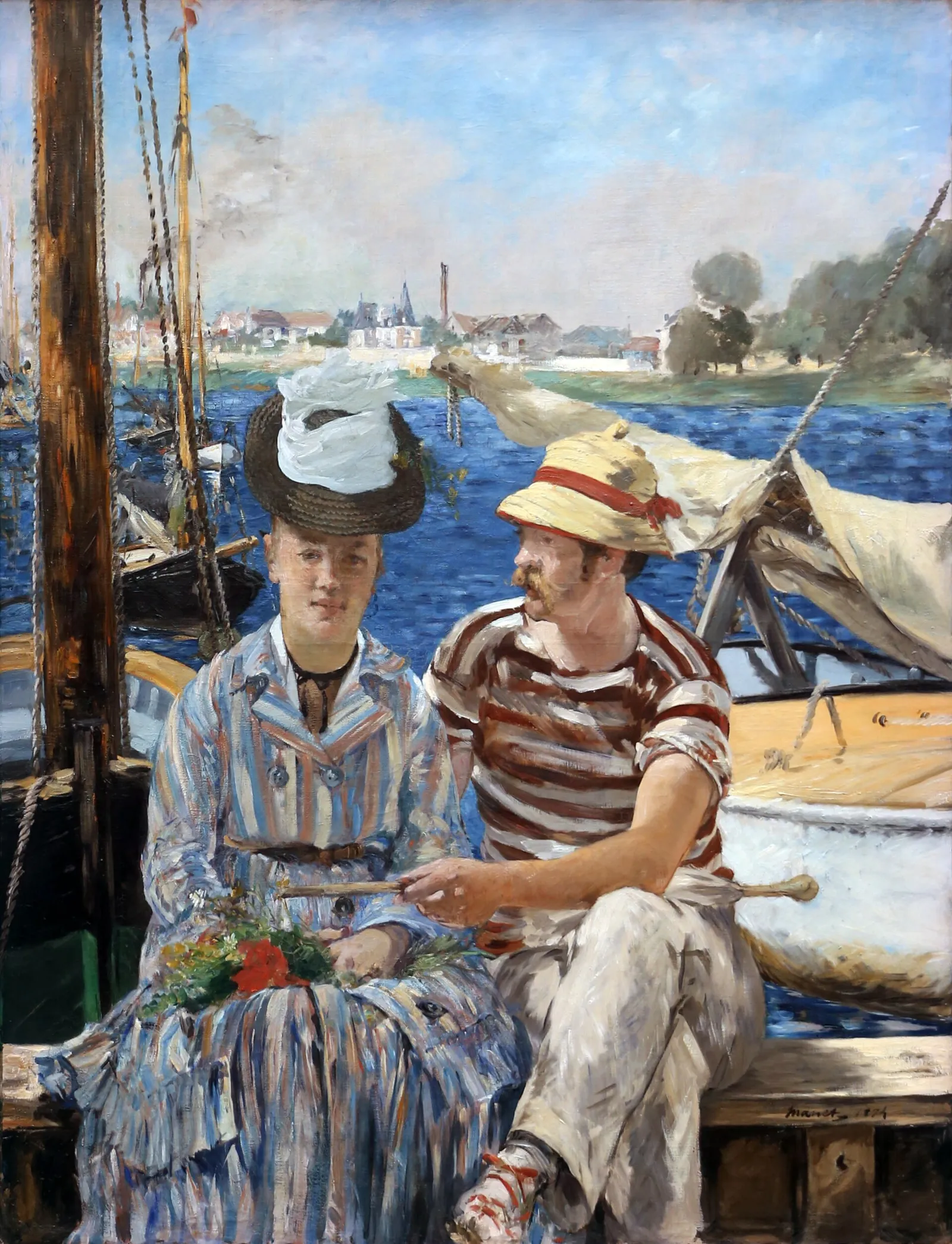
Édouard Manet's Argenteuil, painted in 1874, shows a man and a woman seated by the water with boats and a riverside town behind them. The painting is held by the Musée des Beaux-Arts de Tournai, where its large size and strong blues make it worth seeing in person.
Where to see it
Argenteuil is in the collection of the Musée des Beaux-Arts de Tournai, and the museum is also its recorded location. Displays can change because of rehanging, conservation or loans, so check the museum's official website for current display status, opening hours and ticket information before you travel.
What to look for in person
The blue of the river
Start with the water behind the figures. Manet painted the river as a broad, saturated blue that fills much of the upper canvas and pushes forward rather than receding into the distance. Critics who saw the picture in the 1870s singled out this colour as surprising. In front of the original, notice how the flat expanse of blue works almost like a backdrop, framing the two heads and making the figures stand out sharply against it.
Two figures, close up
The couple sits close to the picture surface, almost at life scale on a canvas measuring 148.5 by 114.5 cm. Look at the contrast between them: the man in a straw boater turned towards his companion, and the woman in a striped dress gazing out with a more reserved expression. Manet leaves their relationship open. Spend a moment on the faces and hands, where his handling becomes more careful than in the looser surrounding passages.
A lighter palette and open-air subject
In 1874 Manet spent time painting at Argenteuil, a boating spot on the Seine near Paris where Claude Monet lived. This picture reflects that contact: the palette is brighter and the subject is modern leisure in daylight. Step back to see the sails, masts and buildings on the far bank, painted in quick strokes. Then move closer to compare them with the firmer modelling of the figures, a mix typical of Manet's work in these years.
About the painting
Argenteuil dates from 1874, a period when Édouard Manet was in close contact with the younger painters who would soon be called Impressionists. That summer he worked at Argenteuil, a town on the Seine popular with Parisians for sailing and day trips, and where Claude Monet had settled. Manet painted there alongside Monet, and the experience is visible in the brighter colours and outdoor setting of this canvas.
Unlike Monet's landscapes of the same place, however, Manet kept people at the centre. Here a man and a woman sit at the edge of the water, with boats and the opposite bank arranged behind them. The composition is vertical and the figures are large, so the scene reads as much as a double portrait of modern leisure as a view of the river. Their clothes, the straw hat and the striped dress, mark them as fashionable contemporaries rather than idealised types.
Manet sent the painting to the official Paris Salon of 1875, choosing to show it in that setting rather than with the independent group exhibition. Its bold colour and direct treatment drew criticism, particularly the intense blue of the water, which some found unnatural. Today the same qualities are what make it distinctive: the picture shows Manet adopting aspects of open-air painting while keeping his own emphasis on figures, contrast and a strong, flattened design.
When visiting, allow time to view the painting from a distance to take in the overall arrangement, then close up to see how differently Manet treats faces, fabric and the busy background.
Key facts
| Artist | Édouard Manet |
|---|---|
| Date | 1874 |
| Size | 148.5 × 114.5 cm |
| Medium | oil paint, canvas |
| Collection | Musée des Beaux-Arts de Tournai |
How to visit: Musée des Beaux-Arts de Tournai
Tournai, Belgium
Hours and prices can change. Please check the official website before you go.
More by Édouard Manet
 A Bar at the Folies-Bergère — Courtauld Gallery
 Luncheon on the Grass — Musée d'Orsay
 Portrait of Stéphane Mallarmé — Musée d'Orsay
 A Bundle of Asparagus
 Music in the Tuileries — National Gallery
 Emile Zola — Musée d'Orsay
 The Fif — Musée d'Orsay
 Berthe Morisot with a Bouquet of Violets — Musée d'Orsay
 Nana
 Olympia — Musée d'Orsay
 The Balcony — Musée d'Orsay