Art! Art! Art! › Works
Emile Zola
 Édouard Manet, 1868
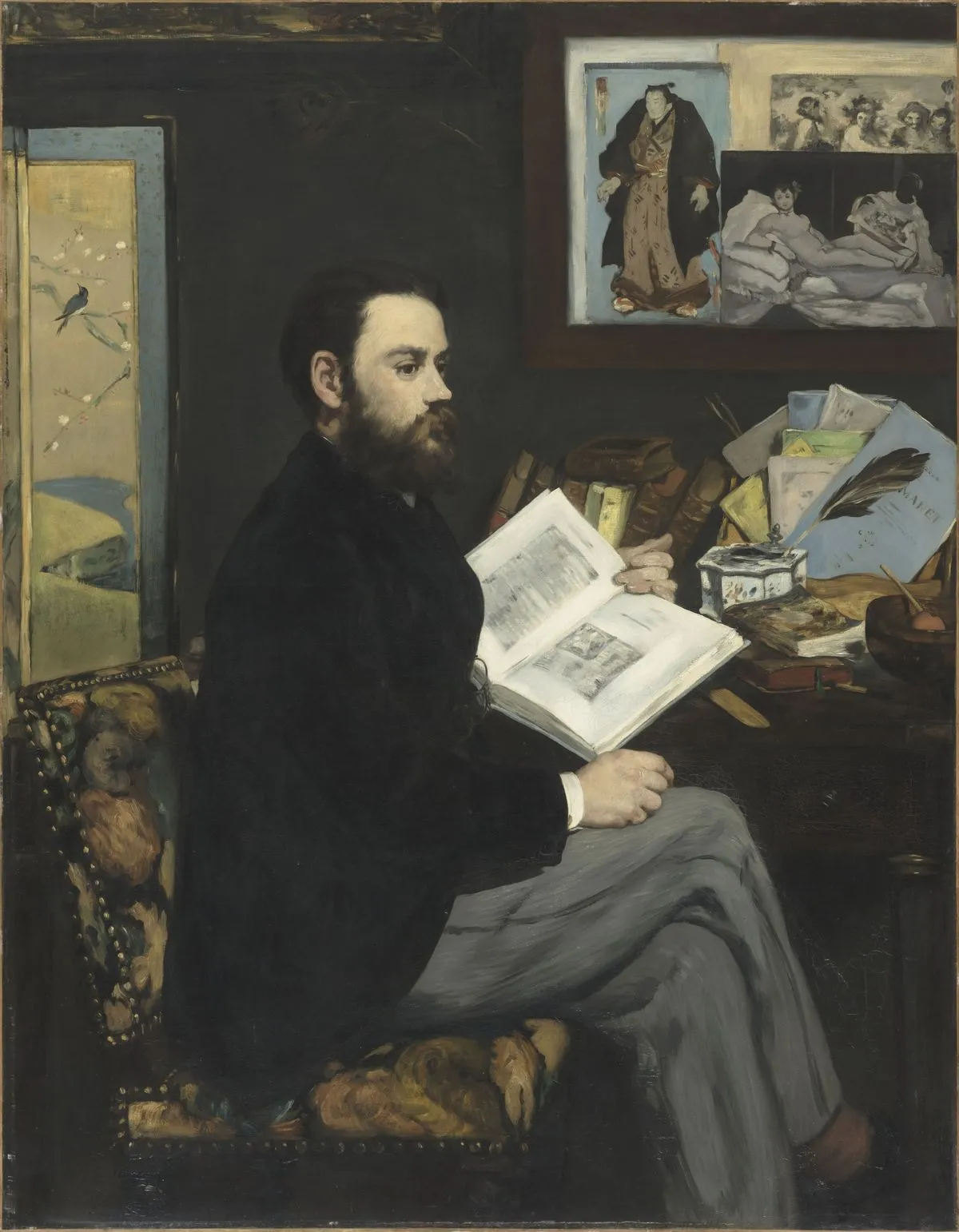
Édouard Manet's portrait of the writer Emile Zola, painted in 1868, belongs to the Musée d'Orsay. It shows Zola seated at a cluttered desk, surrounded by books, prints and objects that reveal the shared tastes of the painter and his sitter.
Where to see it
The painting is in the collection of the Musée d'Orsay, which is also its listed location. Display arrangements can change, and works are sometimes rotated, lent or temporarily removed, so check the Musée d'Orsay's official website for current display status before you visit. The canvas measures 146.5 cm high by 114 cm wide, a substantial size that makes the details on the desk and wall easy to study up close.
What to look for in person
The pictures on the wall
Look to the upper right, where a small frame holds several images pinned together. One is a reproduction of Manet's own Olympia, with the figure's head turned slightly. Beside it are a Japanese woodblock print of a wrestler and a print after a painting by Velázquez, an artist Manet admired deeply. Together they read like a compact statement of the influences that mattered to Manet in the 1860s: Spanish painting, Japanese prints and his own controversial modern work. Take a moment to compare how loosely these images are painted with the firmer handling of Zola's figure.
The desk and the pamphlet
On the desk, among the books, papers, quill and inkwell, notice the pale blue booklet with Manet's name on its cover. This is generally identified as the pamphlet Zola published in defence of Manet's art, and the name on it also works as the painter's signature. It is a quiet acknowledgement of the friendship and the critical support behind the portrait. Look at how Manet paints the stacked volumes and loose sheets with quick, confident strokes, giving the corner the feel of a working writer's study rather than a staged setting.
The Japanese screen and the sitter's pose
At the left edge, a folding screen decorated with birds and plants closes off the space. Its flat, decorative surface reflects the enthusiasm for Japanese art shared by many Parisian artists and writers at the time. Zola himself sits in profile, holding an open book, his gaze directed past it rather than at the viewer. Many observers have noted that he seems detached, almost absorbed in thought. Notice how the dark tones of his jacket stand out against the lighter background, and how the composition keeps him slightly apart from the objects around him.
About the painting
Manet painted this portrait in 1868, at a time when his work was regularly attacked by critics and the public. Emile Zola, then a young journalist and novelist, was among his most outspoken defenders. In his writings of the late 1860s he argued that Manet should be judged on his own terms, as a painter who looked honestly at modern life rather than following academic conventions. The portrait can be seen as Manet's response to that support. It was shown at the Paris Salon of 1868.
Rather than flattering his sitter with grand symbolism, Manet places Zola in an ordinary interior and lets the objects speak. The prints on the wall and the Japanese screen point to tastes the two men shared, and the pamphlet on the desk refers directly to Zola's writing about the artist. In that sense the painting is as much about Manet's own artistic loyalties as it is about the writer.
For visitors, the work rewards slow looking. At 146.5 by 114 cm, it is large enough to show the range of Manet's handling, from the crisp outline of Zola's profile to the looser brushwork of the books and papers. Consider how the flat areas of colour and the shallow space owe something to Japanese prints, while the dark, restrained palette recalls the Spanish painting Manet studied. Standing in front of it, try reading the picture from left to right: screen, sitter, desk, then wall, as a sequence of clues about two figures at the centre of debates over modern art in 1860s Paris.
Key facts
| Artist | Édouard Manet |
|---|---|
| Date | 1868 |
| Size | 146.5 × 114 cm |
| Medium | oil paint, canvas |
| Collection | Musée d'Orsay |
How to visit: Musée d'Orsay
Paris, France · Museum guide
| Opening hours | Tue–Wed, Fri–Sun 09:30–18:00 (galleries close at 17:30) Thu 09:30–21:45 (late opening; galleries close at 21:15) |
|---|---|
| Closed | Every Monday, 1 May and 25 December. |
| Last entry | 17:00 (exhibitions 17:15); Thursdays 21:00 |
| Admission | Full rate, online EUR 16 Full rate, at the museum EUR 14 Reduced rate (on site only) EUR 11 Enfant & Cie, online EUR 13 Enfant & Cie, at the museum EUR 11 Night rate (Thursday), online EUR 12 Night rate (Thursday), at the museum EUR 10 Under 18s; EEA residents under 26 free |
| Free entry | Free for under 18s and residents of the European Economic Area under 26. Free on the first Sunday of the month, with booking required. |
| Booking | Booking is strongly recommended. Entry is by timed slot. |
The museum stays open and all collections and exhibitions remain accessible, but entrances have changed: timed-ticket holders use Entrance 1 (Quay); priority visitors, reseller voucher holders, visitors without tickets and groups use Entrance 2 (Forecourt). Arrive at least 15 minutes before your time slot.
Official ticket page
Official website
View on map
Hours and prices can change. Please check the official website before you go. (Checked on: 2026-11-11)
More by Édouard Manet
 A Bar at the Folies-Bergère — Courtauld Gallery
 Luncheon on the Grass — Musée d'Orsay
 Portrait of Stéphane Mallarmé — Musée d'Orsay
 A Bundle of Asparagus
 Music in the Tuileries — National Gallery
 The Fif — Musée d'Orsay
 Argenteuil
 Berthe Morisot with a Bouquet of Violets — Musée d'Orsay
 Nana
 Olympia — Musée d'Orsay
 The Balcony — Musée d'Orsay