Art! Art! Art! › Works
Berthe Morisot with a Bouquet of Violets
 Édouard Manet, 1872
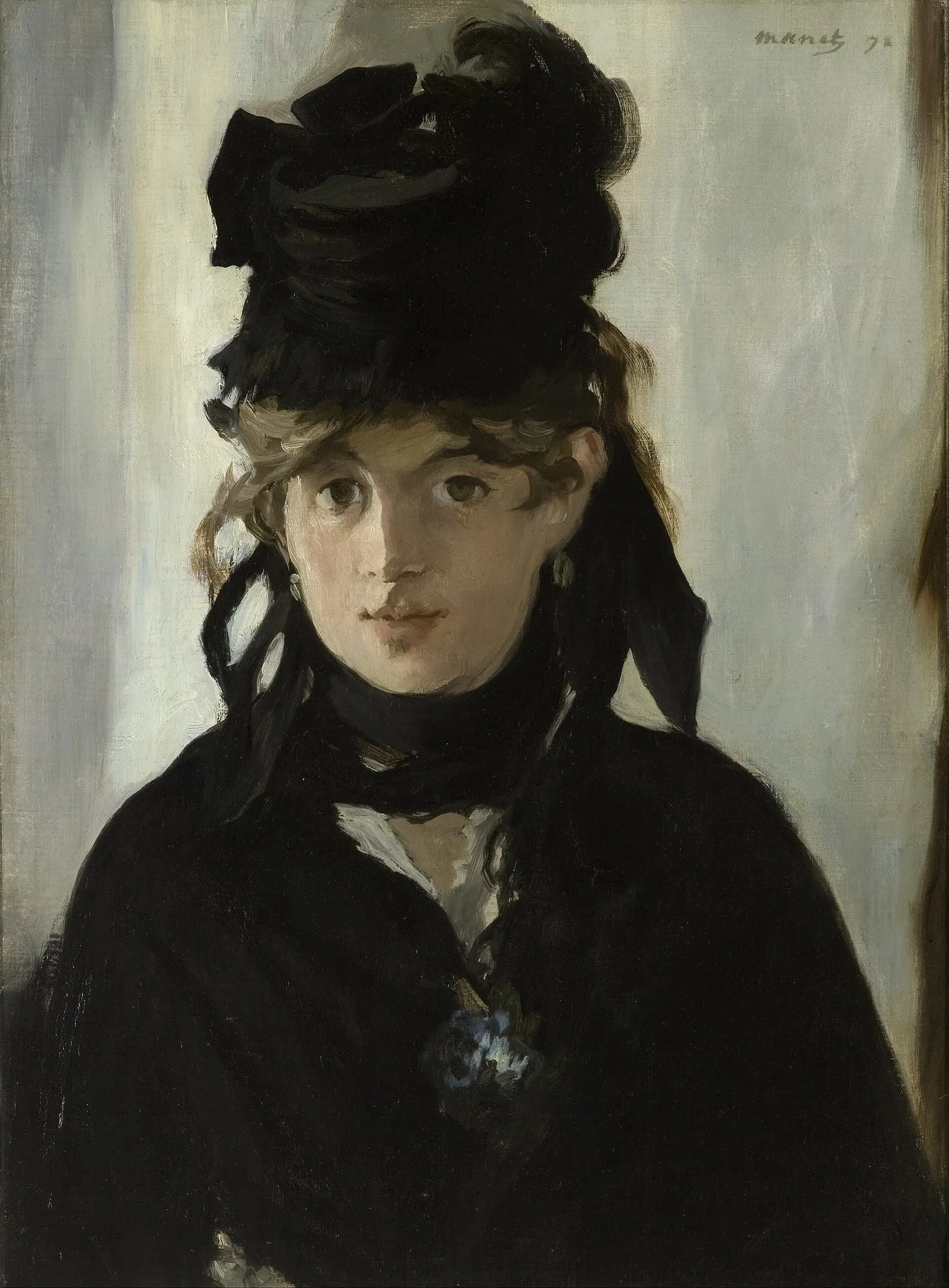
Édouard Manet painted Berthe Morisot with a Bouquet of Violets in 1872, a close, direct portrait of a fellow painter dressed almost entirely in black. The work belongs to the Musée d'Orsay. In front of it, the pleasure lies in how much Manet achieves with a restricted palette and quick, confident brushwork.
Where to see it
Berthe Morisot with a Bouquet of Violets is held in the collection of the Musée d'Orsay, and the fact sheet gives its location as the Musée d'Orsay. Museums rotate works, lend them to exhibitions and occasionally close rooms, so check the Musée d'Orsay's official website for the painting's current display status, as well as opening hours and ticketing, before you plan your visit.
What to look for in person
Black as a colour
Start by noticing how much of the picture is black: the hat, the dress, the ribbons around the throat. Manet admired Spanish painting and treated black as a full colour rather than simply as shadow. Step a little closer and you will see that the blacks are not flat. Some passages read warmer, others cooler, and fast strokes describe the folds of fabric and the curve of the hat brim. Against this dark mass, the pale, side-lit face stands out sharply, which is the central contrast the whole portrait is built on.
The face and the gaze
Spend time with the face. Manet models it with relatively few strokes and a strong division of light and shadow, so part of it falls into darkness while the rest is brightly lit. The eyes look very dark and meet the viewer directly, giving the portrait its immediacy. Notice, too, the loose strands of hair escaping from under the hat, painted with a light, quick touch. The expression is difficult to name with certainty: alert, self-possessed, perhaps faintly amused. That ambiguity is part of why visitors tend to linger in front of it.
Finding the violets
Despite the title, the violets are easy to overlook. Look near the opening of her clothing at the chest, where a small bouquet is tucked in, rendered so darkly that it nearly merges with the black of the dress. It is a quiet detail rather than a showpiece. Then step back and consider the background: a pale, neutral, lightly brushed field with no setting or props. This plain ground isolates the figure and lets the contrast of black costume and lit face carry the composition.
About the painting
Berthe Morisot was herself a painter, and she became one of the artists associated with the Impressionist exhibitions in Paris. She came to know Édouard Manet in the late 1860s, and over the following years he painted her a number of times, making her one of his most frequent sitters. This portrait, dated 1872, comes from that period of close artistic contact between the two. In 1874 Morisot married Manet's brother, Eugène Manet, which brought her into the painter's family. Seen in that context, the portrait is not a commissioned likeness of a patron but an image of a colleague, painted by someone who knew her well. The picture shows several qualities often associated with Manet's work: a bold reliance on black, a direct and unidealised treatment of the sitter, and brushwork that remains visible rather than smoothed away. The composition is simple, a half-length figure against a plain ground, yet the strong lighting and the sitter's steady gaze give it a sense of presence. Many viewers find that the painting feels spontaneous, as if captured quickly, although that impression is the result of considered choices about what to finish and what to leave suggested. When you visit, it is worth viewing the work twice: once from a distance, where the bold pattern of black and light reads clearly, and once up close, where you can follow the individual strokes of the hat, ribbons and hair. Because works at major museums can be moved or lent, confirm on the Musée d'Orsay's official website that it is on view before you go.
Key facts
| Artist | Édouard Manet |
|---|---|
| Date | 1872 |
| Size | 0.555 × 0.405 cm |
| Medium | oil paint, canvas |
| Collection | Musée d'Orsay |
How to visit: Musée d'Orsay
Paris, France · Museum guide
| Opening hours | Tue–Wed, Fri–Sun 09:30–18:00 (galleries close at 17:30) Thu 09:30–21:45 (late opening; galleries close at 21:15) |
|---|---|
| Closed | Every Monday, 1 May and 25 December. |
| Last entry | 17:00 (exhibitions 17:15); Thursdays 21:00 |
| Admission | Full rate, online EUR 16 Full rate, at the museum EUR 14 Reduced rate (on site only) EUR 11 Enfant & Cie, online EUR 13 Enfant & Cie, at the museum EUR 11 Night rate (Thursday), online EUR 12 Night rate (Thursday), at the museum EUR 10 Under 18s; EEA residents under 26 free |
| Free entry | Free for under 18s and residents of the European Economic Area under 26. Free on the first Sunday of the month, with booking required. |
| Booking | Booking is strongly recommended. Entry is by timed slot. |
The museum stays open and all collections and exhibitions remain accessible, but entrances have changed: timed-ticket holders use Entrance 1 (Quay); priority visitors, reseller voucher holders, visitors without tickets and groups use Entrance 2 (Forecourt). Arrive at least 15 minutes before your time slot.
Official ticket page
Official website
View on map
Hours and prices can change. Please check the official website before you go. (Checked on: 2026-11-11)
More by Édouard Manet
 A Bar at the Folies-Bergère — Courtauld Gallery
 Luncheon on the Grass — Musée d'Orsay
 Portrait of Stéphane Mallarmé — Musée d'Orsay
 A Bundle of Asparagus
 Music in the Tuileries — National Gallery
 Emile Zola — Musée d'Orsay
 The Fif — Musée d'Orsay
 Argenteuil
 Nana
 Olympia — Musée d'Orsay
 The Balcony — Musée d'Orsay