Art! Art! Art! › Works
The Balcony
 Édouard Manet, 1868
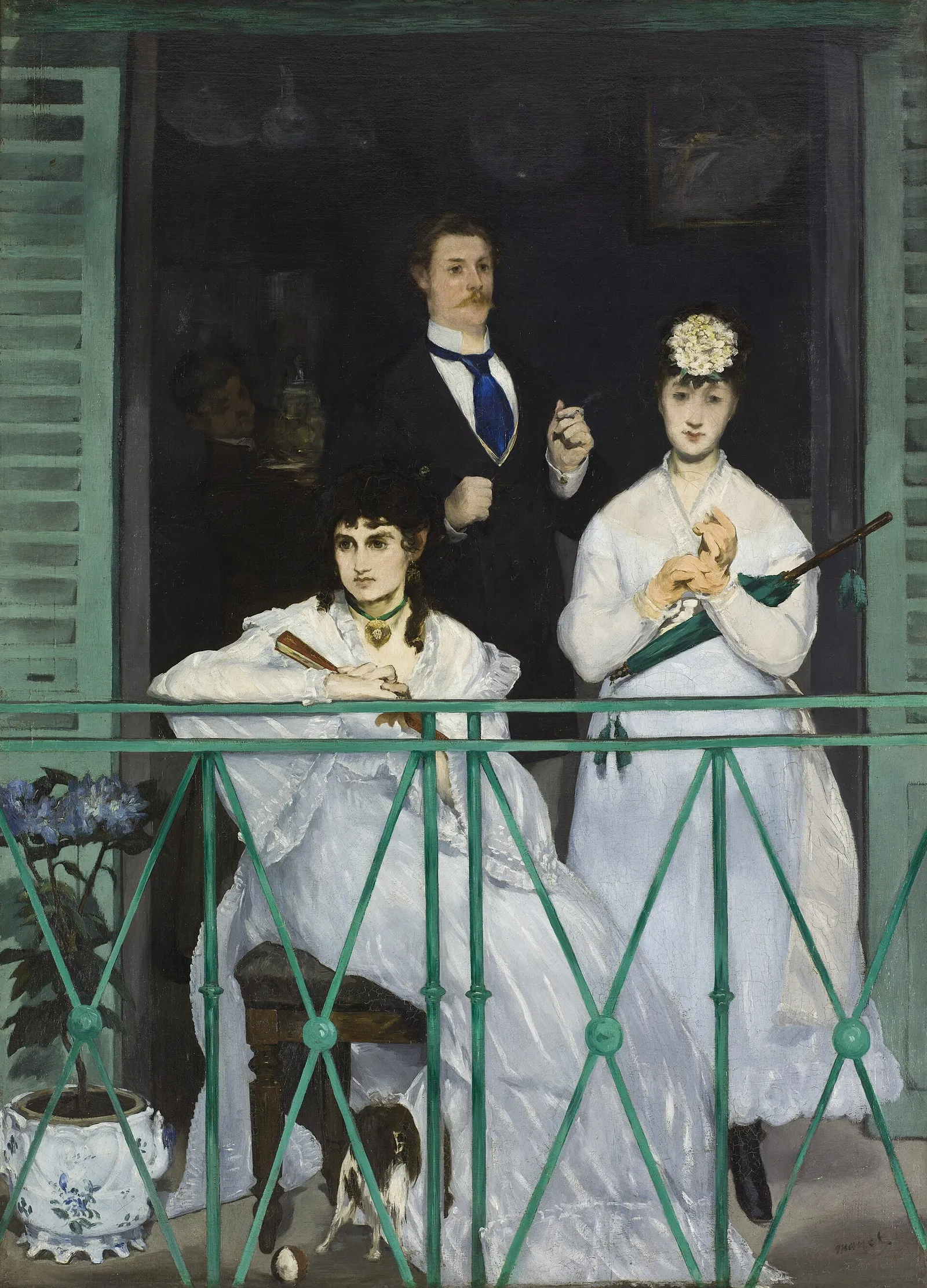
Édouard Manet's The Balcony, dated 1868, shows three fashionably dressed figures gathered at a green railing, framed by open shutters and a dark room behind them. The canvas is held by the Musée d'Orsay, and at 170 × 124.5 cm its figures appear close to life-size, as if they were standing just above you.
Where to see it
The Balcony is in the collection of the Musée d'Orsay, which is also its listed location. Works in museum collections are sometimes moved between galleries, lent to other institutions or taken off view for conservation, so check the Musée d'Orsay's official website for the painting's current display status before you plan your visit.
What to look for in person
The insistent green
Start with the colour that first meets the eye: the bright green of the railing and shutters. Manet lays it down in flat, unmodulated bands that cut across the picture and press the figures toward the front edge of the canvas. Notice how the green frames the women's white dresses and makes them read as pale, almost luminous shapes. Step back and the railing works like a stage barrier, separating your space from theirs while putting the figures on display.
Figures side by side, yet apart
Look at where each person is looking. The seated woman on the left, the painter Berthe Morisot, gazes off to one side with a dark, intense expression. The standing woman, usually identified as the violinist Fanny Claus, looks in another direction, and the man behind them, the painter Antoine Guillemet, faces yet another way. No one speaks to anyone else. Many viewers find this lack of contact the most modern thing about the picture: a group portrait of people sharing a space without sharing a moment.
The darkness behind
Let your eyes adjust to the shadowy interior behind the balcony. It is easy to miss on first glance, but a further figure can be made out in the gloom, generally identified as Léon Leenhoff, a young man in Manet's household, carrying a jug or pitcher. The contrast between the brilliant foreground and this murky room is central to the painting's effect. Look, too, at the accessories that Manet picks out with quick, confident strokes: the fan, the gloves, the parasol, and the small dog near the seated woman's feet.
About the painting
The Balcony belongs to the period in the late 1860s when Édouard Manet was reworking older traditions of painting into scenes of contemporary Parisian life. The composition is widely understood to respond to Francisco de Goya's Majas on a Balcony, a theme of figures seen at a balcony railing that Manet would have known from his interest in Spanish art. Rather than Goya's sense of intrigue, however, Manet offers well-dressed acquaintances posed with a cool, detached reserve.
The sitters were people from Manet's own circle. Berthe Morisot, seated at the left, was a painter who would become one of the central figures of Impressionism; this is the first of several portraits Manet made of her. Fanny Claus, a violinist, stands beside her, and the painter Antoine Guillemet stands behind. Their individuality is clear, yet Manet treats them with the same directness he gives to the railing and the shutters, which is part of what made the picture feel unsettling to its first audiences.
When the painting was shown at the Paris Salon, critics responded with puzzlement and some ridicule, focusing in particular on the harsh green and on the figures' apparent indifference to one another. Today those same qualities are often seen as signs of Manet's independence: his flattened colour, his refusal to tell a story, and his interest in how modern people present themselves in public. In front of the canvas, it rewards slow looking, moving between the bright foreground and the barely visible room behind.
Key facts
| Artist | Édouard Manet |
|---|---|
| Date | 1868 |
| Size | 170 × 124.5 cm |
| Medium | oil paint, canvas |
| Collection | Musée d'Orsay |
How to visit: Musée d'Orsay
Paris, France · Museum guide
| Opening hours | Tue–Wed, Fri–Sun 09:30–18:00 (galleries close at 17:30) Thu 09:30–21:45 (late opening; galleries close at 21:15) |
|---|---|
| Closed | Every Monday, 1 May and 25 December. |
| Last entry | 17:00 (exhibitions 17:15); Thursdays 21:00 |
| Admission | Full rate, online EUR 16 Full rate, at the museum EUR 14 Reduced rate (on site only) EUR 11 Enfant & Cie, online EUR 13 Enfant & Cie, at the museum EUR 11 Night rate (Thursday), online EUR 12 Night rate (Thursday), at the museum EUR 10 Under 18s; EEA residents under 26 free |
| Free entry | Free for under 18s and residents of the European Economic Area under 26. Free on the first Sunday of the month, with booking required. |
| Booking | Booking is strongly recommended. Entry is by timed slot. |
The museum stays open and all collections and exhibitions remain accessible, but entrances have changed: timed-ticket holders use Entrance 1 (Quay); priority visitors, reseller voucher holders, visitors without tickets and groups use Entrance 2 (Forecourt). Arrive at least 15 minutes before your time slot.
Official ticket page
Official website
View on map
Hours and prices can change. Please check the official website before you go. (Checked on: 2026-11-11)
More by Édouard Manet
 A Bar at the Folies-Bergère — Courtauld Gallery
 Luncheon on the Grass — Musée d'Orsay
 Portrait of Stéphane Mallarmé — Musée d'Orsay
 A Bundle of Asparagus
 Music in the Tuileries — National Gallery
 Emile Zola — Musée d'Orsay
 The Fif — Musée d'Orsay
 Argenteuil
 Berthe Morisot with a Bouquet of Violets — Musée d'Orsay
 Nana
 Olympia — Musée d'Orsay