Art! Art! Art! › Works
A Bundle of Asparagus
 Édouard Manet, 1880
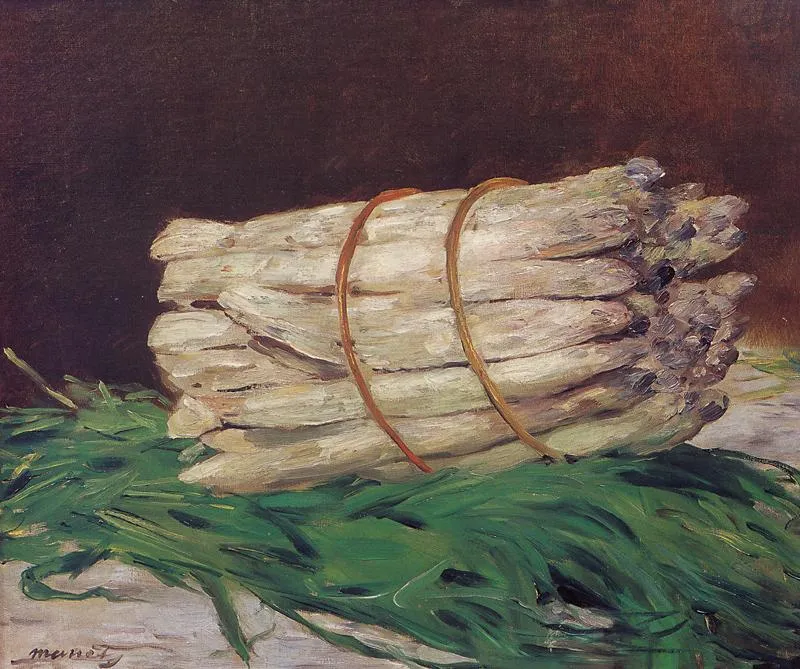
Édouard Manet painted A Bundle of Asparagus in 1880, turning a few stalks of white asparagus into a study of colour and brushwork. The oil on canvas, 46 by 55 cm, belongs to the Wallraf–Richartz Museum in Cologne.
Where to see it
A Bundle of Asparagus is in the collection of the Wallraf–Richartz Museum in Cologne, Germany. Works may be moved, lent or temporarily taken off view, so check the museum's official website for current display status before you plan your visit.
What to look for in person
The bundle up close
Stand close and follow the stalks one by one. The asparagus is white with violet tips, held together by two thin willow rods and resting on a bed of green leaves. Manet worked these forms with a narrow brush and blended his colours on the canvas itself rather than premixing them on the palette. Up close, you can see pale tones, violets and greens meeting within single strokes, which gives the stalks their soft, rounded look without any fussy detail.
A dark ground, painted around the subject
Step back and look at the dark background. Manet laid in the brown thinly, using a flat brush over a canvas primed in grey, and he left the area of the asparagus unpainted while doing so. This was confirmed when museum staff studied the painting in transmitted light in 2008. Compare the broad, even strokes of the backdrop with the finer, more varied handling of the vegetables: the contrast helps the bundle stand out against the darkness. Also look for the signature, 'Manet', in the lower left corner.
The missing spear
This picture has a small companion elsewhere. The collector Charles Ephrussi commissioned the painting for 800 francs but paid Manet 1,000. Manet answered by painting a smaller canvas showing a single asparagus spear and sending it to Ephrussi with a note saying one had slipped out of his bundle. That little painting is now in the Musée d'Orsay in Paris. Keeping the story in mind while you look at the Cologne canvas adds a touch of the painter's humour to a quiet still life.
About the painting
A Bundle of Asparagus dates from 1880, late in Manet's career, and it shows how much he could draw from a very simple kitchen subject. The painting was made for Charles Ephrussi, a Paris art collector, whose generous overpayment led to Manet's playful follow-up picture of a single spear, now at the Musée d'Orsay. Ephrussi was clearly proud of the work. He lent it to the Manet memorial exhibition at the École des Beaux-Arts in 1884, to the Paris World's Fair of 1889 and to the Exposition Centennale in Paris in 1900. The painting then moved to Germany. The dealer Paul Cassirer showed it in May 1903 at the seventh exhibition of the Berlin Secession, and on 6 April 1907 the painter Max Liebermann bought it from him. It stayed with the Liebermann family until 1967 and later entered the setting of the Wallraf–Richartz Museum in Cologne. Technical study has added to our understanding of how Manet worked. In 2008, while preparing an exhibition on Impressionism, the museum's staff examined the canvas in transmitted light and under the microscope. They found that the grey-primed canvas received a thin brown background applied with a flat brush, with the space for the asparagus held in reserve. The vegetables themselves were painted with a narrow brush, the colours combined directly on the surface. For visitors, these findings explain what the eye already senses in front of the picture: a quick, confident painting in which the brushstrokes remain visible and the subject seems to emerge from the dark.
Key facts
| Artist | Édouard Manet |
|---|---|
| Date | 1880 |
| Size | 46 × 55 cm |
| Medium | oil paint, canvas |
| Collection | Wallraf–Richartz Museum |
How to visit: Wallraf–Richartz Museum
Cologne, Germany
Hours and prices can change. Please check the official website before you go.
More by Édouard Manet
 A Bar at the Folies-Bergère — Courtauld Gallery
 Luncheon on the Grass — Musée d'Orsay
 Portrait of Stéphane Mallarmé — Musée d'Orsay
 Music in the Tuileries — National Gallery
 Emile Zola — Musée d'Orsay
 The Fif — Musée d'Orsay
 Argenteuil
 Berthe Morisot with a Bouquet of Violets — Musée d'Orsay
 Nana
 Olympia — Musée d'Orsay
 The Balcony — Musée d'Orsay
Sources
- Wikidata Q18223037
- Wikipedia (en) (CC BY-SA 4.0)
- Wikipedia (it) (CC BY-SA 4.0)
- Wikipedia (fr) (CC BY-SA 4.0)
- Wikipedia (de) (CC BY-SA 4.0)