Art! Art! Art! › Works
Olympia
 Édouard Manet, 1863
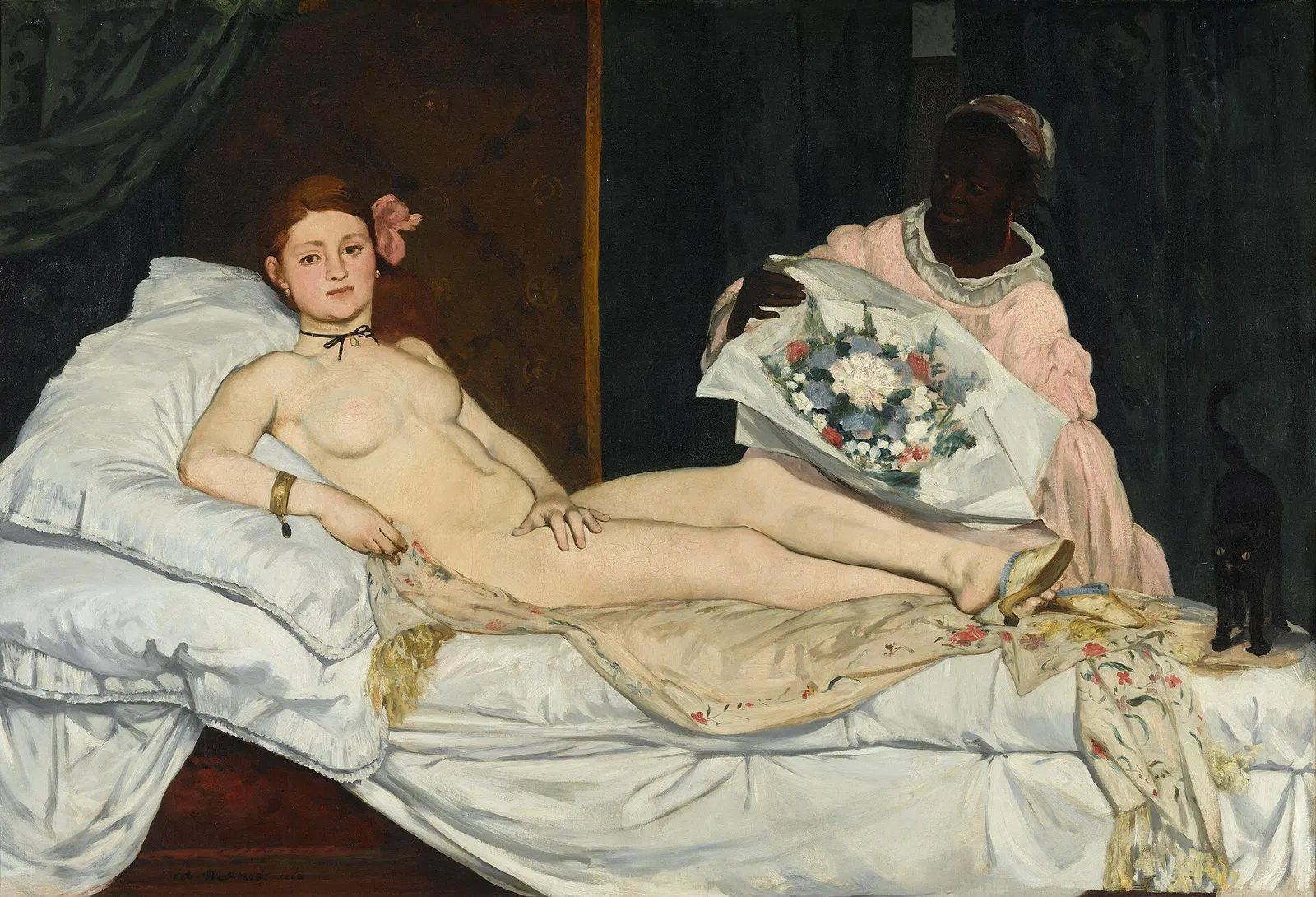
Édouard Manet's Olympia, dated 1863, is held by the Musée d'Orsay. It shows a reclining nude who looks straight at the viewer. The painting is at once a reworking of an old-master subject and a sharply modern image.
Where to see it
Olympia is in the collection of the Musée d'Orsay, which is also its listed location. Displays can change because of rehangs, conservation work or loans. Check the Musée d'Orsay's official website for current display status, opening hours and ticketing before you visit. The canvas measures 130.5 × 191 cm, so it is a large picture that rewards both a distant view and a closer look.
What to look for in person
The direct gaze
Start with her face. The woman on the bed looks straight out of the picture, calm and composed, with no hint of shyness. Her left hand rests firmly across her thigh. The pose recalls Titian's Venus of Urbino, a model Manet clearly had in mind. Titian's figure is soft and inviting. Olympia is alert and self-possessed, and she seems to meet whoever stands before her. Take a few steps back and notice how her gaze holds the room. That frank exchange between figure and viewer is central to why the painting still feels confrontational.
Hard light and flattened form
Look at how the body is lit. Manet uses strong, frontal light that flattens the figure. There is very little of the gradual shading that academic painters used to make flesh look rounded. The pale body is set against a dark background and framed by crisp white sheets and pillows. Contemporary critics found this treatment harsh and unfinished. Up close, look at the firm contour around the body and the broad, economical brushwork in the linens and the embroidered shawl beneath her. Then compare how solid the figure feels with how close to the surface she seems to sit.
The attendant, the cat and small details
Next, turn to the right side of the canvas. A Black attendant brings a large bouquet wrapped in paper, probably a gift from an admirer. At the foot of the bed, a black cat arches its back. It takes the place of the sleeping dog in Titian's picture, often read as a symbol of fidelity. Then look at the smaller accessories: the flower in Olympia's hair, the thin black ribbon at her neck, her bracelet and the slipper hanging from one foot. Together these details present her as a contemporary courtesan rather than a mythological goddess.
About the painting
Olympia is dated 1863 and measures 130.5 × 191 cm. It is held by the Musée d'Orsay. Édouard Manet took up one of the most established subjects in European art, the reclining female nude, and stripped it of its usual excuses. There is no goddess, no myth and no distant setting. The model, generally identified as Victorine Meurent, who also posed for other works by Manet, is presented as a woman of the artist's own time, widely understood to be a courtesan. The title, the bouquet, the jewellery and the knowing gaze all support that reading.
When the painting was shown at the Paris Salon, it provoked a strong public and critical backlash. Viewers objected to its subject, which many found indecent. They also objected to its style: the flat lighting, the firm outlines and the apparent lack of finish broke with academic conventions. That double challenge, to both subject matter and technique, is why Olympia is so often discussed as a key work in the move toward modern painting.
In recent decades, scholars and exhibitions have paid closer attention to the attendant, who was long overlooked in discussions of the picture. She raises questions about race and representation in nineteenth-century art. When you visit, give yourself time to look at both figures, not only the nude.
A practical tip: the canvas is wide, so begin a few metres back to take in the whole composition, the diagonal of the reclining body and the dark right-hand side. Then move closer to study the brushwork in the sheets, the bouquet and the cat.
Key facts
| Artist | Édouard Manet |
|---|---|
| Date | 1863 |
| Size | 130.5 × 191 cm |
| Medium | oil paint, canvas |
| Collection | Musée d'Orsay |
How to visit: Musée d'Orsay
Paris, France · Museum guide
| Opening hours | Tue–Wed, Fri–Sun 09:30–18:00 (galleries close at 17:30) Thu 09:30–21:45 (late opening; galleries close at 21:15) |
|---|---|
| Closed | Every Monday, 1 May and 25 December. |
| Last entry | 17:00 (exhibitions 17:15); Thursdays 21:00 |
| Admission | Full rate, online EUR 16 Full rate, at the museum EUR 14 Reduced rate (on site only) EUR 11 Enfant & Cie, online EUR 13 Enfant & Cie, at the museum EUR 11 Night rate (Thursday), online EUR 12 Night rate (Thursday), at the museum EUR 10 Under 18s; EEA residents under 26 free |
| Free entry | Free for under 18s and residents of the European Economic Area under 26. Free on the first Sunday of the month, with booking required. |
| Booking | Booking is strongly recommended. Entry is by timed slot. |
The museum stays open and all collections and exhibitions remain accessible, but entrances have changed: timed-ticket holders use Entrance 1 (Quay); priority visitors, reseller voucher holders, visitors without tickets and groups use Entrance 2 (Forecourt). Arrive at least 15 minutes before your time slot.
Official ticket page
Official website
View on map
Hours and prices can change. Please check the official website before you go. (Checked on: 2026-11-11)
More by Édouard Manet
 A Bar at the Folies-Bergère — Courtauld Gallery
 Luncheon on the Grass — Musée d'Orsay
 Portrait of Stéphane Mallarmé — Musée d'Orsay
 A Bundle of Asparagus
 Music in the Tuileries — National Gallery
 Emile Zola — Musée d'Orsay
 The Fif — Musée d'Orsay
 Argenteuil
 Berthe Morisot with a Bouquet of Violets — Musée d'Orsay
 Nana
 The Balcony — Musée d'Orsay