Art! Art! Art! › Works
The Dream of a Knight
 Raphael, 1504
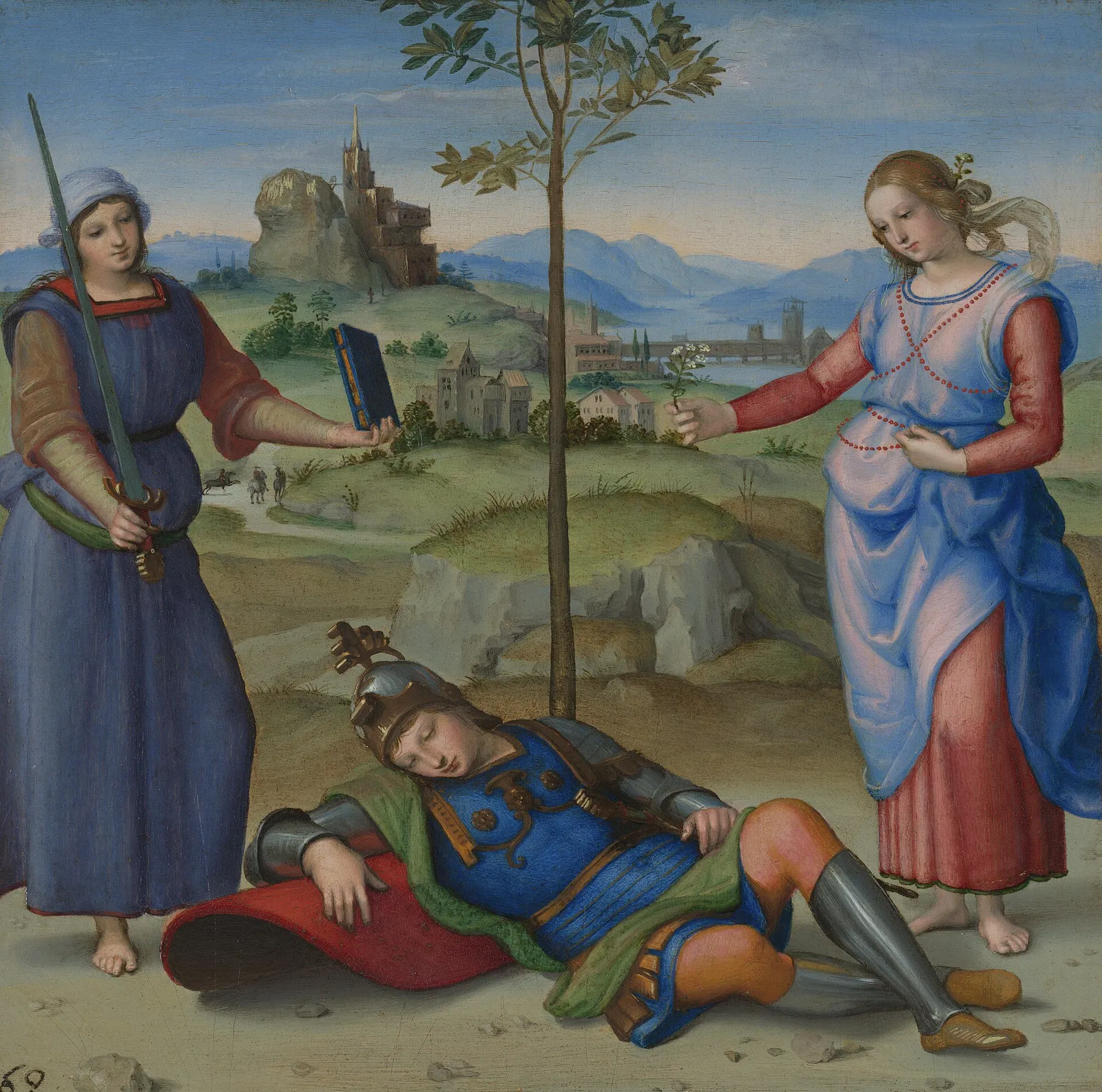
The Dream of a Knight is a small painting by Raphael dated to 1504 and held by the National Gallery. Barely larger than a hand-span, it shows a young knight asleep between two women who seem to offer him different paths in life. It rewards close, unhurried looking.
Where to see it
The Dream of a Knight is in the collection of the National Gallery, and the fact sheet gives its location as the National Gallery. Display arrangements can change, so check the National Gallery's official website for current display status before you visit. The painting measures only about 17.1 cm high by 17.3 cm wide, so plan to stand close to take in its detail.
What to look for in person
The sleeping knight and the tree
At the centre, a young man in armour sleeps with his head resting on his shield, stretched out beneath a slender tree. The tree's thin trunk divides the picture into two halves, and much of the meaning depends on that division. Notice how relaxed his pose is compared with the upright figures on either side: he is not acting but dreaming. In a panel roughly seventeen centimetres across, the horizontal body and the vertical tree give the composition a clear, steady structure.
Two women, two offers
On the left stands a woman in sober dress holding a book and a sword. On the right, a woman in softer, more decorative clothing holds out a sprig of flowers. They are commonly read as personifications of contrasting ways of life: learning, duty and arms on one side, pleasure or love on the other. Compare their clothing, hair and gestures closely. Raphael conveys the contrast through small details rather than drama, and both figures lean gently toward the sleeper, keeping the scene calm and balanced.
A landscape that echoes the choice
Look past the figures to the background. Behind the woman with the book, the ground rises steeply toward a rocky height crowned by a building; behind the woman with the flowers, the land opens into gentler, softer terrain. The landscape repeats the idea of two different paths. Because the painting is so small, step in close: the distant hills, delicate trees and clear sky are painted with the fine, quiet precision associated with Raphael's early work, when his style was close to that of his teacher Perugino.
About the painting
Raphael painted The Dream of a Knight early in his career; the National Gallery's record dates it to 1504, when the artist was around twenty-one. At this stage he was still working in the gentle, clear manner he had absorbed from Perugino in Umbria, before the larger ambitions of his years in Florence and Rome. The picture's small size, about 17.1 by 17.3 centimetres, suggests a work made for private contemplation rather than public display, something to be held or viewed at close range. Its subject is often interpreted as a moral allegory of choice. The young knight, asleep between two female figures, appears to be presented with alternatives: on one side the book and sword, suggesting study and military or civic duty; on the other the flowers, suggesting pleasure or love. Many scholars have connected the scene with the story of the Roman general Scipio, who in a classical text dreams of being offered a choice between Virtue and Pleasure, and the painting is sometimes called by titles that reflect this reading. Not every detail of the interpretation is settled, and viewers may find that the painting avoids declaring a clear winner. Both women are shown with dignity, and the composition is carefully balanced. For visitors, the main pleasure lies in the precision of the small scale: the clarity of the figures, the symmetry of the design and the way the landscape quietly echoes the meaning of the scene. Give yourself time with it, as its effect builds with close attention.
Key facts
| Artist | Raphael |
|---|---|
| Date | 1504 |
| Size | 17.1 × 17.3 cm |
| Medium | oil paint, poplar panel |
| Collection | National Gallery |
How to visit: National Gallery
London, United Kingdom · Museum guide
| Opening hours | Mon–Thu, Sat, Sun 10:00–18:00 Fri 10:00–21:00 (Friday late) |
|---|---|
| Closed | 24–26 December and 1 January. |
| Admission | General admission (collection) free; donations invited Some exhibitions are charged (e.g. Renoir and Love, until 31 Jan 2027) |
| Free entry | General admission is always free. |
| Booking | No reservation or timed entry is required. Free timed booking gives fast-track entry. |
Building work and improvements are under way: some rooms are closed and some paintings have moved, so check the floorplans or collection search before visiting. A new Research Centre is due to open in 2028. On 17 November only, some east wing rooms and the Espresso Bar close from 16:00.
Official ticket page
Official website
View on map
Hours and prices can change. Please check the official website before you go. (Checked on: 2026-11-11)
More by Raphael
 Madonna of the Pinks — National Gallery
 La fornarina
 The Marriage of the Virgin
 Saint Catherine of Alexandria — National Gallery
 Transfiguration
 Madonna of the Goldfinch — Uffizi Gallery
 Madonna del Prato — Kunsthistorisches Museum
 The Deposition — Galleria Borghese
 Alba Madonna — National Gallery of Art
 Portrait of Leo X
 Christ Falling on the Way to Calvary — Museo del Prado
 Ansidei Madonna — National Gallery