Art! Art! Art! › Works
The Descent from the Cross
 Rembrandt, 1633
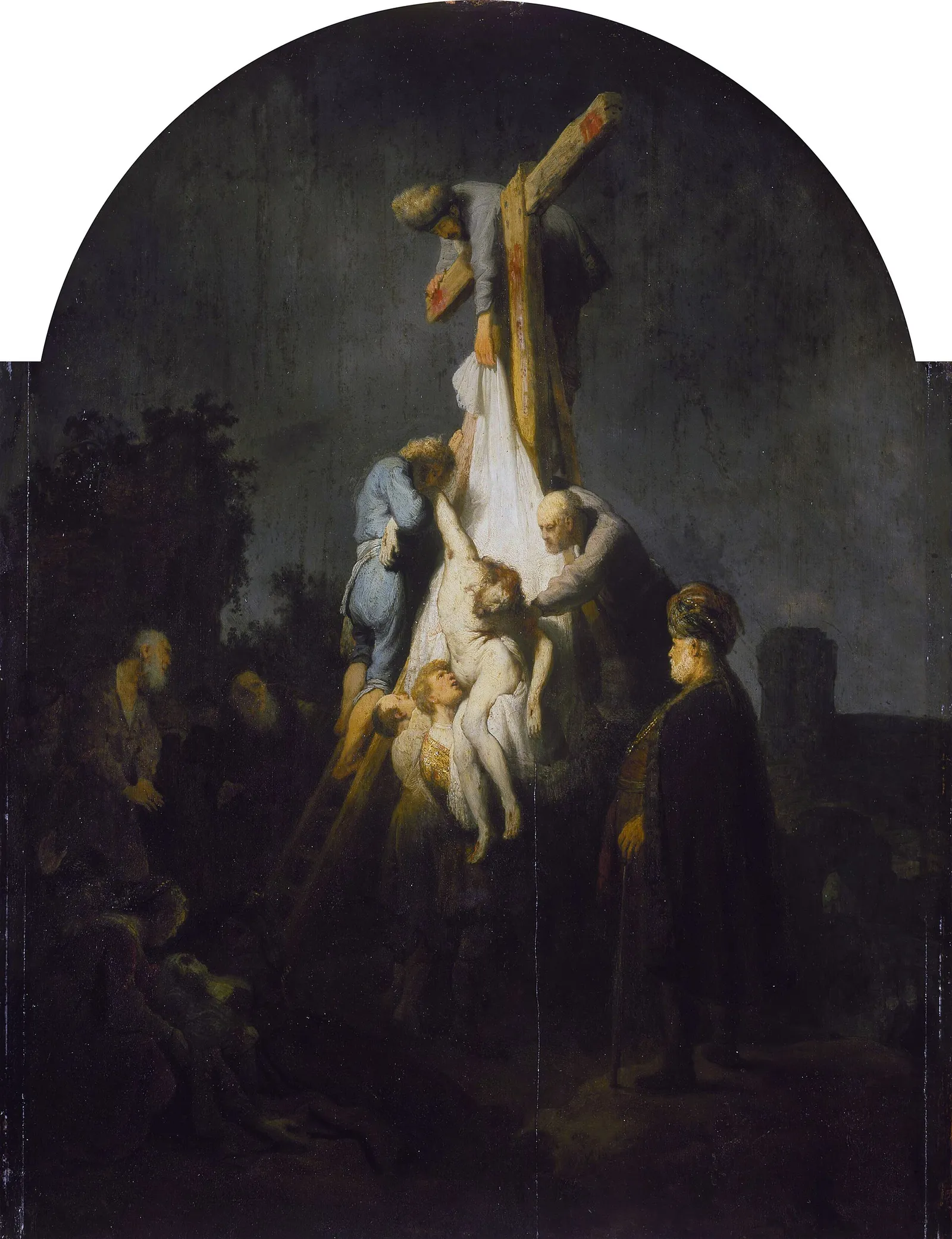
Rembrandt's The Descent from the Cross, dated 1633, belongs to the Bavarian State Painting Collections and is shown at the Alte Pinakothek. At 89.4 by 65.2 cm it is smaller than many visitors expect. Up close, a tight group of figures lowers the body of Christ through a pool of light surrounded by deep shadow.
Where to see it
The painting is held by the Bavarian State Painting Collections and is listed at the Alte Pinakothek, on the upper floor in gallery IX. Museums rehang rooms, close galleries for renovation and lend works to exhibitions, so check the Alte Pinakothek's official website for current display status before you visit. Because the picture is modest in size, plan to stand close. The small details of faces, hands and cloth are easy to miss from across the room.
What to look for in person
Follow the light
Start with the light. It falls almost entirely on Christ's pale, sagging body and the white shroud being drawn down to receive it. Everything else sinks into brown and black shadow. Notice how the light picks out only a few faces and hands, so your eye moves from the body to the people struggling to hold it. This strong contrast between light and dark is typical of Rembrandt's work in the early 1630s. It turns a crowded scene into a clear, readable drama.
The weight of the body
Look at how Christ's body is shown. It does not float gracefully. It slumps awkwardly, with the head dropping and the limbs hanging under their own weight, while the helpers strain on ladders and reach up from below. Rembrandt stresses the physical effort and clumsiness of lowering a dead man. This makes the moment feel human and immediate rather than idealised. Take time with the hands gripping the cloth and the body, which carry much of the scene's emotion.
A small picture in a big tradition
The subject was a major theme of altarpieces, and Rembrandt knew Peter Paul Rubens's famous large-scale treatment of it, probably through a print. His version adopts the general idea of a diagonal body lowered by many hands. But it is compressed into a small, upright panel meant to be seen up close. Compare the restrained, sombre mood here with the heroic grandeur usually linked to Rubens. The difference is one of the most instructive things to notice in front of the work.
About the painting
Rembrandt painted The Descent from the Cross in 1633, during his early, highly successful years in Amsterdam. The picture is generally associated with a series of Passion scenes made for Frederik Hendrik, Prince of Orange, the stadholder of the Dutch Republic. Surviving letters from Rembrandt to Constantijn Huygens, the prince's secretary, document his work on this commission. The Descent is usually discussed together with its companion, The Raising of the Cross. Together the two show the beginning and end of the Crucifixion.
The composition answers a well-known model. Rubens's monumental Descent from the Cross had set a standard for the subject, and Rembrandt's design echoes its basic arrangement. He reworked that model into something darker, more intimate and more focused on the strain and grief of the people involved. Instead of polished heroism, the viewer sees ordinary-looking figures handling a heavy, lifeless body at night.
The painting's later history is reflected in its collection record. It was part of the collection of Johann Wilhelm, Elector Palatine. Today it belongs to the Bavarian State Painting Collections and is displayed at the Alte Pinakothek. Its dimensions are 89.4 by 65.2 cm.
For visitors, the work is a good example of how Rembrandt used light to direct attention and build emotion. Seen alongside other works of the period, it shows a young painter testing himself against the grand tradition of religious art. He answered that tradition with a quieter, more personal voice.
Key facts
| Artist | Rembrandt |
|---|---|
| Date | 1633 |
| Size | 89.4 × 65.2 cm |
| Medium | oil paint, panel |
| Collection | Johann Wilhelm von der Pfalz collection / Bavarian State Painting Collections / Johann Wilhelm, Elector Palatine |
How to visit: Alte Pinakothek
Munich, Germany · Museum guide
| Opening hours | Thu–Sun 10:00–18:00 Tue–Wed 10:00–20:00 |
|---|---|
| Closed | Closed on Mondays. Also closed on Shrove Tuesday (17.02.2026), Labour Day (01.05.), Christmas Eve (24.12.), Christmas Day (25.12.) and New Year's Eve (31.12.). Open until 18:00 on Epiphany, Easter (Good Friday to Easter Monday), Whitsun, Boxing Day, New Year's Day and, in 2026, on Ascension Day, Assumption Day, German Unity Day and All Saints' Day. |
| Admission | Adult (permanent collection) EUR 9 Reduced (students, visitors 65+, severely disabled visitors, groups of 15+) EUR 6 (ID required) Under 18 free Sundays (all visitors) EUR 1 Combined ticket (Alte Pinakothek, Pinakothek der Moderne, Museum Brandhorst, Sammlung Schack, one day) EUR 12 (museum ticket office only; excludes paid special exhibitions) Annual ticket EUR 90 (reduced EUR 60) |
| Free entry | Free for under-18s. Sundays cost EUR 1. Special exhibitions may be priced separately. |
| Booking | No reservation is needed and there is no timed entry. |
The Neue Pinakothek is closed for renovation, with reopening planned for 2029; a selection of its 19th-century main works is shown on the ground floor of the Alte Pinakothek (East Wing) and in Sammlung Schack. No closure of the Alte Pinakothek itself has been announced.
Official ticket page
Official website
View on map
Hours and prices can change. Please check the official website before you go. (Checked on: 2026-11-09)
More by Rembrandt
 Rembrandt and Saskia in the parable of the Prodigal Son — Staatliche Kunstsammlungen Dresden
 Belshazzar's Feast — National Gallery
 Syndics of the Drapers' Guild — Rijksmuseum
 The Abduction of Europa — J. Paul Getty Museum
 Juno
 The Night Watch — Rijksmuseum
 The Conspiracy of Claudius Civilis — Rijksmuseum
 The Storm on the Sea of Galilee
 Danaë
 Aristotle with a Bust of Homer — Metropolitan Museum of Art
 The Stoning of Saint Stephen
 The Mill — National Gallery of Art