Art! Art! Art! › Works
The Anatomy Lesson of Dr. Nicolaes Tulp
 Rembrandt, 1632
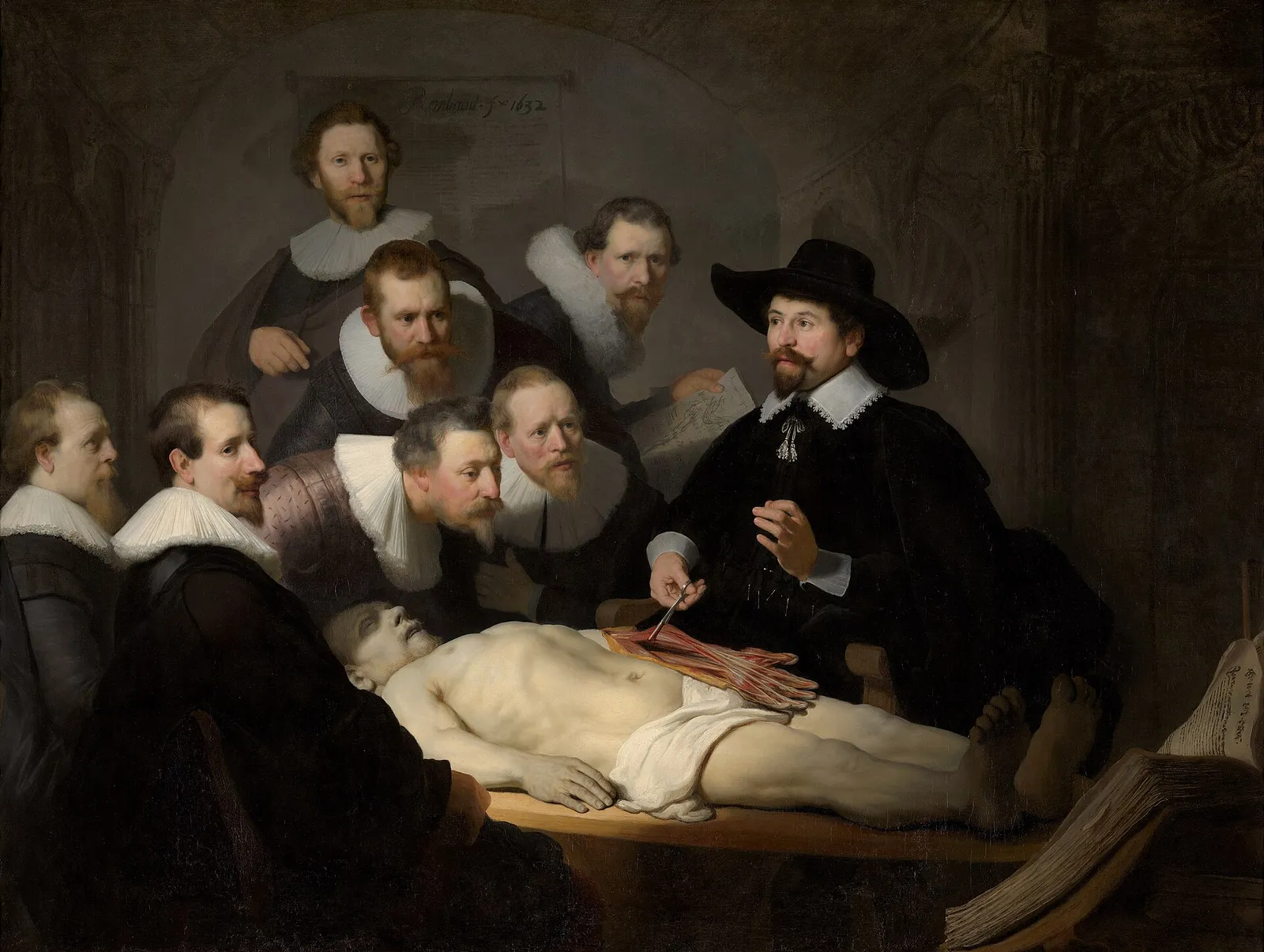
Rembrandt's The Anatomy Lesson of Dr. Nicolaes Tulp, dated 1632, is in the collection of the Mauritshuis. The large canvas shows a surgeon demonstrating the anatomy of an arm to a group of attentive onlookers, and it rewards slow, close looking.
Where to see it
The painting belongs to the collection of the Mauritshuis, which is also its recorded location. Works can be moved, lent or temporarily taken off view for conservation, so check the Mauritshuis's official website for current display status, opening hours and ticketing before you visit.
What to look for in person
Follow the doctor's hands
Start with Dr. Tulp's two hands. With forceps in his right hand he lifts the exposed muscles and tendons of the corpse's forearm, while his raised left hand curls its fingers, as if showing the movement those tendons control. Notice how the gesture sits close to the centre of the composition and how light gathers on the dissected arm. Rembrandt turns what could have been a static group portrait into a single moment of explanation, and your eye moves back and forth between the doctor's demonstration and the anatomy he is describing.
Read the faces of the onlookers
Seven men crowd around Tulp, and each pays attention in a different way. Some lean in to study the arm, others look toward the doctor, and at least one seems to look out of the picture toward the viewer. Instead of setting the heads in an even row, Rembrandt stacks and staggers them in a tight, roughly pyramidal cluster. Take time to move from face to face: the varied expressions and angles make the group feel engaged in a shared event rather than lined up for a formal likeness.
Light, the body and the signature
The pale body, laid diagonally across the foreground, is the brightest area of the painting, set against dark clothing and a shadowy background. Compare its cool, greyish flesh with the warmer complexions of the living men around it; the contrast quietly separates life from death. The canvas measures 169.5 by 216.5 centimetres, so step back to take in the whole group before moving closer for detail. Then look at the back wall, where Rembrandt's signature and the date appear.
About the painting
The Anatomy Lesson of Dr. Nicolaes Tulp is dated 1632, early in Rembrandt's career, when he was in his mid-twenties and had recently established himself in Amsterdam after working in his home town of Leiden. The painting is a group portrait, a type of commission that was popular in the Dutch Republic, where guilds, civic militias and charitable boards paid to have their members portrayed together. In this case the sitters were members of the Amsterdam Guild of Surgeons, shown with Dr. Nicolaes Tulp, who served as the city's praelector, or lecturer, in anatomy. Public anatomy demonstrations were occasional, carefully organised events in the seventeenth century, and the bodies used were those of executed criminals. The challenge for any painter of a group portrait was to give each paying sitter a recognisable likeness while still producing a coherent picture. Rembrandt's solution was to unite the figures around a single action: Tulp's demonstration of the arm. The result reads as a moment in time rather than a row of portraits, and it is often cited as an important step in the young artist's reputation. For visitors, the painting is a chance to see how Rembrandt used light, gesture and grouping to tell a story within a commissioned portrait. Stand at a distance first to see how the bright body and the faces form the structure of the scene, then move closer to study the handling of the faces, the white collars and the dissected arm. The work is held by the Mauritshuis, and its dimensions of 169.5 by 216.5 centimetres make it one of the larger paintings you are likely to encounter there.
Key facts
| Artist | Rembrandt |
|---|---|
| Date | 1632 |
| Size | 169.5 × 216.5 cm |
| Medium | oil paint, canvas |
| Collection | Mauritshuis |
How to visit: Mauritshuis
The Hague, Netherlands · Museum guide
| Opening hours | Mon 13:00–18:00 Tue–Sun 10:00–18:00 Prince William V Gallery: Tue–Sun 12:00–17:00 (closed Mon) 5 Dec 2026 (Saint Nicholas), 26 Dec 2026: 10:00–18:00 (special hours) 24 Dec 2026, 31 Dec 2026: 10:00–16:00 (special hours) |
|---|---|
| Closed | Closed 25 December and 1 January (2027); otherwise open almost every day of the year. |
| Last entry | 30 minutes before closing |
| Admission | Adult (Mauritshuis) EUR 21 Adult (combo Mauritshuis + Prince William V Gallery) EUR 24 Under 19 free Student (Mauritshuis) EUR 13.5 CJP (Mauritshuis) EUR 13 Groups of 15+ adults (Mauritshuis) EUR 18.5 Mauritshuis Friends, Museum Card, Vriendenloterij VIP, Rembrandt Society, ICOM, Ooievaarspas free |
| Free entry | Free for under-19s; Mauritshuis Friends, Museum Card, Vriendenloterij VIP, Rembrandt Society, ICOM and Ooievaarspas holders; and attendants of visitors with an impairment. |
| Booking | Entry is by timed slot, and booking in advance is strongly recommended. |
Cashless museum: payment by card or smartphone only.
Official ticket page
Official website
View on map
Hours and prices can change. Please check the official website before you go. (Checked on: 2026-11-12)
More by Rembrandt
 Rembrandt and Saskia in the parable of the Prodigal Son — Staatliche Kunstsammlungen Dresden
 Belshazzar's Feast — National Gallery
 Syndics of the Drapers' Guild — Rijksmuseum
 The Abduction of Europa — J. Paul Getty Museum
 Juno
 The Night Watch — Rijksmuseum
 The Conspiracy of Claudius Civilis — Rijksmuseum
 The Storm on the Sea of Galilee
 Danaë
 Aristotle with a Bust of Homer — Metropolitan Museum of Art
 The Stoning of Saint Stephen
 The Mill — National Gallery of Art