Art! Art! Art! › Works
Sistine Madonna
 Raphael, 1510s
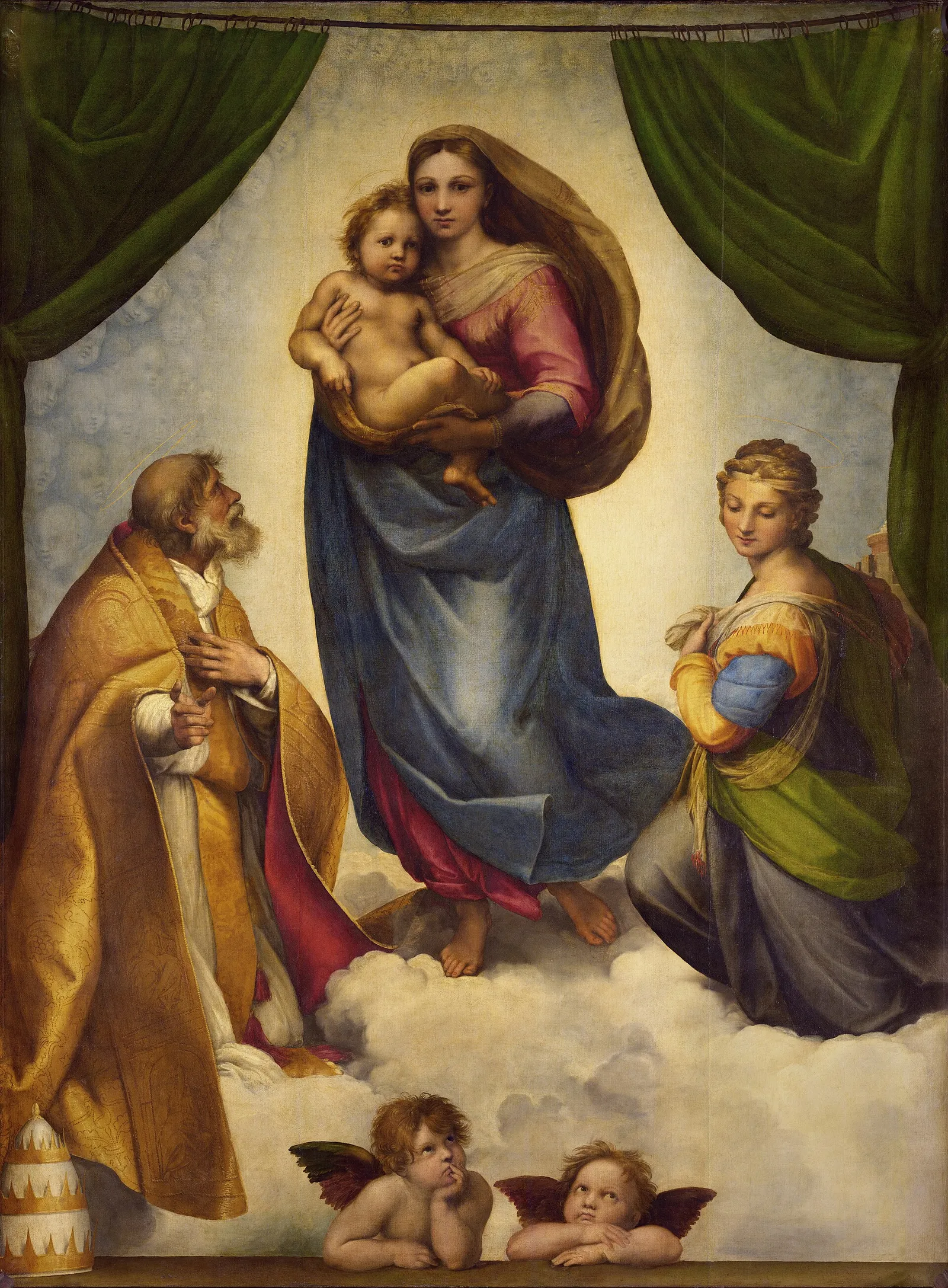
Raphael's Sistine Madonna, painted in the 1510s, belongs to the Staatliche Kunstsammlungen Dresden and is associated with the Gemäldegalerie Alte Meister. At 269.5 by 201 cm, it is a large altarpiece in which the Virgin and Child seem to step forward through parted curtains toward the viewer.
Where to see it
The Sistine Madonna is in the collection of the Staatliche Kunstsammlungen Dresden, at the Gemäldegalerie Alte Meister. Display arrangements, opening hours and ticketing can change, so check the official website of the Staatliche Kunstsammlungen Dresden for current display status before you plan your visit. The canvas measures 269.5 cm high and 201 cm wide. Stand back first to take in the whole composition, then move closer to study the faces and details along the lower edge.
What to look for in person
The two cherubs at the bottom edge
Look to the lower edge of the painting, where two small winged cherubs lean on a ledge and gaze upward. They are among the most reproduced details in Western art, often printed on their own, so many visitors recognise them before they recognise the painting. Seen in place, they work as a link between our space and the vision above: their relaxed, almost bored poses contrast with the solemn figures behind them. Notice how their eyes direct your attention up toward the Virgin and Child.
Curtains, clouds and a sky full of faces
The scene is framed by green curtains drawn back on a rod at the top, as if a stage or window has just been opened. This device makes the Virgin appear to be revealed to the viewer rather than simply placed in a picture. Take time with the pale background behind her: what first reads as soft cloud and light is filled with faint faces of angels. The effect is easy to miss from a distance, so move closer to see how Raphael builds the glowing space.
Saint Sixtus, Saint Barbara and the papal tiara
The Virgin is flanked by two saints. On the left, the elderly Pope Sixtus, in a gold-embroidered cope, looks up and points outward, as though presenting the worshippers to the Virgin. On the right, Saint Barbara turns her face down toward the space below, where the cherubs and the viewer are. Between these opposite glances, the composition forms a gentle triangle. Look for the papal tiara resting on the ledge near Sixtus, a still-life detail that marks his rank and anchors the lower part of the picture.
About the painting
The Sistine Madonna is an altarpiece by Raphael dating from the 1510s, the period when the artist was working in Rome. It takes its name from Saint Sixtus, the pope-saint who kneels on the left, and it is generally connected with the church of San Sisto in Piacenza, a Benedictine church dedicated to that saint. The painting now belongs to the Staatliche Kunstsammlungen Dresden and is associated with the Gemäldegalerie Alte Meister.
Unlike many altarpieces of the time, there is no architectural setting or landscape. Instead, the Virgin walks barefoot on clouds, holding the Christ Child, between two parted curtains. Her movement toward the viewer, and the direct, serious gaze of both mother and child, give the image a sense of immediacy. Saint Sixtus and Saint Barbara act as intermediaries, one looking up to the Virgin, the other looking down toward the faithful.
The large format, 269.5 by 201 cm, was designed to be seen from a distance above an altar, which helps explain the strong, simple outline of the composition. For visitors today, the painting rewards both views: from afar, the balanced triangle of figures and the framing curtains; up close, the delicate faces in the clouds and the expressions of the cherubs.
The cherubs at the base have taken on a life of their own in popular culture, appearing on posters, stationery and souvenirs. Seeing them in context, as part of a devotional image, restores their original role within the altarpiece.
Key facts
| Artist | Raphael |
|---|---|
| Date | 1510s |
| Size | 269.5 × 201 cm |
| Medium | oil paint, canvas |
| Collection | Staatliche Kunstsammlungen Dresden |
How to visit: Staatliche Kunstsammlungen Dresden
Dresden, Germany · Museum guide
| Opening hours | Tue–Sun 10:00–17:00 (closed Mon) Day of Repentance and Prayer (18/11/2026) 10:00–17:00 Fri–Sun, 27/11/2026–30/12/2026 10:00–18:00 (extended hours) Christmas Eve (24/12/2026) 10:00–14:00 Christmas Day (25/12/2026) 10:00–18:00 Boxing Day (26/12/2026) 10:00–18:00 New Year's Eve (31/12/2026) 10:00–16:00 New Year's Day (01/01/2027) 12:00–17:00 |
|---|---|
| Closed | Monday |
| Admission | Zwinger ticket, standard EUR 18 (Old Masters Picture Gallery, Sculpture Collection up to 1800, Mathematisch-Physikalischer Salon, Porcelain Collection; excludes the Correggio special exhibition) Zwinger ticket, reduced EUR 13.5 Zwinger ticket, pupils (under 20) EUR 2 Zwinger ticket, groups (10+) EUR 16 per person Zwinger ticket, children up to school age free Correggio. Movingly Human timed ticket, standard EUR 14 (reduced EUR 10.50, pupils EUR 2, groups EUR 12.50) Correggio. Movingly Human combined ticket, standard EUR 23 (includes all other Old Masters exhibitions; reduced EUR 17.50, pupils EUR 4, groups EUR 20.50) SKD Day Ticket, standard EUR 28 (all SKD museums except the Historic Green Vault; Sparkassencard holders EUR 21, pupils EUR 2) SKD 2-Day Ticket, standard EUR 32 (all SKD museums incl. special exhibitions, except the Historic Green Vault; Sparkassencard holders EUR 24, pupils EUR 4) SKD Annual Ticket, standard EUR 95 (reduced EUR 45, students EUR 25, seniors EUR 70, Sparkassencard holders EUR 85) |
| Free entry | Children up to school age go free. |
| Booking | No reservation is required. |
The Old Masters Picture Gallery is open as usual; the Kunsthalle im Lipsiusbau and the Kunstgewerbemuseum (Schloss Pillnitz), other SKD venues, are currently closed.
Hours and prices can change. Please check the official website before you go. (Checked on: 2026-11-12)
More by Raphael
 Madonna of the Pinks — National Gallery
 La fornarina
 The Marriage of the Virgin
 Saint Catherine of Alexandria — National Gallery
 Transfiguration
 Madonna of the Goldfinch — Uffizi Gallery
 Madonna del Prato — Kunsthistorisches Museum
 The Deposition — Galleria Borghese
 Alba Madonna — National Gallery of Art
 Portrait of Leo X
 Christ Falling on the Way to Calvary — Museo del Prado
 Ansidei Madonna — National Gallery