Art! Art! Art! › Works
Pallas Athena
 Rembrandt, 1657
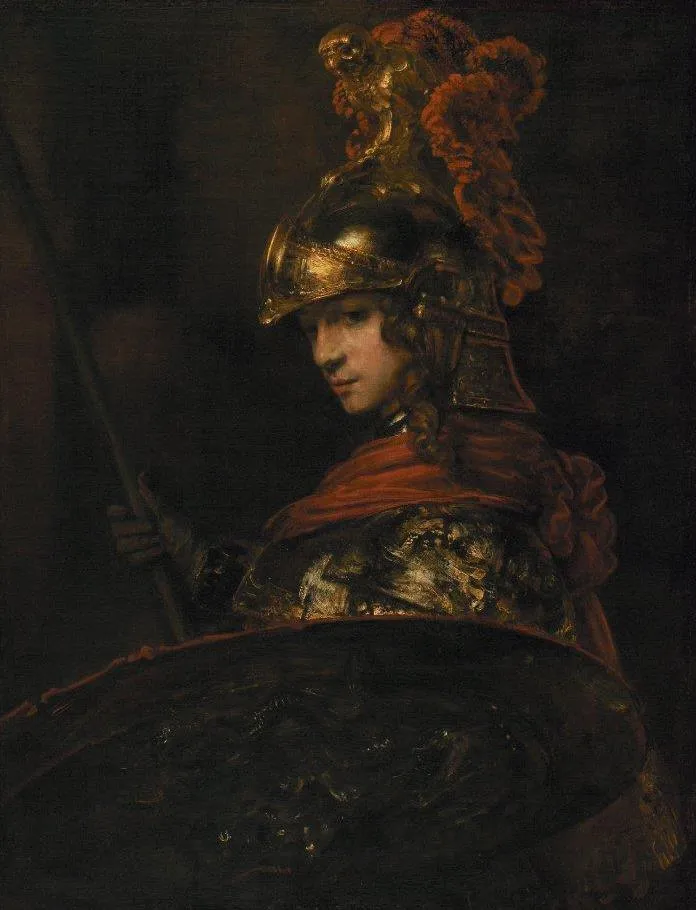
Rembrandt's Pallas Athena, dated 1657, shows a single armoured figure emerging from deep shadow, lit so that the face and helmet glow against the dark. The painting is located at the Calouste Gulbenkian Museum. Measuring 118 by 91 cm, it is a late work that rewards close, slow looking at its paint surface.
Where to see it
Pallas Athena is held by the Calouste Gulbenkian Museum, which is listed as its current location. Its collection record also names the Hermitage Museum. Display arrangements can change, so check the Calouste Gulbenkian Museum's official website for current display status, opening hours and ticketing before you visit.
What to look for in person
Light carved out of darkness
Stand back first and notice how little of the canvas is brightly lit. Rembrandt lets most of the background sink into warm brown shadow, then directs light onto the face, the helmet and parts of the armour. This selective lighting, typical of his work, pulls the figure forward and gives it a quiet, almost sculptural presence. Watch how the edges of the figure dissolve into the dark rather than being sharply outlined, so the boundary between body and space feels soft and uncertain.
Thick paint on metal and plumage
Move closer to the helmet and armour. In the 1650s Rembrandt often built up light areas with heavy, textured paint, and here the highlights on metal catch the light physically as well as pictorially. Look at how short, loaded strokes suggest gleam and ornament without describing every detail. From a distance these marks resolve into polished surfaces; up close they read as rough, energetic handling. Shifting your viewing distance is the best way to appreciate this effect.
A face that invites questions
Spend time with the face itself. The expression is calm and inward rather than heroic or theatrical, and the features are softly modelled. This restraint is one reason the identity of the figure has been discussed: the title names the goddess Pallas Athena, but the image does not announce its subject loudly. Ask yourself what clues the costume and armour offer, and how the mood of the face shapes your reading of a warrior figure.
About the painting
Pallas Athena is a painting by Rembrandt dated 1657, measuring 118 cm high and 91 cm wide. It belongs to the later part of his career, a period when his handling of paint grew broader and more textured and his interest in strong contrasts of light and shadow remained central. The picture presents a half-length armoured figure set against a dark ground, with attention concentrated on the head, helmet and gleaming armour. Rembrandt painted a number of single figures in rich costume or armour, and such works often sit between portrait, character study and history painting. They let him explore surfaces such as metal, fabric and skin, and test how light behaves on each. In front of Pallas Athena, visitors can see this interest clearly: the brightest passages are also the most heavily painted, while the shadows are thinner and more transparent. The title identifies the figure as Pallas Athena, the Greek goddess associated with wisdom and warfare, a fitting subject for armour and a helmet. The figure's identity has, however, been a matter of discussion, and the painting is best approached with that openness in mind. The work is located at the Calouste Gulbenkian Museum, and its collection record also names the Hermitage Museum. For visitors, the painting offers a compact introduction to Rembrandt's late manner: a restrained composition, a contemplative mood, and a surface that changes character as you move closer or step away. Allow time to view it from several distances.
Key facts
| Artist | Rembrandt |
|---|---|
| Date | 1657 |
| Size | 118 × 91 cm |
| Medium | oil paint, canvas |
| Collection | Calouste Gulbenkian Museum / Hermitage Museum |
How to visit: Calouste Gulbenkian Museum
Lisbon, Portugal
Hours and prices can change. Please check the official website before you go.
More by Rembrandt
 Rembrandt and Saskia in the parable of the Prodigal Son — Staatliche Kunstsammlungen Dresden
 Belshazzar's Feast — National Gallery
 Syndics of the Drapers' Guild — Rijksmuseum
 The Abduction of Europa — J. Paul Getty Museum
 Juno
 The Night Watch — Rijksmuseum
 The Conspiracy of Claudius Civilis — Rijksmuseum
 The Storm on the Sea of Galilee
 Danaë
 Aristotle with a Bust of Homer — Metropolitan Museum of Art
 The Stoning of Saint Stephen
 The Mill — National Gallery of Art