Art! Art! Art! › Works
Moses Smashing the Tablets of the Law
 Rembrandt, 1659
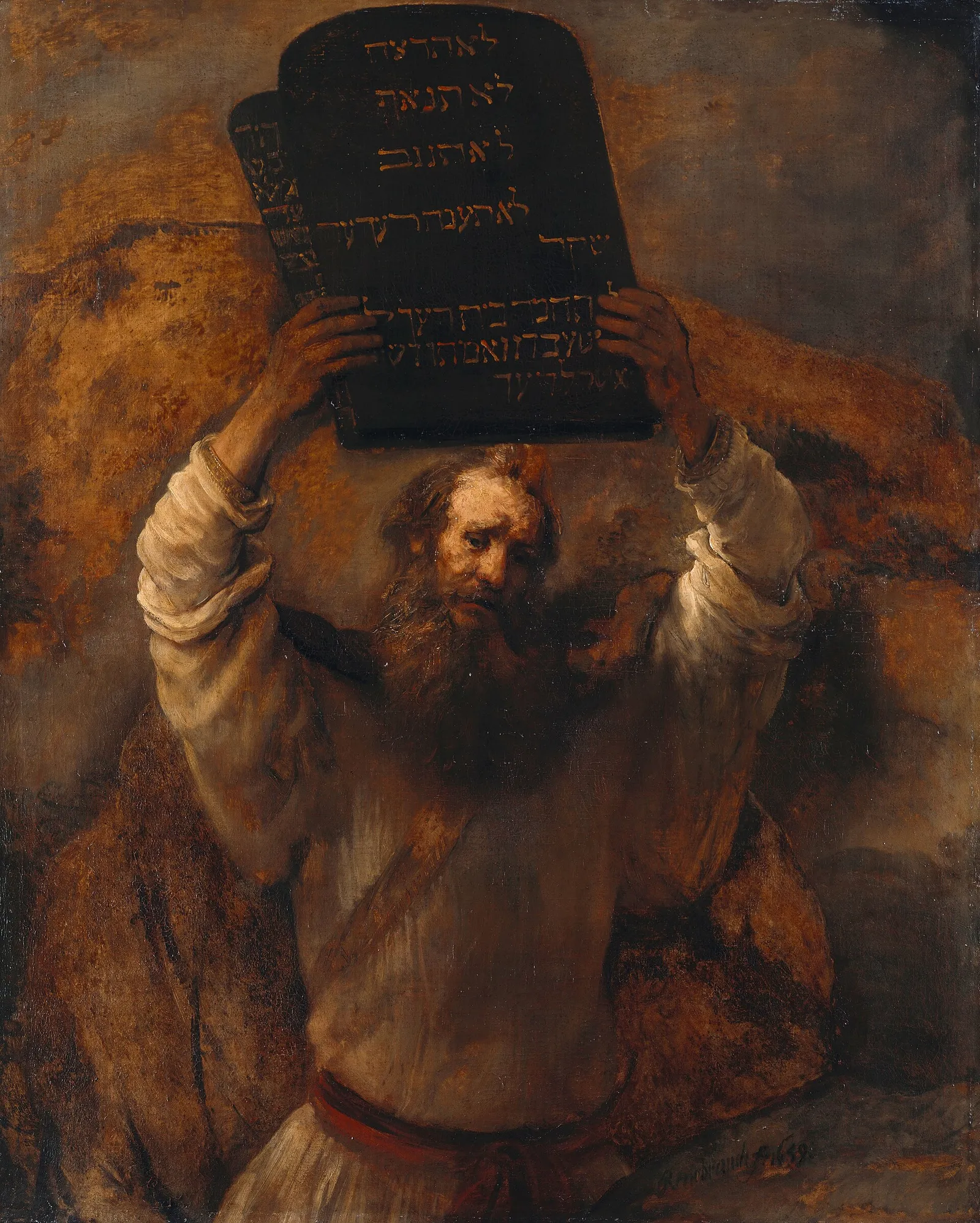
Rembrandt's Moses Smashing the Tablets of the Law, dated 1659, belongs to the Gemäldegalerie Berlin. It shows the prophet holding the two stone tablets of the Ten Commandments high above his head, a single figure filling a canvas of 168.5 × 136.5 cm. In front of it, the scale and the quiet intensity of the face count for more than any dramatic action.
Where to see it
The painting is in the collection of the Gemäldegalerie Berlin, which is also its listed location. Displays can change because of rehanging, conservation or loans, so check the Gemäldegalerie's official website for current display status, opening hours and ticket information before you visit.
What to look for in person
The tablets held overhead
The composition is built around one gesture: Moses raises two large stone tablets above his head with both arms. Stand back first to see how the tablets occupy the upper part of the picture and frame his head and shoulders. Then move closer and notice how Rembrandt conveys their weight through the strain in the arms and the set of the body. The pose is held at a moment of suspension, which is why the painting feels charged even though little is actually happening.
The Hebrew lettering
Look at the lower tablet, which faces you. Rembrandt painted Hebrew characters on its surface, and the legible text corresponds to the later commandments of the Decalogue. The letters are not decorative scribbles; they are carefully placed so that the viewer reads the stone as the actual Law. Compare the crisp lettering with the looser treatment of the surrounding stone, and you will see how Rembrandt directs attention to the words themselves, the subject at the heart of the story.
Face, light and late brushwork
Moses' face is lit against a dark background, with only hints of a rocky setting that suggests Mount Sinai. His expression is restrained rather than furious, which is worth studying closely: it adds to the painting's ambiguity. Up close, the handling is broad and economical, typical of Rembrandt's late work, with paint applied in visible strokes in the clothing and background. Step back again and these strokes resolve into solid form and soft, concentrated light.
About the painting
The subject comes from the Book of Exodus. Moses receives the tablets of the Law on Mount Sinai, descends the mountain, and finds the Israelites worshipping the golden calf; in his anger he breaks the tablets. Later, a second set is made. Rembrandt reduces this episode to a single figure, without the golden calf, the crowd or any narrative clutter. The viewer is placed below Moses, looking up at the tablets as if standing among the people he confronts. The painting is dated 1659, from Rembrandt's late period, years after his financial difficulties of the mid-1650s. Works from this time often show a simplified composition, a restricted palette and broad, expressive brushwork, all of which are visible here. The canvas measures 168.5 by 136.5 centimetres, so the figure appears close to life-size, which makes the encounter direct and physical. A long-standing point of discussion is exactly which moment is shown. The traditional title describes Moses about to smash the tablets, but his calm face has led some viewers to read the image as Moses presenting the Law instead. Rather than settling the question, it is rewarding to look for yourself: does the raised gesture read as a threat or as a display? The painting works on both levels, and that tension is part of why it holds attention. When you visit the Gemäldegalerie Berlin, allow time to view the work from a distance and then up close, where the lettering and paint surface reward patient looking.
Key facts
| Artist | Rembrandt |
|---|---|
| Date | 1659 |
| Size | 168.5 × 136.5 cm |
| Medium | oil paint, canvas |
| Collection | Gemäldegalerie Berlin |
How to visit: Gemäldegalerie Berlin
Berlin, Germany · Museum guide
| Opening hours | Tue–Sun 10:00–18:00 |
|---|---|
| Closed | Closed Mondays. Closed 24 Dec 2026 and 31 Dec 2026. Open Sunday hours on 25–26 Dec 2026; 1 Jan 2027 12:00–18:00. Most other public holidays: Sunday hours. |
| Admission | Adult (Paintings from the 13th to 18th century) EUR 14 Reduced (schoolchildren, apprentices, students, severely disabled, etc.; ID required) EUR 7 Adult incl. special exhibition “Portraits!” (16 Oct 2026 – 14 Mar 2027) EUR 16 (reduced EUR 8) Kulturforum-Ticket (all Kulturforum museums, one day) EUR 22 (reduced EUR 11) Under 18 free (free ticket required, at the counter or online) |
| Free entry | Free with a free ticket and proof for children and young people up to 18, school groups, ICOM/German Museums Association members, friends' association members, press, recipients of Bürgergeld and similar benefits, required companions of severely disabled persons, and annual-pass holders. |
| Booking | Booking is recommended; there is no timed entry. Tickets can be bought up to four weeks in advance. |
Official ticket page
Official website
View on map
Hours and prices can change. Please check the official website before you go. (Checked on: 2026-11-09)
More by Rembrandt
 Rembrandt and Saskia in the parable of the Prodigal Son — Staatliche Kunstsammlungen Dresden
 Belshazzar's Feast — National Gallery
 Syndics of the Drapers' Guild — Rijksmuseum
 The Abduction of Europa — J. Paul Getty Museum
 Juno
 The Night Watch — Rijksmuseum
 The Conspiracy of Claudius Civilis — Rijksmuseum
 The Storm on the Sea of Galilee
 Danaë
 Aristotle with a Bust of Homer — Metropolitan Museum of Art
 The Stoning of Saint Stephen
 The Mill — National Gallery of Art