Art! Art! Art! › Works
Holy Family with Saint Elizabeth and the infant St. John
 Raphael, 1510s
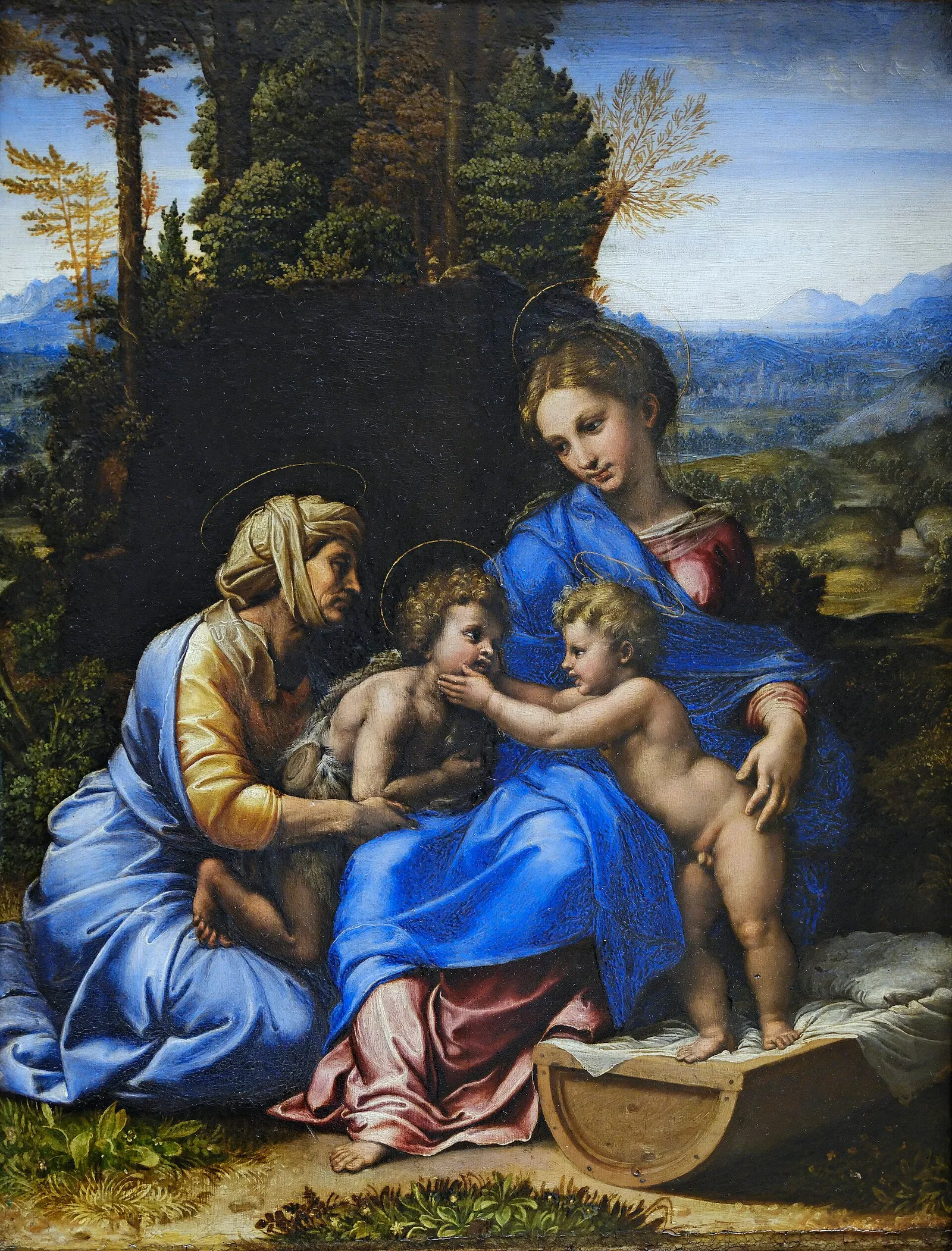
Raphael's Holy Family with Saint Elizabeth and the infant St. John, often called the Small Holy Family, belongs to the Department of Paintings of the Louvre. Dated to the 1510s and signed 1518, this oil on walnut panel measures 38 by 32 cm. It rewards a close, unhurried look at its tender figure group and atmospheric landscape.
Where to see it
The painting is held by the Department of Paintings of the Louvre, and its recorded location is Room 710. Because works are sometimes moved, lent or taken off view, check the Louvre's official website for current display status before you visit. The panel is small, so plan to stand close to take in the figures, the landscape and the inscription on the Virgin's hem.
What to look for in person
The embrace at the heart of the picture
Start with the two children. The Christ Child stands on a cradle and leans back against his mother's legs as he reaches out to embrace the infant Saint John. John, in turn, is supported by his own mother, Saint Elizabeth. Follow how the gesture links the two mothers and the two infants into one compact group, with each figure physically supporting another. At this intimate scale, the arrangement reads almost like a single shape, and it is worth tracing the hands and arms to see how the composition holds together.
A landscape split between shadow and distance
Look behind the figures. A dark mass of trees rises behind Mary and Elizabeth, setting off their faces and bodies, while on the right the view opens onto hilly country with a clearing and mountains fading to blue. In 1669 the painter Philippe de Champaigne gave a lecture on this work at the Royal Academy of Painting and Sculpture. He admired the composition but faulted the lighting of the trees and the placement of the Christ Child's feet, blaming Raphael's assistants. Compare the trees and the feet and judge for yourself.
The signature hidden in the hem
Move in close to the edge of the Virgin's garment. Along the hem runs an inscription, RAPHAEL VRBINAS S[anti] PINGEBAT MDXVIII, which names the painter of Urbino and gives the date 1518. Lettering worked into clothing like this is easy to miss from across the room, so take your time. The panel is only 38 by 32 cm and painted in oil on walnut wood, which makes it an object meant for close viewing, quite different in feel from large altarpieces of the same period.
About the painting
The painting is widely known as the Small Holy Family, a name that separates it from Raphael's larger Great Holy Family, which also belongs to the Louvre. It is an oil painting on a walnut panel, signed and dated 1518 on the Virgin's hem, and it is attributed to Raphael and his workshop. Specialists usually credit the actual painting, as well as a related preparatory drawing now in the Royal Collection at Windsor Castle, to Raphael's leading pupil Giulio Romano. That drawing was once owned by Adrien Gouffier de Boissy, papal legate to France. According to the seventeenth-century writer André Félibien, the panel originally had a cover: a monochrome painting of Abundance or Ceres, also now in the Louvre. The work and its cover may have been made around 1519 as a gift connected with Gouffier de Boissy, possibly at the request of Pope Leo X as thanks for his services. By 1622 the picture was recorded in the collection of the Count of Brienne, who later passed it to Louis XIV, a route that helps explain its place in the French royal and then national collections. Its attribution has shifted over time: around 1900, while already in the Louvre, it was given to Guido Reni before scholars reassigned it to Giulio Romano. The 1669 lecture by Philippe de Champaigne shows that questions about the workshop's role were being discussed in France long before modern scholarship. For visitors, the panel offers a chance to see how Raphael's designs were carried out by his circle in his final years.
Key facts
| Artist | Raphael |
|---|---|
| Date | 1510s |
| Size | 38 × 32 cm |
| Medium | oil paint, walnut panel |
| Collection | Department of Paintings of the Louvre |
How to visit: Louvre Museum
Paris, France · Museum guide
| Opening hours | Mon, Thu, Sat, Sun 09:00–18:00 Wed, Fri 09:00–21:00 (evening opening) Rooms are cleared 30 minutes before closing |
|---|---|
| Closed | Every Tuesday; 1 January, 1 May and 25 December. Other public holidays are open unless they fall on a Tuesday. |
| Last entry | 1 hour before closing |
| Admission | Adult (non-EEA visitors) EUR 32 Adult (EEA citizens and residents) EUR 22 Under 18 free (ID required) EEA citizens/residents under 26 free (photo ID; residents also need a residence permit of over 90 days) Audio guide rental EUR 6 (can be booked in advance online) Rates apply from 14 January 2026 |
| Free entry | Free for under-18s, EEA citizens/residents under 26, all visitors on the first Friday of the month after 18:00 (except July and August) and on 14 July, and disabled visitors plus one carer. Also free with proof for EEA art and art-history teachers, ICOM members, journalists, EEA job seekers and EEA residents on income support. |
| Booking | Entry is by timed slot, and booking in advance is recommended. |
The Cour Carrée entrance is currently closed. On Thursday 12 November 2026 the museum may open later and some exhibition rooms may remain closed.
Official ticket page
Official website
View on map
Hours and prices can change. Please check the official website before you go. (Checked on: 2026-11-11)
More by Raphael
 Madonna of the Pinks — National Gallery
 La fornarina
 The Marriage of the Virgin
 Saint Catherine of Alexandria — National Gallery
 Transfiguration
 Madonna of the Goldfinch — Uffizi Gallery
 Madonna del Prato — Kunsthistorisches Museum
 The Deposition — Galleria Borghese
 Alba Madonna — National Gallery of Art
 Portrait of Leo X
 Christ Falling on the Way to Calvary — Museo del Prado
 Ansidei Madonna — National Gallery
Sources
- Wikidata Q538243
- Wikipedia (en) (CC BY-SA 4.0)
- Wikipedia (it) (CC BY-SA 4.0)
- Wikipedia (fr) (CC BY-SA 4.0)
- www.louvre.fr
- contact.louvre.fr