Art! Art! Art! › Works
El retorno del hijo gey
 Rembrandt, 1665
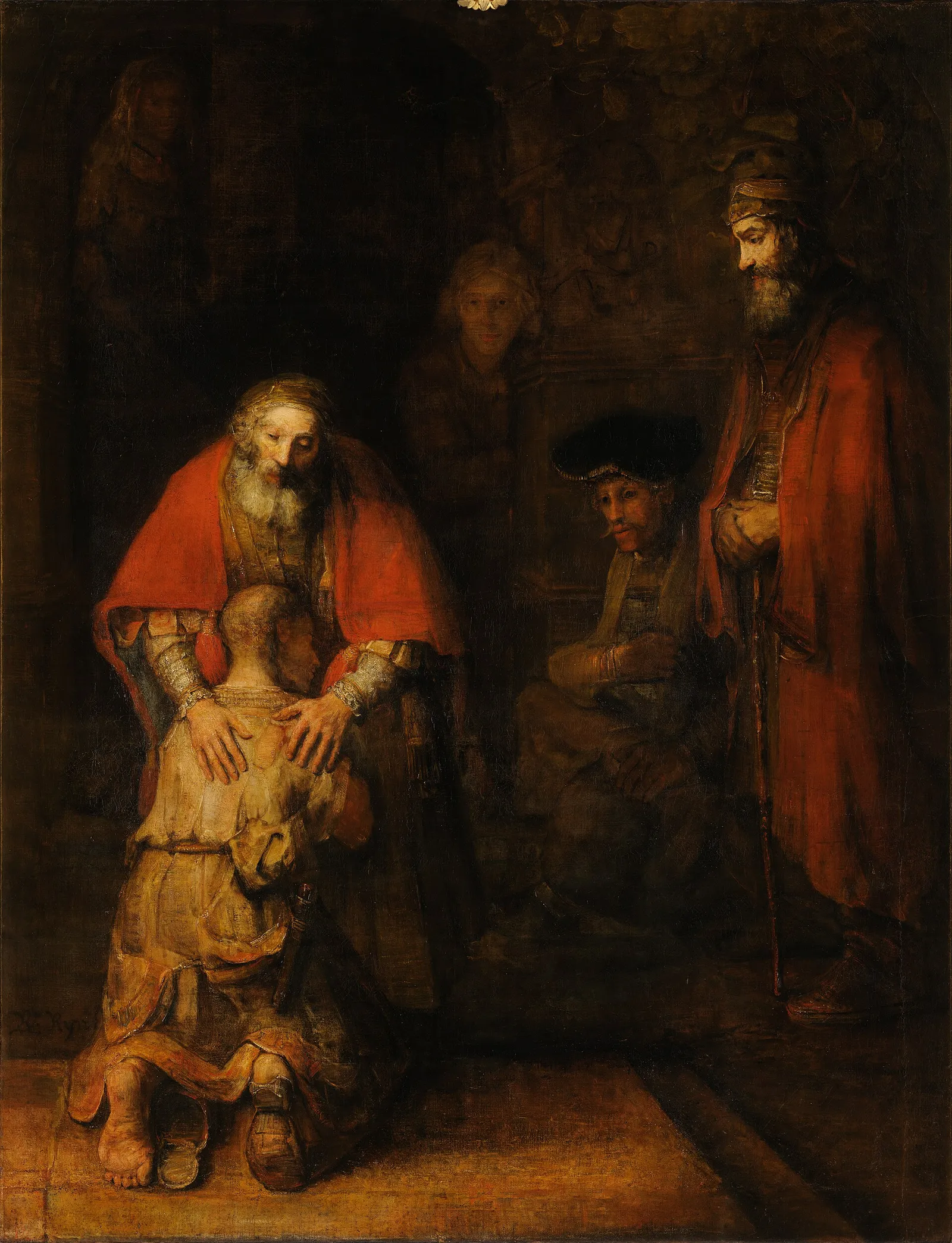
Rembrandt's The Return of the Prodigal Son is in the collection of the Hermitage Museum. Dated 1665 on our fact sheet and measuring 262 x 205 cm, it shows a father embracing his kneeling son, a scene that rewards slow, close looking.
Where to see it
The painting is held by the Hermitage Museum, which is listed as both its collection and its location. Display arrangements can change because of rehanging, conservation or temporary closures, so check the Hermitage Museum's official website for current display status, opening hours and ticket information before you visit.
What to look for in person
The father's hands
Start with the centre of the composition: the old father's two hands resting on his son's back. Many viewers and writers have noticed that the hands do not look like a matching pair. One appears broader and heavier, the other slimmer and gentler. Stand close enough to see how Rembrandt builds them with thick, warm paint, then step back and notice how they draw your eye. The father's bowed head and half-closed eyes support the sense of quiet forgiveness rather than drama.
The kneeling son
The returning son kneels with his back partly turned to us, so we see little of his face. Look at the details that tell his story: the shaved or closely cropped head, the torn and faded garment, and the worn feet. One shoe has slipped off, exposing a calloused sole, while the other is broken down. These small, plain details stand in for the hardship described in the parable. Notice how he presses his head against his father's chest, his body almost absorbed into the older man's cloak.
Light, shadow and the watching figures
The strongest light falls on the father and son, while other figures stand in the surrounding darkness. On the right, a tall standing man, usually identified as the elder brother, watches with his hands clasped, lit almost as strongly as the central pair. Look into the shadowy background to find further onlookers, some barely visible. Pay attention to the rich reds and browns, which unify the scene. The contrast between the embrace and the distant, upright witness is central to how the picture reads.
About the painting
The Return of the Prodigal Son takes its subject from the parable told in the Gospel of Luke. A younger son asks for his inheritance, spends it far from home and, reduced to poverty, returns to ask his father's forgiveness. The father welcomes him back, while the dutiful elder son struggles to accept the celebration. Rembrandt focuses on the moment of reunion and leaves out the feasting that follows. The fact sheet dates the work to 1665, placing it among the paintings of Rembrandt's later years. Works from this period are known for broad, textured brushwork and a restrained, warm palette. Here the painting surface is loose in places, especially in the clothing and background, while the faces and hands receive more careful attention. At 262 x 205 cm, the canvas is large, and the figures appear close to life size. This scale shapes the experience in the gallery. Standing in front of it, you are positioned almost as one of the onlookers, at a slight distance from the embrace. The composition is simple in outline: a compact group on the left, a vertical standing figure on the right, and darkness filling much of the space between and behind them. When you visit, give yourself time. Look first from a distance to take in the overall arrangement of light and dark, then move closer to study the paint handling in the hands, the son's feet and the garments. Finally, step back again and consider the different responses the figures show, from the father's tenderness to the reserved gaze of the elder son.
Key facts
| Artist | Rembrandt |
|---|---|
| Date | 1665 |
| Size | 262 × 205 cm |
| Medium | oil paint, canvas |
| Collection | Hermitage Museum |
How to visit: Hermitage Museum
Saint Petersburg, Russia
Hours and prices can change. Please check the official website before you go.
More by Rembrandt
 Rembrandt and Saskia in the parable of the Prodigal Son — Staatliche Kunstsammlungen Dresden
 Belshazzar's Feast — National Gallery
 Syndics of the Drapers' Guild — Rijksmuseum
 The Abduction of Europa — J. Paul Getty Museum
 Juno
 The Night Watch — Rijksmuseum
 The Conspiracy of Claudius Civilis — Rijksmuseum
 The Storm on the Sea of Galilee
 Danaë
 Aristotle with a Bust of Homer — Metropolitan Museum of Art
 The Stoning of Saint Stephen
 The Mill — National Gallery of Art