Art! Art! Art! › Works
Artist in his studio
 Rembrandt, 1628
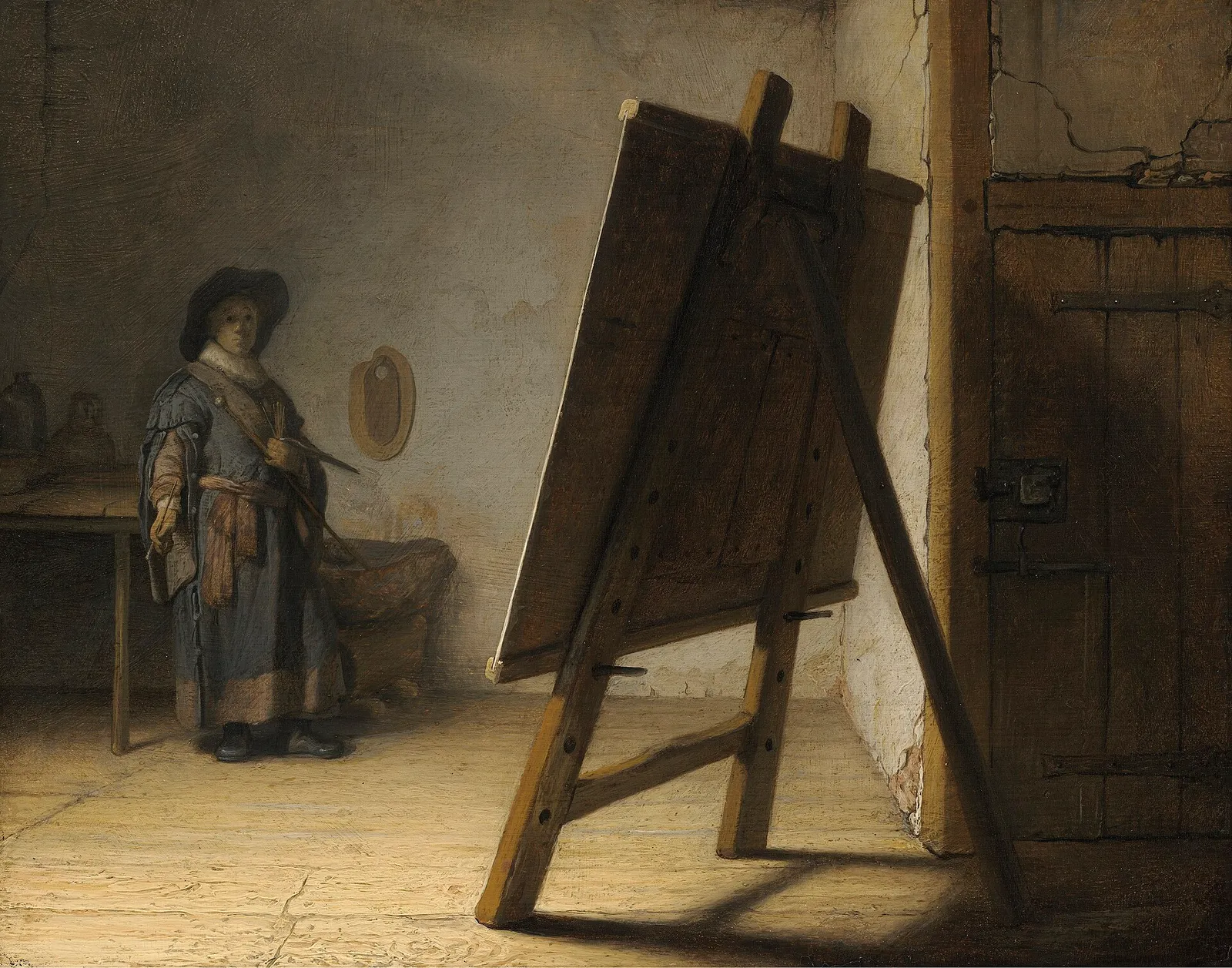
Rembrandt's Artist in his studio, dated 1628, is a small early work in the collection of the Museum of Fine Arts Boston. It shows a young painter standing back from a large easel in a bare room. It is a compact picture of a painter's working life, and it rewards a slow, close look.
Where to see it
Artist in his studio belongs to the Museum of Fine Arts Boston, in Boston. Works can be moved, rotated off view or lent elsewhere, so check the museum's official website for current display status before you visit. The painting measures only 24.8 cm high by 31.7 cm wide, so plan to stand close to take in its details.
What to look for in person
The easel that dominates the room
Start with the easel. It stands in the foreground and fills much of the composition. We see the large painting on it only from behind, as a plain back edged with light. Whatever the artist is making stays hidden from us. Note how big the easel looks next to the small figure at the back of the room. That difference in scale shapes the whole picture. It turns a simple studio scene into a picture about looking and judging. The finished image is withheld, and the act of making takes its place.
The small figure keeping his distance
Look toward the far side of the room. A young painter stands there in a long robe and a hat, holding his brushes and other tools. He is not painting. He stands back and looks at his work from across the room. His face is small and only lightly described, yet his stance shows concentration. Watch how the distance between painter and easel draws your eye back and forth across the floor. You end up repeating his act of stepping back to assess.
Light, plaster and worn surfaces
Spend time on the room itself. Light enters from the left and falls across the floorboards and the pale walls. It brings out cracks and patches in the plaster and the rough texture of the door. Look for the studio equipment against the walls and hanging on them. These are tools of the painter's trade, shown without decoration. The young Rembrandt gives these plain surfaces as much care as the figure. Up close, you can see how he builds the sense of a real, lived-in workspace in a very small format.
About the painting
Rembrandt painted Artist in his studio in 1628, early in his career, when he was in his early twenties and working in his home town of Leiden. The picture is small: 24.8 cm high and 31.7 cm wide, a horizontal format a little wider than it is tall. Today it is in the collection of the Museum of Fine Arts Boston.
The subject is the painter at work, or more exactly, the painter thinking about his work. Many studio scenes show an artist with brush raised. Here the painter stands at a distance from his easel, apparently studying what he has done or what he will do next. The painting on the easel is turned away, so viewers never see its image. This choice is often read as a statement about painting: the work begins with looking and judgment, not only with the hand.
The room is sparse. There are bare floorboards, worn walls and a few tools of the trade. Rembrandt makes this ordinary interior absorbing through light, which falls from the left and gives each surface its own texture. The contrast between the looming easel and the small, distant figure gives the scene its drama.
For visitors, the main pleasure is in the close detail. Stand near enough to follow the light across the floor and the textures of the plaster. Then step back, as the painter in the picture does, and see how the whole room fits together.
Key facts
| Artist | Rembrandt |
|---|---|
| Date | 1628 |
| Size | 24.8 × 31.7 cm |
| Medium | oil paint, panel |
| Collection | Museum of Fine Arts Boston |
How to visit: Museum of Fine Arts Boston
Boston, United States · Museum guide
| Opening hours | Sat, Sun, Mon, Wed 10:00–17:00 Thu, Fri 10:00–22:00 (late opening; until 17:00 on Christmas Eve and New Year's Eve) |
|---|---|
| Closed | Closed Tuesdays, and on New Year's Day, Patriots' Day, Fourth of July, Thanksgiving and Christmas. Galleries may close temporarily without notice. |
| Last entry | 30 minutes before closing |
| Admission | Adult USD 30 Ages 7–17 USD 14 Ages 0–6 free (ticket required) Members free Phone order fee USD 6 (per order, phone orders only) |
| Free entry | Pay what you wish (USD 5 minimum) every third Thursday after 17:00 (19 Nov 2026, 17 Dec 2026; in person only). Free for Massachusetts residents on Open House days (18 Jan 2027, 31 May 2027, 18 Jun 2027; in person, no advance tickets). Also free for US active-duty military and veterans plus 5 guests, students and faculty of participating colleges, Bank of America cardholders on the first full weekend of each month, Boston students and families on the first and second Sundays (Boston Family Days), and caregivers of visitors with disabilities. |
| Booking | Booking is recommended; there is no timed entry. General admission tickets are available for dates through January 2027 (as of 9 Nov 2026). |
The Fenway Entrance is closed. Some galleries are closed until further notice: 209/209A/209B (Ancient Egypt, Nubia, Near East), 210/210A/216 (Greece and Rome), 275, 278A–C, 279 and 280 (Asia). The Arts of Japan galleries are closed while three new Japanese art spaces are added.
Official ticket page
Official website
View on map
Hours and prices can change. Please check the official website before you go. (Checked on: 2026-11-12)
More by Rembrandt
 Rembrandt and Saskia in the parable of the Prodigal Son — Staatliche Kunstsammlungen Dresden
 Belshazzar's Feast — National Gallery
 Syndics of the Drapers' Guild — Rijksmuseum
 The Abduction of Europa — J. Paul Getty Museum
 Juno
 The Night Watch — Rijksmuseum
 The Conspiracy of Claudius Civilis — Rijksmuseum
 The Storm on the Sea of Galilee
 Danaë
 Aristotle with a Bust of Homer — Metropolitan Museum of Art
 The Stoning of Saint Stephen
 The Mill — National Gallery of Art