Art! Art! Art! › Works
A Woman Bathing in a Stream (Hendrickje Stoffels?)
 Rembrandt, 1654
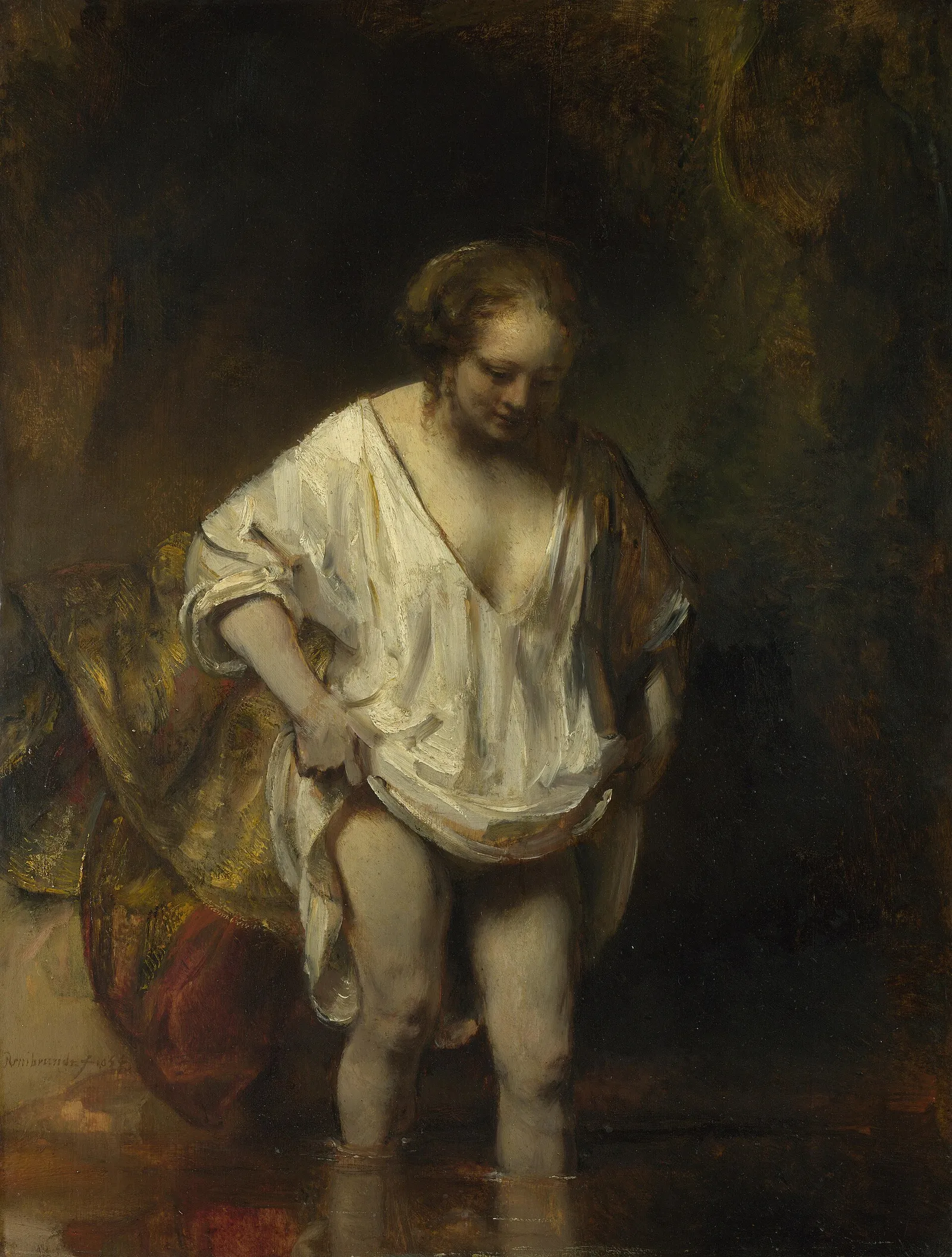
Rembrandt's A Woman Bathing in a Stream, dated 1654, shows a young woman lifting her white shift as she wades into shallow water. The painting belongs to the National Gallery. At 61.8 by 47 cm it is a small, intimate picture that rewards close looking at its unusually free brushwork.
Where to see it
A Woman Bathing in a Stream (Hendrickje Stoffels?) is in the collection of the National Gallery, which is also its listed location. Paintings are sometimes moved, lent or taken off view for conservation, so check the National Gallery's official website for current display status before you visit.
What to look for in person
Brushwork you can follow
The white shift is painted with broad, quick strokes, and you can trace individual sweeps of the brush through the sleeves and folds. Step close to see how loosely the fabric is laid in, then step back and watch those marks turn into cloth catching the light. Compare this freedom with the more carefully modelled face, arms and legs. The contrast between rough and smoother passages is one of the main reasons the picture is so often discussed, and it is easiest to appreciate in person rather than in reproduction.
Light emerging from darkness
The figure stands out against a deep, dark background, a contrast typical of Rembrandt. Light falls on her face, chest, raised shift and bare legs, while the surroundings dissolve into warm brown shadow. Look down at the water: her legs and their reflection are suggested with very little paint, yet the surface reads as shallow and still. Notice too the rich red and gold fabric heaped on the bank behind her, which adds warmth beside the cool white of the shift.
A quiet, private moment
She gathers up her shift and looks down as she steps into the stream, as if testing the depth or temperature of the water. Her expression is calm and absorbed, and she does not acknowledge the viewer. There is no obvious narrative detail to decode; the subject is simply the moment itself. The modest size of the panel, 61.8 by 47 cm, suits this close focus, so take a moment at normal viewing distance to let the scene's stillness register.
About the painting
Rembrandt painted A Woman Bathing in a Stream in 1654, during his mature years, when his handling of paint was becoming increasingly broad and expressive. The picture is small, measuring 61.8 cm high and 47 cm wide, and it belongs to the National Gallery.
The title carries a question mark for a reason. The model is often identified as Hendrickje Stoffels, who lived with Rembrandt as his partner in the 1650s, but there is no documentary proof that she posed for it. The identification rests on resemblance to other women in Rembrandt's work from these years, so it is best treated as a likely suggestion rather than a fact.
What makes the painting stand out is its technique. Large areas, especially the shift, are painted so loosely that the picture has sometimes been described as sketch-like, and writers have debated whether Rembrandt considered it a finished work or a private study. Either way, it shows a working method in which brushstrokes remain visible instead of being smoothed away.
The subject is equally open. A woman wading into water was a theme Rembrandt's contemporaries would have linked to biblical or mythological bathers, and the rich garments on the bank hint at something more than an everyday scene. Yet the painting includes no clear attributes that tie it to a specific story. For visitors, that openness is part of its appeal: you can simply look at a figure, light, water and paint, and judge for yourself how much is portrait, how much is invention, and how finished it feels.
Key facts
| Artist | Rembrandt |
|---|---|
| Date | 1654 |
| Size | 61.8 × 47 cm |
| Medium | paint, oak panel |
| Collection | National Gallery |
How to visit: National Gallery
London, United Kingdom · Museum guide
| Opening hours | Mon–Thu, Sat, Sun 10:00–18:00 Fri 10:00–21:00 (Friday late) |
|---|---|
| Closed | 24–26 December and 1 January. |
| Admission | General admission (collection) free; donations invited Some exhibitions are charged (e.g. Renoir and Love, until 31 Jan 2027) |
| Free entry | General admission is always free. |
| Booking | No reservation or timed entry is required. Free timed booking gives fast-track entry. |
Building work and improvements are under way: some rooms are closed and some paintings have moved, so check the floorplans or collection search before visiting. A new Research Centre is due to open in 2028. On 17 November only, some east wing rooms and the Espresso Bar close from 16:00.
Official ticket page
Official website
View on map
Hours and prices can change. Please check the official website before you go. (Checked on: 2026-11-11)
More by Rembrandt
 Rembrandt and Saskia in the parable of the Prodigal Son — Staatliche Kunstsammlungen Dresden
 Belshazzar's Feast — National Gallery
 Syndics of the Drapers' Guild — Rijksmuseum
 The Abduction of Europa — J. Paul Getty Museum
 Juno
 The Night Watch — Rijksmuseum
 The Conspiracy of Claudius Civilis — Rijksmuseum
 The Storm on the Sea of Galilee
 Danaë
 Aristotle with a Bust of Homer — Metropolitan Museum of Art
 The Stoning of Saint Stephen
 The Mill — National Gallery of Art