Art! Art! Art! › Works
White House at Night
 Vincent van Gogh, 1890
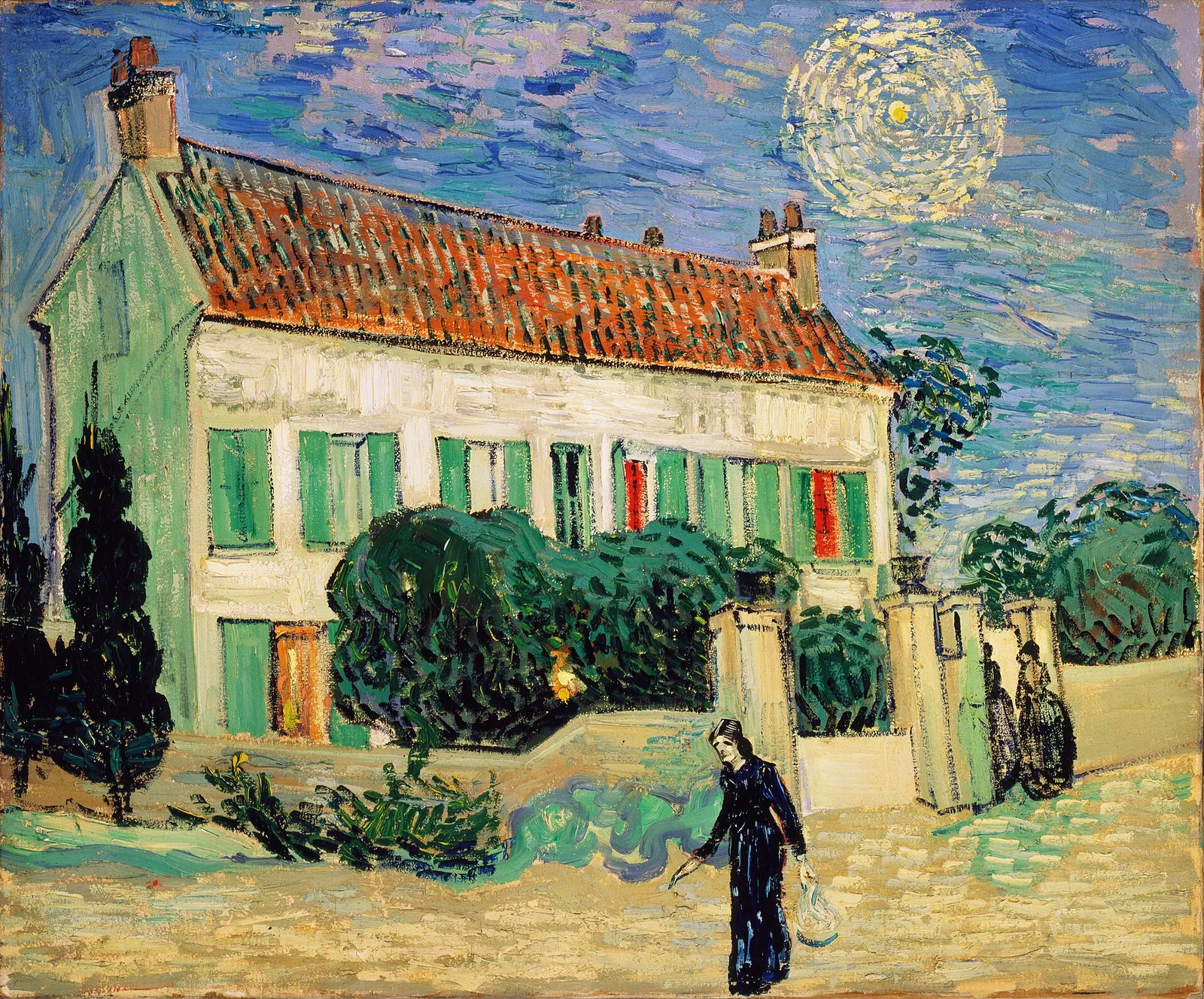
White House at Night is an oil on canvas that Vincent van Gogh painted in Auvers-sur-Oise in June 1890, about six weeks before his death. It belongs to the Hermitage Museum in St. Petersburg, where it reappeared in 1995 after decades out of public view.
Where to see it
White House at Night is held by the Hermitage Museum in St. Petersburg. Before planning a visit around this work, check the Hermitage's official website for its current display status.
What to look for in person
The yellow star in the upper right
Look first to the upper right of the canvas, where a bright yellow star hangs above the two-storey house. Astronomers Donald Olson and Russell Doescher of Texas State University-San Marcos studied this detail and identified the star as the planet Venus. Working from its position in the sky, they suggested the scene corresponds to about 8 p.m. In front of the painting, notice how this single bright point holds your attention against the evening sky and draws the eye up and away from the building below.
An evening read from bottom to top
Olson also examined the shadows in the picture and found that they suit a time of around 7 p.m., roughly an hour earlier than the position of Venus implies. From this gap he proposed that Van Gogh worked on the canvas from the bottom upward as the light changed. Compare the lower part of the picture with the sky above it. The idea invites you to see the painting as a passage of fading evening light rather than one frozen instant, though it remains an interpretation.
A house from Van Gogh's last weeks
The two-storey house at the centre of this picture is the same building that appears in Van Gogh's Blossoming Chestnut Tree, another work from his time in Auvers-sur-Oise. Painted in June 1890, this canvas belongs to the final weeks of his life, and he referred to it in his letters. If you know the chestnut tree painting, look for the shared subject here, now seen at dusk under a single bright star rather than in the setting of a flowering tree.
About the painting
White House at Night is an oil painting on canvas measuring 59 by 72.5 cm. Van Gogh made it in June 1890 in Auvers-sur-Oise, the village north of Paris where he spent the last period of his life; it dates from around six weeks before his death. The subject is a two-storey house beneath an evening sky, with a bright yellow star placed in the upper right. The same house appears in his Blossoming Chestnut Tree, and Van Gogh mentioned this painting in his letters. In Jan Hulsker's catalogue The Complete Van Gogh, it is listed as number 2001. The painting's later history is unusually eventful. During the 1920s it was shown several times in exhibitions in Switzerland, and toward the end of that decade it passed into the private collection of the German industrialist Otto Krebs. After the Second World War it was long thought to be lost. It resurfaced publicly in 1995, when the Hermitage in St. Petersburg staged an exhibition of artworks taken by the Soviets at the close of the war. On that occasion it was displayed together with three other Van Gogh paintings that had also belonged to Krebs. The work has since been associated with the Hermitage Museum, which holds it today. The painting has also attracted scientific interest: astronomers have used the star, identified as Venus, and the shadows in the scene to estimate the time of evening it depicts.
Key facts
| Artist | Vincent van Gogh |
|---|---|
| Date | 1890 |
| Size | 59 × 72.5 cm |
| Medium | oil paint, canvas |
| Collection | Otto Krebs collection / Hermitage Museum |
How to visit: Hermitage Museum
Saint Petersburg, Russia
Hours and prices can change. Please check the official website before you go.
More by Vincent van Gogh
 Café Terrace at Night — Kröller-Müller Museum
 The siesta (after Millet) — Musée d'Orsay
 The Church at Auvers — Musée d'Orsay
 Portrait of Père Tanguy
 Starry Night Over the Rhône — Musée d'Orsay
 The Potato Eaters — Van Gogh Museum
 The Red Vineyard
 The Yellow House — Van Gogh Museum
 Agostina Segatori Sitting in the Café du Tambourin — Van Gogh Museum
 Irises — J. Paul Getty Museum
 Langlois Bridge at Arles with Women Washing, The — Kröller-Müller Museum
 Blossoming chestnut trees — Kröller-Müller Museum
Sources
- Wikidata Q1171740
- Wikipedia (en) (CC BY-SA 4.0)
- Wikipedia (ja) (CC BY-SA 4.0)
- Wikipedia (fr) (CC BY-SA 4.0)