Art! Art! Art! › Works
Portrait of Père Tanguy
 Vincent van Gogh, 1887
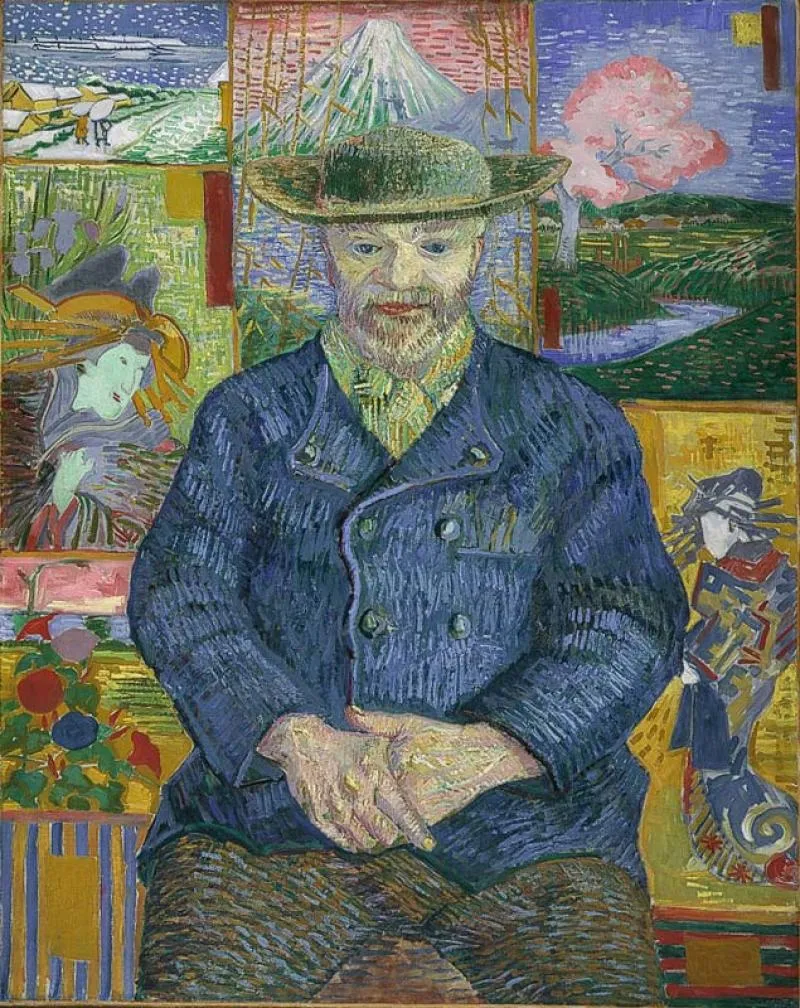
Vincent van Gogh's Portrait of Père Tanguy, painted in 1887, is held by the Musée Rodin. The canvas shows the Paris paint dealer Julien Tanguy seated squarely before a wall of Japanese prints. It is a portrait of a friend and a statement of the artist's fascination with Japanese art.
Where to see it
The painting belongs to the collection of the Musée Rodin, where it is located. Works on canvas can be moved for conservation, rehanging or exhibitions, so check the Musée Rodin's official website for current display status, opening hours and ticketing before you visit.
What to look for in person
A sitter facing you head-on
Start with the pose. Tanguy sits almost perfectly frontal and symmetrical, hands folded in his lap, wearing a straw hat and a simple jacket. There is little sense of depth around him; he reads almost like a figure set against a flat screen. Notice how calm and still he appears. Van Gogh gives this modest shopkeeper the steady, centred presence usually reserved for more formal portraits, which tells you something about the respect he felt for the man who supplied his paints.
The wall of Japanese prints
Look past the sitter to the background, which is filled edge to edge with images based on Japanese woodblock prints: figures in kimono, flowering branches and a snow-capped mountain rising behind Tanguy's hat. Van Gogh collected such prints and studied them closely during his Paris years. Here they are not a precise copy of a real wall but a decorative field of flat colour and strong outline. Compare how they are painted with how Tanguy's face and hands are treated.
Colour and brushwork from the Paris years
Step closer to see the handling of paint. The surface is built from distinct, visible strokes, and the palette is bright, with strong blues, greens, reds and yellows set against each other. This lighter, more saturated colour marks the change in Van Gogh's work after he moved to Paris and encountered Impressionist and Neo-Impressionist painting. At roughly 92 by 73 cm, the canvas is large enough that you can stand back for the overall pattern, then approach to follow individual strokes.
About the painting
Julien Tanguy, known affectionately as Père (Father) Tanguy, ran a small shop selling artists' materials in Montmartre. He was known for his generosity toward struggling painters, sometimes accepting pictures in exchange for paint and canvas, and his shop became a place where young artists could see one another's work. Van Gogh, who lived in Paris with his brother Theo from 1886 to early 1888, was among his customers and friends, and he painted Tanguy more than once. This version, dated 1887, measures 92 by 73 cm and is now in the collection of the Musée Rodin.
The portrait brings together two of Van Gogh's preoccupations at the time. One was the human figure: he wanted to paint ordinary people with dignity, and Tanguy, a working man with radical political sympathies, suited that aim. The other was Japanese art. Van Gogh admired the clear outlines, flat areas of colour and unusual compositions of Japanese woodblock prints, and he and Theo built up a collection of them. By surrounding Tanguy with these images, Van Gogh turns the background into an imagined, idealised setting rather than a record of a specific room.
The painting also shows how quickly his style changed in Paris. The dark, earthy tones of his earlier Dutch work give way here to brighter, contrasting colour and energetic brushwork. For visitors, it is a useful picture for understanding the period just before Van Gogh left for the south of France, where these lessons in colour and Japanese-inspired design would continue to develop.
Key facts
| Artist | Vincent van Gogh |
|---|---|
| Date | 1887 |
| Size | 92 × 73 cm |
| Medium | oil paint, canvas |
| Collection | Musée Rodin |
How to visit: Musée Rodin
Paris, France
Hours and prices can change. Please check the official website before you go.
More by Vincent van Gogh
 Café Terrace at Night — Kröller-Müller Museum
 White House at Night
 The siesta (after Millet) — Musée d'Orsay
 The Church at Auvers — Musée d'Orsay
 Starry Night Over the Rhône — Musée d'Orsay
 The Potato Eaters — Van Gogh Museum
 The Red Vineyard
 The Yellow House — Van Gogh Museum
 Agostina Segatori Sitting in the Café du Tambourin — Van Gogh Museum
 Irises — J. Paul Getty Museum
 Langlois Bridge at Arles with Women Washing, The — Kröller-Müller Museum
 Blossoming chestnut trees — Kröller-Müller Museum