Art! Art! Art! › Works
The Yellow House
 Vincent van Gogh, 1888
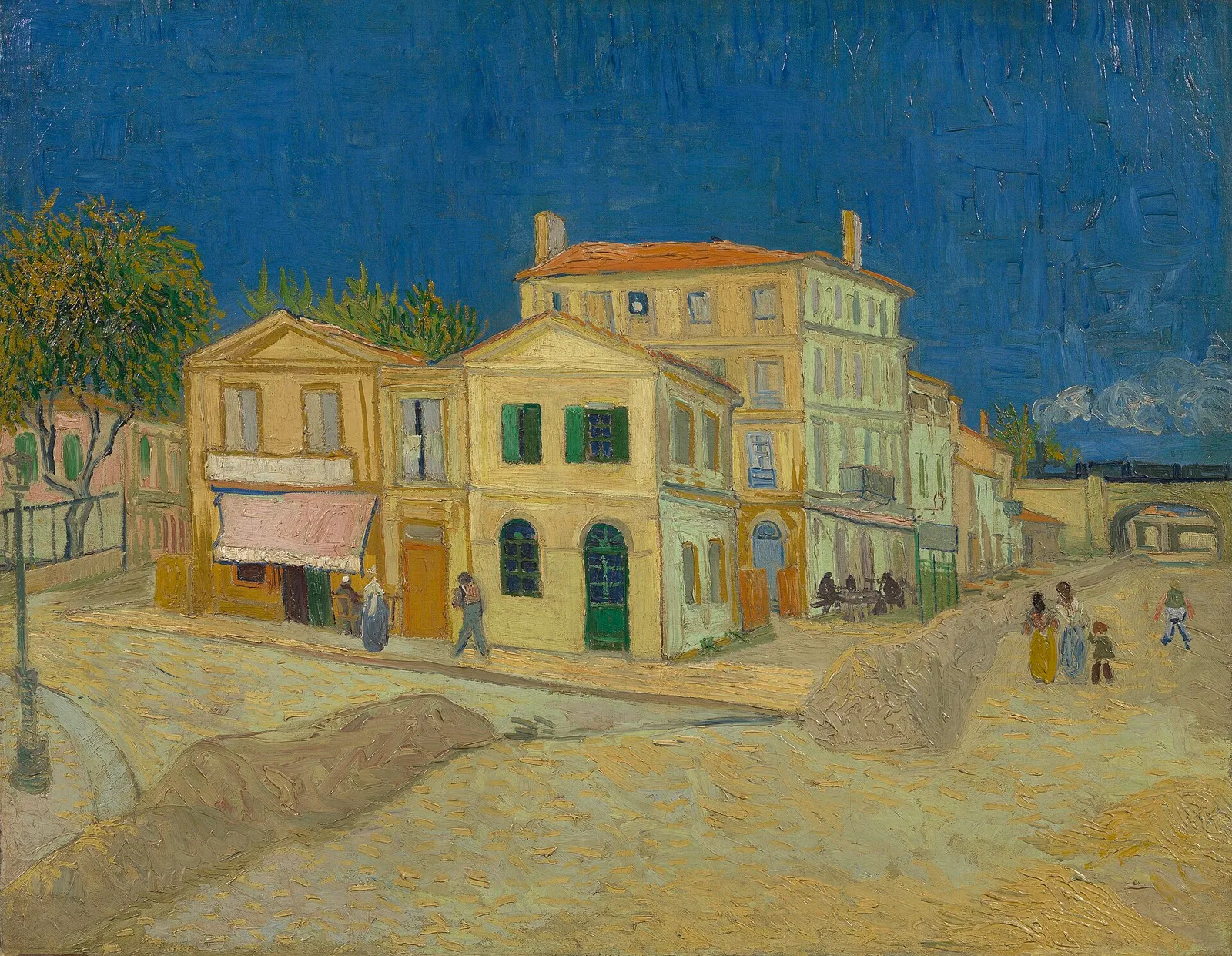
Vincent van Gogh's The Yellow House, painted in 1888, is part of the collection of the Van Gogh Museum. It shows the building in Arles where he rented rooms and set up a studio, painted in strong yellows set against a deep blue sky.
Where to see it
The Yellow House is held by the Van Gogh Museum. The museum may rotate works, lend them to other institutions, or close galleries for maintenance, so check the Van Gogh Museum's official website for current display status before you plan your visit. The canvas measures 72 x 91.5 cm, a moderate size that rewards standing both at a distance, to take in the whole street scene, and up close, to see the brushwork.
What to look for in person
Yellow against blue
Start by stepping back and noticing the colour contrast that structures the whole picture. The warm yellow of the house and the sunlit ground sits against a dark, intense blue sky. Van Gogh was deeply interested in complementary and contrasting colours during his time in the south of France, and here the effect makes the buildings seem to glow. Notice that the sky is not a soft, airy blue but a dense, almost solid band of colour across the top of the canvas.
The house and its neighbours
Look at the corner building with its green shutters and door. This is the house where Van Gogh lived and worked, and he painted it as part of an ordinary street rather than isolating it as a portrait of a single building. Neighbouring houses, shopfronts and a pink-toned facade crowd beside it. Take time to compare the different window shapes and wall surfaces: Van Gogh varied his strokes and tones to give each building its own character while keeping the scene unified.
Life in the street and beyond
Move closer and scan the middle and background. Small figures walk along the street, and a road leads the eye past the houses. In the distance, look for railway bridges, with a train passing over one of them, its smoke drifting into the sky. These details turn the picture from a study of architecture into a view of a working neighbourhood. Up close, you can also see how loosely the ground in the foreground is painted compared with the more defined buildings.
About the painting
In 1888 Van Gogh moved from Paris to Arles in the south of France, drawn by its light and colour. There he rented part of a yellow-painted house on a square near the edge of town, which he used as his home and studio. He hoped it could become a base for a community of artists working together, an idea often referred to as the 'Studio of the South'. The painter Paul Gauguin later came to stay with him there for a period, a famously difficult collaboration that ended at the close of 1888.
The Yellow House records this place at a hopeful moment. Van Gogh described the house and its surroundings in his letters, and the painting reflects his pleasure in the bright buildings under a strong southern sky. Rather than a romantic or picturesque view, it is a plain, everyday street: houses, passers-by, a road and a railway beyond. That ordinariness is part of its appeal for visitors today, because it lets you see the setting of one of the most productive phases of his career.
The house itself no longer stands in its original form; it was badly damaged during the Second World War. The painting therefore also serves as a visual record of a building closely tied to the artist's life.
When you visit, it is worth considering the work alongside other paintings Van Gogh made in Arles, if they are on view, to see how he used similar bold colour contrasts across subjects ranging from interiors to landscapes.
Key facts
| Artist | Vincent van Gogh |
|---|---|
| Date | 1888 |
| Size | 72 × 91.5 cm |
| Medium | oil paint, canvas |
| Collection | Van Gogh Museum |
How to visit: Van Gogh Museum
Amsterdam, Netherlands · Museum guide
| Opening hours | 2–30 Nov 2026, daily 09:00–17:00 (Fri until 21:00, except 27 Nov) 1–18 Dec 2026, daily 09:00–17:00 (Fri until 21:00) 19–23 and 27–30 Dec 2026: 09:00–18:00 24, 25, 26 and 31 Dec 2026: 09:00–17:00 1 Jan 2027: 11:00–18:00 2–10 Jan 2027: 09:00–18:00 (Fri until 21:00) 11 Jan – 12 Feb 2027: 09:00–17:00 (Fri until 21:00) 13–28 Feb 2027: 09:00–18:00 (Fri until 21:00, except 26 Feb) March–September 2027: 09:00–18:00 (Fri until 21:00, except 26 Mar, 28 May, 30 Jul, 24 Sep) 1–3 and 11–31 Oct 2027: 09:00–18:00 (Fri until 21:00) 4–10 Oct 2027: from 09:00 (Mon–Thu until 17:00, Fri until 21:00, Sat–Sun until 18:00) 1–7 Nov 2027: 09:00–18:00 (Fri until 21:00) 8–30 Nov and 1–23 Dec 2027: 09:00–17:00 (Fri until 21:00, except 26 Nov) 24–26 and 31 Dec 2027: 09:00–17:00 27–30 Dec 2027: 09:00–18:00 |
|---|---|
| Closed | Open daily with no regular closing day (25 December 09:00–17:00, 1 January 11:00–18:00). |
| Admission | Adult EUR 25 (from 1 January 2027: EUR 26) Adult with multimedia guide EUR 28.75 (from 1 January 2027: EUR 30) Under 18 free (timed ticket still required) Student (EU/EEA institution) EUR 16 (valid until 31 December 2026; proof of enrolment required) Museumkaart, Vincent's Friends, VriendenLoterij VIP-KAART, ICOM, Rembrandt card, Stadspas holders free (reserve a free timed ticket online) |
| Free entry | Free for under-18s and holders of the Museumkaart, Vincent's Friends, VriendenLoterij VIP-KAART, ICOM card, Rembrandt card or Stadspas (a timed ticket must still be booked online). A companion of a visitor needing assistance is also free. The I amsterdam City Card has not been valid since 1 June 2022. |
| Booking | Booking is required, with timed-entry tickets. |
Official ticket page
Official website
View on map
Hours and prices can change. Please check the official website before you go. (Checked on: 2026-11-09)
More by Vincent van Gogh
 Café Terrace at Night — Kröller-Müller Museum
 White House at Night
 The siesta (after Millet) — Musée d'Orsay
 The Church at Auvers — Musée d'Orsay
 Portrait of Père Tanguy
 Starry Night Over the Rhône — Musée d'Orsay
 The Potato Eaters — Van Gogh Museum
 The Red Vineyard
 Agostina Segatori Sitting in the Café du Tambourin — Van Gogh Museum
 Irises — J. Paul Getty Museum
 Langlois Bridge at Arles with Women Washing, The — Kröller-Müller Museum
 Blossoming chestnut trees — Kröller-Müller Museum