Art! Art! Art! › Works
Agostina Segatori Sitting in the Café du Tambourin
 Vincent van Gogh, 1887
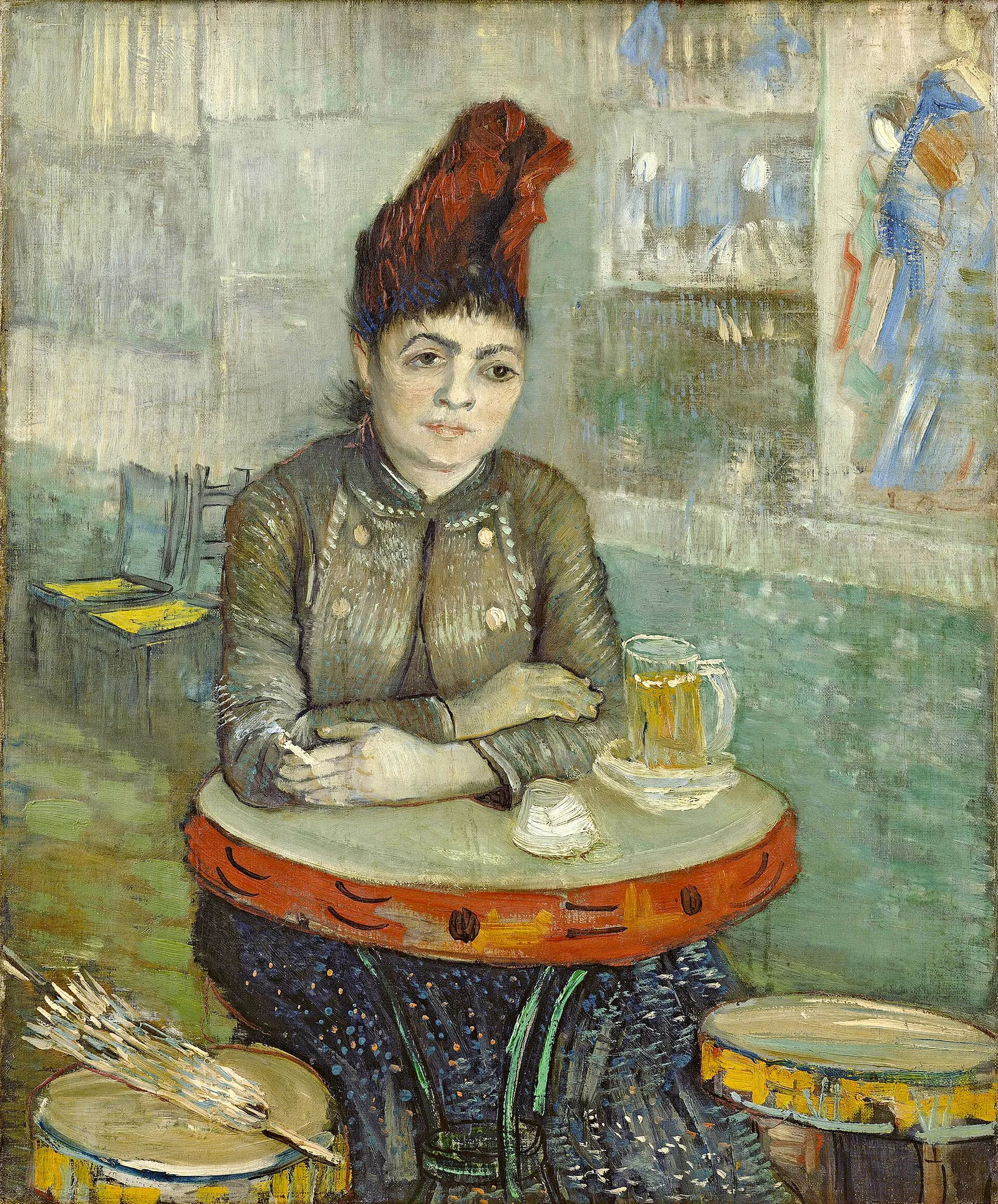
Vincent van Gogh painted Agostina Segatori Sitting in the Café du Tambourin in 1887, during his years in Paris. It shows a woman seated alone at a café table, a quiet, slightly melancholy scene that also records the artist's growing interest in Japanese prints. The painting belongs to the Van Gogh Museum.
Where to see it
The painting is in the collection of the Van Gogh Museum. Works in museum collections are sometimes rotated, lent to other institutions or taken off view for conservation, so check the Van Gogh Museum's official website for current display status and ticket information before you plan your visit.
What to look for in person
The tambourine furniture
Look first at the table and the stool. Both are round and shaped like tambourines, a direct reference to the café's name, the Tambourin. The flat circular tabletop tilts toward you, so you see it almost from above while the woman is seen from the side. This mix of viewpoints flattens the space and pulls the furniture forward, making the café's decorative theme a key part of the composition rather than mere background detail.
Japanese prints on the wall
Behind the sitter, the wall is covered with prints in the Japanese style. They are painted loosely, with patches of colour suggesting figures and patterns rather than precise copies. Van Gogh collected Japanese woodblock prints while in Paris, and their bright colours, strong outlines and flattened space shaped his work from this period onward. Step close to see how lightly the prints are sketched compared with the more solid treatment of the woman and the table in front of them.
The sitter and her mood
The woman sits with her elbows near the table, a cigarette in her hand and a glass of beer before her, wearing a hat. Her gaze drifts away from the viewer, giving the scene a withdrawn, pensive feel. Notice the brushwork: visible strokes in her clothing and face, typical of Van Gogh's Paris years, when he was experimenting with the lighter palette and broken touch he encountered among artists in the city. The modest size of the canvas rewards close, unhurried viewing.
About the painting
Van Gogh lived in Paris from 1886 to early 1888, staying with his brother Theo, an art dealer. These years transformed his painting. He met artists working in the newest styles, saw Impressionist and Neo-Impressionist work, and began collecting Japanese prints. His earlier dark, earthy palette gave way to brighter colour and more varied brushwork, and this 1887 painting shows that transition in progress. The sitter is generally identified as Agostina Segatori, an Italian woman who ran the Café du Tambourin in Montmartre, on the boulevard de Clichy. The café was frequented by artists, and its décor, including the tambourine-shaped tables and stools seen here, gave the place its name. Van Gogh is known to have had dealings with the café during his Paris period, and the Japanese prints in the background link the picture to his enthusiasm for that art. The canvas measures 55.5 by 46.5 centimetres, an intimate size suited to a café scene. Rather than a formal portrait, it reads as a glimpse of a moment: a woman alone at a table, smoking, her thoughts elsewhere. In front of the painting, it is worth comparing the confident, decorative handling of the furniture and wall with the more reflective treatment of the figure. Together they show Van Gogh absorbing new influences while still holding on to his interest in ordinary people and everyday settings. For visitors to the Van Gogh Museum, the work offers a clear window onto the Paris years that prepared the way for his later paintings.
Key facts
| Artist | Vincent van Gogh |
|---|---|
| Date | 1887 |
| Size | 55.5 × 46.5 cm |
| Medium | oil paint, canvas |
| Collection | Van Gogh Museum |
How to visit: Van Gogh Museum
Amsterdam, Netherlands · Museum guide
| Opening hours | 2–30 Nov 2026, daily 09:00–17:00 (Fri until 21:00, except 27 Nov) 1–18 Dec 2026, daily 09:00–17:00 (Fri until 21:00) 19–23 and 27–30 Dec 2026: 09:00–18:00 24, 25, 26 and 31 Dec 2026: 09:00–17:00 1 Jan 2027: 11:00–18:00 2–10 Jan 2027: 09:00–18:00 (Fri until 21:00) 11 Jan – 12 Feb 2027: 09:00–17:00 (Fri until 21:00) 13–28 Feb 2027: 09:00–18:00 (Fri until 21:00, except 26 Feb) March–September 2027: 09:00–18:00 (Fri until 21:00, except 26 Mar, 28 May, 30 Jul, 24 Sep) 1–3 and 11–31 Oct 2027: 09:00–18:00 (Fri until 21:00) 4–10 Oct 2027: from 09:00 (Mon–Thu until 17:00, Fri until 21:00, Sat–Sun until 18:00) 1–7 Nov 2027: 09:00–18:00 (Fri until 21:00) 8–30 Nov and 1–23 Dec 2027: 09:00–17:00 (Fri until 21:00, except 26 Nov) 24–26 and 31 Dec 2027: 09:00–17:00 27–30 Dec 2027: 09:00–18:00 |
|---|---|
| Closed | Open daily with no regular closing day (25 December 09:00–17:00, 1 January 11:00–18:00). |
| Admission | Adult EUR 25 (from 1 January 2027: EUR 26) Adult with multimedia guide EUR 28.75 (from 1 January 2027: EUR 30) Under 18 free (timed ticket still required) Student (EU/EEA institution) EUR 16 (valid until 31 December 2026; proof of enrolment required) Museumkaart, Vincent's Friends, VriendenLoterij VIP-KAART, ICOM, Rembrandt card, Stadspas holders free (reserve a free timed ticket online) |
| Free entry | Free for under-18s and holders of the Museumkaart, Vincent's Friends, VriendenLoterij VIP-KAART, ICOM card, Rembrandt card or Stadspas (a timed ticket must still be booked online). A companion of a visitor needing assistance is also free. The I amsterdam City Card has not been valid since 1 June 2022. |
| Booking | Booking is required, with timed-entry tickets. |
Official ticket page
Official website
View on map
Hours and prices can change. Please check the official website before you go. (Checked on: 2026-11-09)
More by Vincent van Gogh
 Café Terrace at Night — Kröller-Müller Museum
 White House at Night
 The siesta (after Millet) — Musée d'Orsay
 The Church at Auvers — Musée d'Orsay
 Portrait of Père Tanguy
 Starry Night Over the Rhône — Musée d'Orsay
 The Potato Eaters — Van Gogh Museum
 The Red Vineyard
 The Yellow House — Van Gogh Museum
 Irises — J. Paul Getty Museum
 Langlois Bridge at Arles with Women Washing, The — Kröller-Müller Museum
 Blossoming chestnut trees — Kröller-Müller Museum