Art! Art! Art! › Works
The Potato Eaters
 Vincent van Gogh, 1885
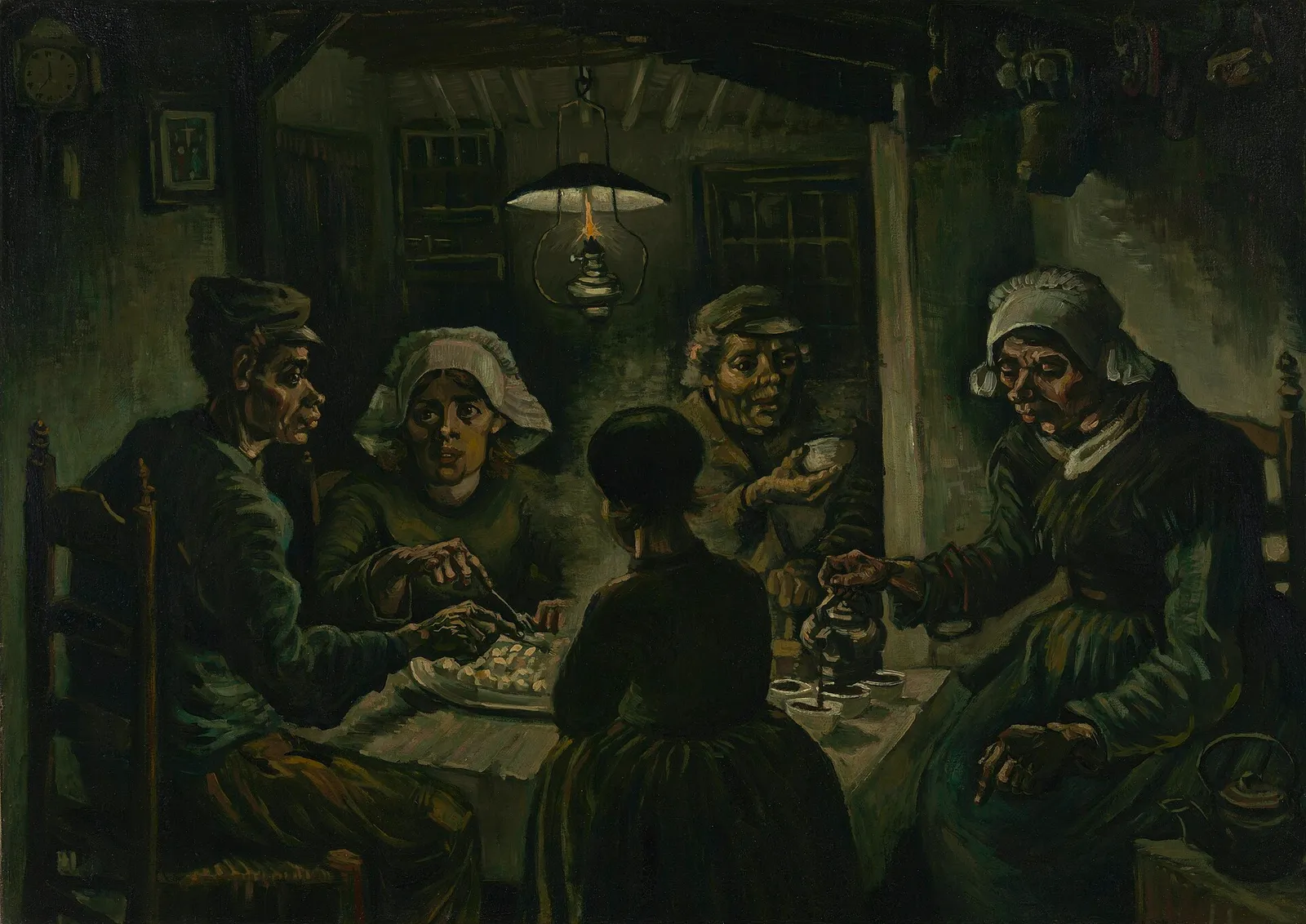
The Potato Eaters, painted by Vincent van Gogh in 1885, shows a peasant family sharing a meal of potatoes under a single lamp. The painting is held by the Van Gogh Museum, where it represents the dark, earthy style of his early Dutch years, before the bright colours most visitors associate with him.
Where to see it
The Potato Eaters is in the collection of the Van Gogh Museum, which is also listed as its location. Display arrangements can change because of rehangs, conservation work or loans, so check the Van Gogh Museum's official website for current display status, opening hours and ticketing before you visit. The canvas measures 82 × 114 cm, large enough to view comfortably from a few steps back, but worth approaching closely to see the brushwork on the hands and faces.
What to look for in person
Lamplight in a dark interior
Start with the oil lamp hanging above the table. It is the only real light source in the scene, and it falls on the faces, the hands and the dish of potatoes, while the walls and corners sink into deep browns and greens. Van Gogh chose this dark, earthy palette on purpose, wanting the colours to feel close to the soil the family works. Notice how few bright tones there are, and how the light picks out just enough detail to hold the group together around the table.
Hands and faces of labour
Look closely at the hands reaching for the potatoes and the cups. They are bony, knotted and heavy, and the faces are coarse rather than idealised. Van Gogh wrote to his brother Theo that he wanted to show these people had dug the earth with the same hands they were putting into the dish, so that the meal would read as honestly earned through manual work. Standing near the canvas, you can see how thick, direct brushstrokes build up the features instead of smooth, polished modelling.
The family around the table
Count the five figures and follow how they connect. On the right, a woman pours a hot drink from a kettle, while the others eat or pass food. In the foreground, a girl sits with her back to us, her dark silhouette set against the lamplight, which draws the viewer into the circle at the table. Small details, such as the clock on the wall and the bare wooden beams, describe a cramped, plain room. Together they make the scene feel like an ordinary evening rather than a staged event.
About the painting
Van Gogh painted The Potato Eaters in 1885, while living in the village of Nuenen in the Dutch province of North Brabant, where his parents had settled. At this stage he was still teaching himself to be a painter, and his main ambition was figure painting: he wanted to depict rural workers with the seriousness that artists such as Jean-François Millet had brought to peasant life. Before tackling the final canvas, he made many studies of local people's heads and hands, as well as preparatory versions of the composition. He also produced a lithograph of the scene, which shows the design in reverse. Van Gogh regarded the painting as an important statement of his aims, but it was not well received by everyone around him. His friend and fellow painter Anthon van Rappard criticised the figures and the drawing sharply, and the disagreement strained their friendship. Later in the 1880s Van Gogh moved to Paris, encountered Impressionism and Neo-Impressionism, and lightened his palette dramatically. Because of that change, The Potato Eaters is now often seen as the culmination of his early Dutch period, a work that shows his commitment to depicting working people before he developed the vivid colour of his later years. When you visit, it helps to keep this contrast in mind: the sombre tones here were a deliberate artistic choice, not a lack of skill with colour. At 82 × 114 cm, the canvas is a substantial work for this period of his career, and it rewards slow looking at the expressions, gestures and the way the light gathers the family together.
Key facts
| Artist | Vincent van Gogh |
|---|---|
| Date | 1885 |
| Size | 82 × 114 cm |
| Medium | oil paint, canvas |
| Collection | Van Gogh Museum |
How to visit: Van Gogh Museum
Amsterdam, Netherlands · Museum guide
| Opening hours | 2–30 Nov 2026, daily 09:00–17:00 (Fri until 21:00, except 27 Nov) 1–18 Dec 2026, daily 09:00–17:00 (Fri until 21:00) 19–23 and 27–30 Dec 2026: 09:00–18:00 24, 25, 26 and 31 Dec 2026: 09:00–17:00 1 Jan 2027: 11:00–18:00 2–10 Jan 2027: 09:00–18:00 (Fri until 21:00) 11 Jan – 12 Feb 2027: 09:00–17:00 (Fri until 21:00) 13–28 Feb 2027: 09:00–18:00 (Fri until 21:00, except 26 Feb) March–September 2027: 09:00–18:00 (Fri until 21:00, except 26 Mar, 28 May, 30 Jul, 24 Sep) 1–3 and 11–31 Oct 2027: 09:00–18:00 (Fri until 21:00) 4–10 Oct 2027: from 09:00 (Mon–Thu until 17:00, Fri until 21:00, Sat–Sun until 18:00) 1–7 Nov 2027: 09:00–18:00 (Fri until 21:00) 8–30 Nov and 1–23 Dec 2027: 09:00–17:00 (Fri until 21:00, except 26 Nov) 24–26 and 31 Dec 2027: 09:00–17:00 27–30 Dec 2027: 09:00–18:00 |
|---|---|
| Closed | Open daily with no regular closing day (25 December 09:00–17:00, 1 January 11:00–18:00). |
| Admission | Adult EUR 25 (from 1 January 2027: EUR 26) Adult with multimedia guide EUR 28.75 (from 1 January 2027: EUR 30) Under 18 free (timed ticket still required) Student (EU/EEA institution) EUR 16 (valid until 31 December 2026; proof of enrolment required) Museumkaart, Vincent's Friends, VriendenLoterij VIP-KAART, ICOM, Rembrandt card, Stadspas holders free (reserve a free timed ticket online) |
| Free entry | Free for under-18s and holders of the Museumkaart, Vincent's Friends, VriendenLoterij VIP-KAART, ICOM card, Rembrandt card or Stadspas (a timed ticket must still be booked online). A companion of a visitor needing assistance is also free. The I amsterdam City Card has not been valid since 1 June 2022. |
| Booking | Booking is required, with timed-entry tickets. |
Official ticket page
Official website
View on map
Hours and prices can change. Please check the official website before you go. (Checked on: 2026-11-09)
More by Vincent van Gogh
 Café Terrace at Night — Kröller-Müller Museum
 White House at Night
 The siesta (after Millet) — Musée d'Orsay
 The Church at Auvers — Musée d'Orsay
 Portrait of Père Tanguy
 Starry Night Over the Rhône — Musée d'Orsay
 The Red Vineyard
 The Yellow House — Van Gogh Museum
 Agostina Segatori Sitting in the Café du Tambourin — Van Gogh Museum
 Irises — J. Paul Getty Museum
 Langlois Bridge at Arles with Women Washing, The — Kröller-Müller Museum
 Blossoming chestnut trees — Kröller-Müller Museum