Art! Art! Art! › Works
The siesta (after Millet)
 Vincent van Gogh, 1890
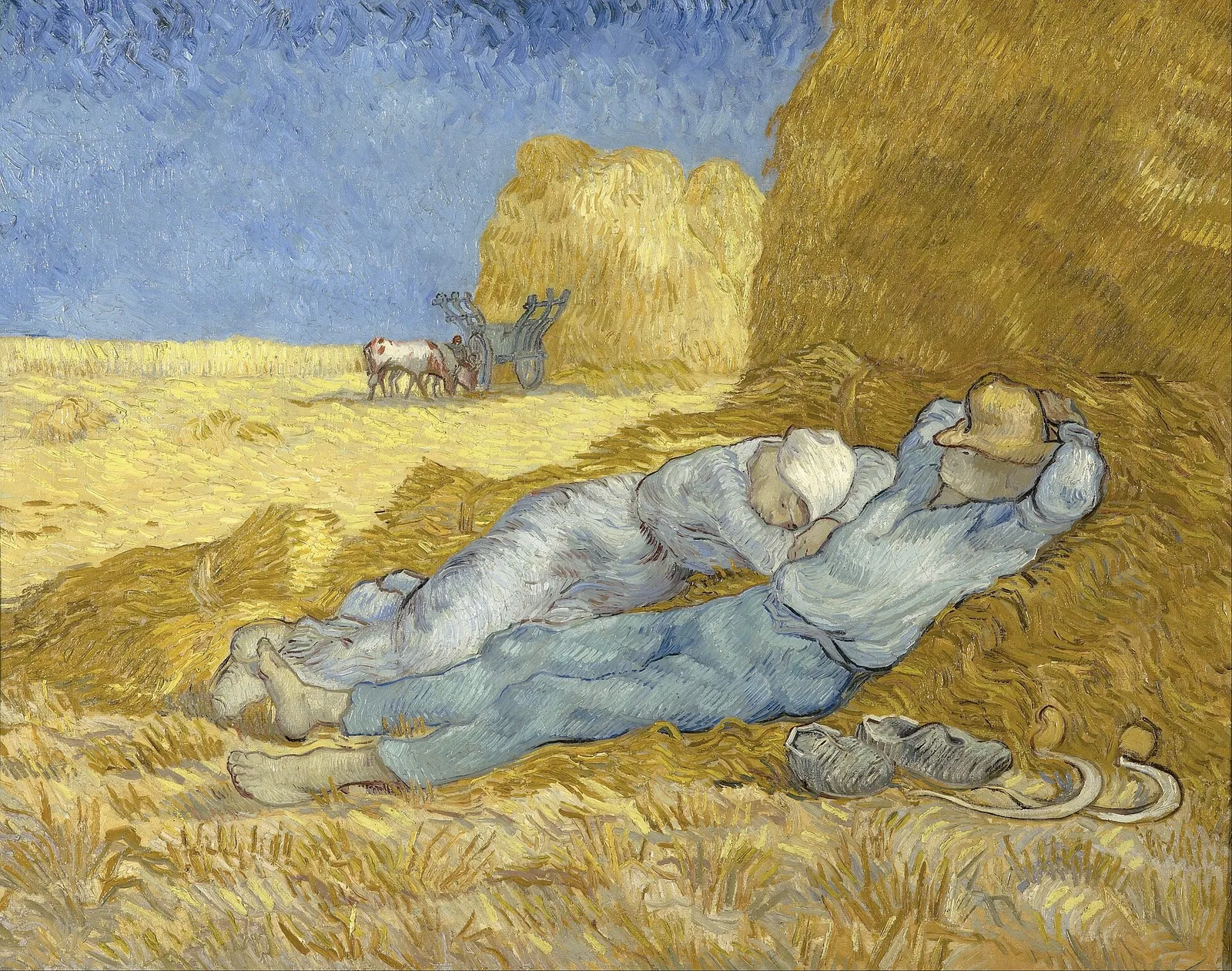
Vincent van Gogh's The siesta (after Millet), also known as La méridienne or La sieste, belongs to the Musée d'Orsay in Paris. Painted in oil on canvas at the asylum in Saint-Rémy-de-Provence, it reimagines a harvest-time scene by Jean-François Millet in Van Gogh's own vivid colour.
Where to see it
The siesta (after Millet) is held by the Musée d'Orsay in Paris, where it is part of the permanent collection. Displays can change, and works are sometimes moved or taken off view, so check the Musée d'Orsay's official website for current display status before you visit. The canvas measures 73 × 91 cm, a moderate size that rewards stepping close to study the brushwork and then back to take in the whole composition.
What to look for in person
Yellow against blue-violet
The first thing most visitors notice is the colour. Warm, straw-yellow tones fill the wheat field and the harvested crop, while cooler blue-violet shades run through the workers' clothing, the sky and the shadows around the haystack. Stand still for a moment and watch how these two families of colour push against each other. The contrast gives an everyday rest a sense of midday heat and brightness, and shows how Van Gogh used colour itself, rather than detail, to describe light and warmth.
A couple at rest
At the centre of the picture, a peasant man and woman lie in the shade of a haystack, taking a break from the harvest. Look at how their bodies are arranged: relaxed, heavy and turned away from the glare. Nothing dramatic happens here. The subject is simply a pause in hard physical work, a theme Van Gogh admired in Millet's depictions of rural life. Notice how the figures sit within the landscape rather than dominating it, as if they belong to the field around them.
The working landscape behind
Let your eye travel past the sleeping couple into the background, which opens onto a rural harvest landscape. An ox cart appears in the scene, a reminder that the labour has only paused, not ended. These details place the rest firmly within a working day in the countryside. Compare the textured strokes of the field and sky with the handling of the figures, and you will see how Van Gogh kept the whole surface lively, so that the setting carries as much energy as the people.
About the painting
Van Gogh made The siesta (after Millet) between December 1889 and January 1890, while he was a patient at the Saint-Paul-de-Mausole asylum in Saint-Rémy-de-Provence. During this period he produced a number of works based on compositions by other artists, and Jean-François Millet, the French painter of peasant life, was one of his most important models. This picture takes its subject from Millet's La Sieste of 1866.
Rather than copying Millet line for line, Van Gogh reworked the scene in his own idiom. The basic arrangement of a peasant couple resting beside a haystack, with the harvest landscape and an ox cart behind them, comes from the earlier image. The colour scheme, built on the contrast between golden wheat and blue-violet clothing, sky and shadow, is distinctly his. Seeing the painting in person, you can appreciate how the thick, directional brushstrokes turn a quiet subject into a vibrant surface.
The work is an oil painting on canvas, 73 cm high and 91 cm wide, and it is generally placed among Van Gogh's paintings of rural fields and agricultural labour. It is part of the permanent collection of the Musée d'Orsay in Paris, which holds a significant group of his works. The image has also travelled beyond the museum: it served as the basis for the cover of Julien Clerc's 2017 album À nos amours. For visitors, it offers a clear example of how Van Gogh, in his final year, used the work of an artist he admired as a starting point for his own experiments with colour.
Key facts
| Artist | Vincent van Gogh |
|---|---|
| Date | 1890 |
| Size | 73 × 91 cm |
| Medium | oil paint, canvas |
| Collection | Musée d'Orsay |
How to visit: Musée d'Orsay
Paris, France · Museum guide
| Opening hours | Tue–Wed, Fri–Sun 09:30–18:00 (galleries close at 17:30) Thu 09:30–21:45 (late opening; galleries close at 21:15) |
|---|---|
| Closed | Every Monday, 1 May and 25 December. |
| Last entry | 17:00 (exhibitions 17:15); Thursdays 21:00 |
| Admission | Full rate, online EUR 16 Full rate, at the museum EUR 14 Reduced rate (on site only) EUR 11 Enfant & Cie, online EUR 13 Enfant & Cie, at the museum EUR 11 Night rate (Thursday), online EUR 12 Night rate (Thursday), at the museum EUR 10 Under 18s; EEA residents under 26 free |
| Free entry | Free for under 18s and residents of the European Economic Area under 26. Free on the first Sunday of the month, with booking required. |
| Booking | Booking is strongly recommended. Entry is by timed slot. |
The museum stays open and all collections and exhibitions remain accessible, but entrances have changed: timed-ticket holders use Entrance 1 (Quay); priority visitors, reseller voucher holders, visitors without tickets and groups use Entrance 2 (Forecourt). Arrive at least 15 minutes before your time slot.
Official ticket page
Official website
View on map
Hours and prices can change. Please check the official website before you go. (Checked on: 2026-11-11)
More by Vincent van Gogh
 Café Terrace at Night — Kröller-Müller Museum
 White House at Night
 The Church at Auvers — Musée d'Orsay
 Portrait of Père Tanguy
 Starry Night Over the Rhône — Musée d'Orsay
 The Potato Eaters — Van Gogh Museum
 The Red Vineyard
 The Yellow House — Van Gogh Museum
 Agostina Segatori Sitting in the Café du Tambourin — Van Gogh Museum
 Irises — J. Paul Getty Museum
 Langlois Bridge at Arles with Women Washing, The — Kröller-Müller Museum
 Blossoming chestnut trees — Kröller-Müller Museum
Sources
- Wikidata Q11826275
- Wikipedia (en) (CC BY-SA 4.0)
- Wikipedia (fr) (CC BY-SA 4.0)
- billetterie.musee-orsay.fr
- www.musee-orsay.fr