Art! Art! Art! › Works
Irises
 Vincent van Gogh, 1889
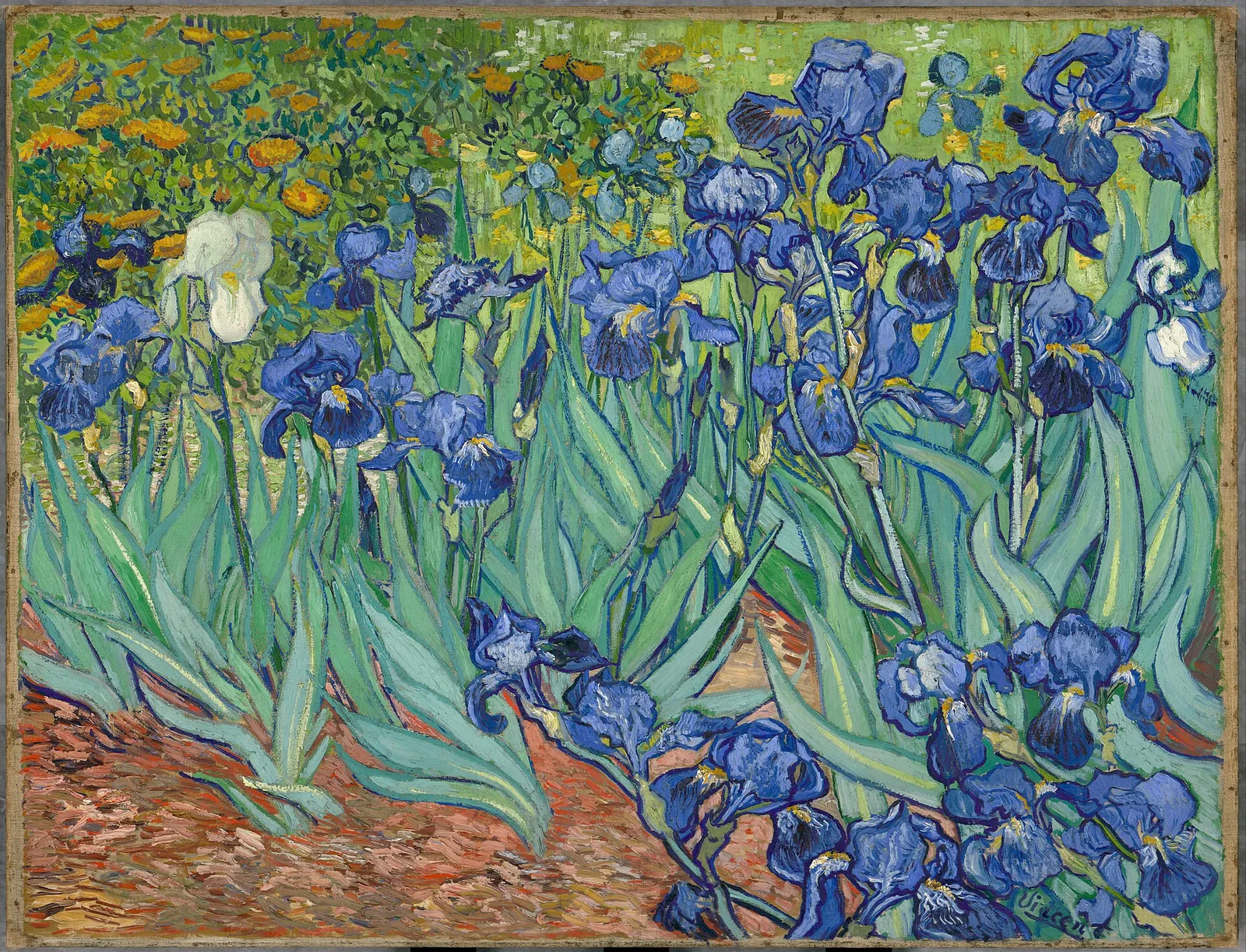
Vincent van Gogh's Irises, dated 1889, belongs to the J. Paul Getty Museum and is held at the Getty Center. Painted in the year he entered the asylum at Saint-Rémy-de-Provence, it fills the canvas with a close-up bed of blue irises, a single white bloom and twisting green leaves.
Where to see it
Irises is in the collection of the J. Paul Getty Museum, with its location listed as the Getty Center. Works can move between galleries, go into storage for conservation or travel on loan, so check the J. Paul Getty Museum's official website for the painting's current display status before you plan your visit.
What to look for in person
The single white iris
Scan the crowd of blue and violet blooms and your eye will settle on one white iris standing apart from the rest. It is the clearest accent in the picture and gives the dense, repeated flower shapes a focal point. Notice how Van Gogh lets this pale flower interrupt the rhythm of the darker petals around it. Step back to see how it balances the composition, then move closer to study how the white is built up from strokes of paint rather than left as bare canvas.
Outlines and flat color
Look at the edges of the leaves and petals. Many forms are bounded by dark contour lines, and areas of color are laid down in fairly flat, decorative patches. Art historians widely connect this approach with Van Gogh's admiration for Japanese woodblock prints, which he collected and studied. The cropped, close-up view, with no sky and no horizon, adds to that effect. Plants are cut off by the edges of the canvas, so the bed of flowers seems to continue beyond the frame.
Brushwork and texture
Seen up close, the surface is physical and active. The long, sword-like leaves are made with directional strokes that follow their curves and twists, while the soil and background are worked in shorter, broken touches. The paint sits thickly in places, catching the gallery light. Try viewing the canvas from a slight angle to see this relief. Then compare the restless movement of the leaves with the more compact, rounded petals, and notice how warm earth tones in the foreground set off the cool blues above.
About the painting
Van Gogh painted Irises in 1889, the year he voluntarily entered the asylum of Saint-Paul-de-Mausole at Saint-Rémy-de-Provence in southern France. It is generally regarded as one of the first pictures he made there, drawing on the plants growing in the asylum garden. Working directly from nature gave him a subject close at hand during a period when his movements were restricted, and flowers, trees and fields became central to the work he produced at Saint-Rémy.
Rather than presenting a tidy bouquet or a distant view of a garden, Van Gogh brings the viewer down among the plants. The flowers fill almost the entire surface, and the composition is built from repetition: petal shapes, leaf blades and patches of soil recur across the canvas, with small variations that keep the eye moving. The strong contours and decorative color reflect his long interest in Japanese prints, an influence that runs through much of his later work.
The canvas measures 74.3 by 94.3 centimeters, a horizontal format that suits the spreading bed of flowers. That size is large enough that, standing in front of it, the plants appear close to life scale, which strengthens the sense of being in the garden itself.
Irises was shown in Paris at the Salon des Indépendants in 1889, sent by his brother Theo while Vincent remained in Saint-Rémy. Today it is part of the collection of the J. Paul Getty Museum at the Getty Center. When you visit, allow time to view it both from a distance, to take in the overall pattern, and up close, to follow the individual brushstrokes.
Key facts
| Artist | Vincent van Gogh |
|---|---|
| Date | 1889 |
| Size | 74.3 × 94.3 cm |
| Medium | oil paint, canvas |
| Collection | J. Paul Getty Museum |
How to visit: J. Paul Getty Museum
Los Angeles, United States · Museum guide
| Opening hours | Tue, Wed, Thu, Fri, Sun 10:00–18:30 Sat 10:00–21:00 (late opening) |
|---|---|
| Closed | Closed on Mondays, and on New Year's Day, Independence Day, Thanksgiving Day and Christmas Day. Closes early on Christmas Eve and New Year's Eve. |
| Admission | Museum admission (everyone) free (timed-entry reservation required) Parking per car or motorcycle USD 25 (cashless; includes LA parking tax) Parking after 15:00 USD 15 Parking after 18:00 USD 10 |
| Free entry | Admission is always free (reservation required). Parking is free on Saturdays after 18:00. Bicycles park free. |
| Booking | A timed-entry reservation is required. |
The South Pavilion, the East Pavilion plaza-level galleries and the North Pavilion galleries are closed for renovation as part of the Getty Center modernisation. The Getty Villa Museum (a separate site in Pacific Palisades) is open daily 10:00–17:00, closed Tuesdays.
Official ticket page
Official website
View on map
Hours and prices can change. Please check the official website before you go. (Checked on: 2026-11-09)
More by Vincent van Gogh
 Café Terrace at Night — Kröller-Müller Museum
 White House at Night
 The siesta (after Millet) — Musée d'Orsay
 The Church at Auvers — Musée d'Orsay
 Portrait of Père Tanguy
 Starry Night Over the Rhône — Musée d'Orsay
 The Potato Eaters — Van Gogh Museum
 The Red Vineyard
 The Yellow House — Van Gogh Museum
 Agostina Segatori Sitting in the Café du Tambourin — Van Gogh Museum
 Langlois Bridge at Arles with Women Washing, The — Kröller-Müller Museum
 Blossoming chestnut trees — Kröller-Müller Museum