Art! Art! Art! › Works
The Red Vineyard
 Vincent van Gogh, 1888
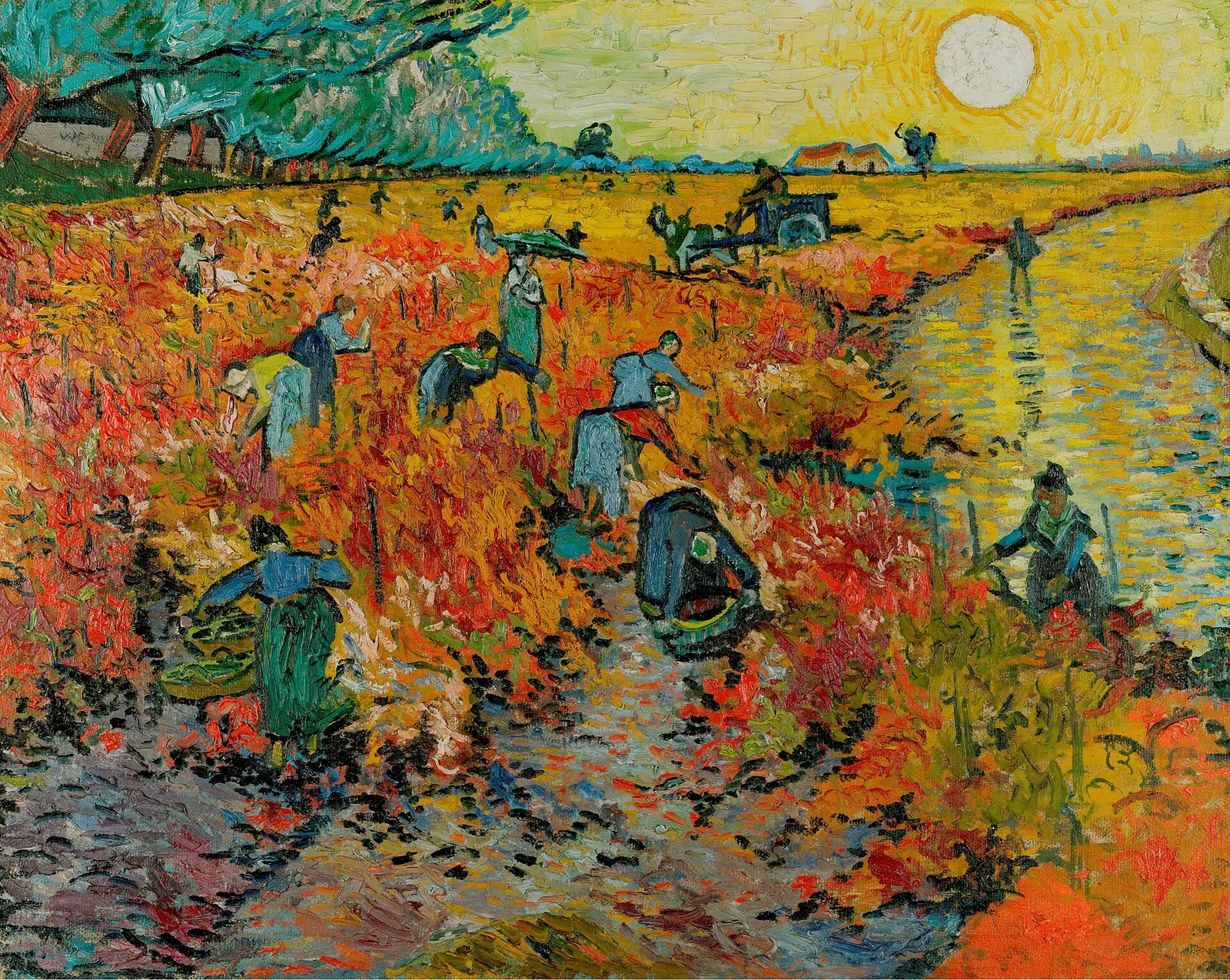
The Red Vineyard is an 1888 painting by Vincent van Gogh, held in the collection of the Pushkin Museum of Fine Arts. It shows workers harvesting grapes in a field of glowing red vines beneath a low yellow sun. At 73 x 91 cm, it is a mid-sized canvas that rewards both a step back and a close look at the paint.
Where to see it
The Red Vineyard belongs to the Pushkin Museum of Fine Arts, which is also its recorded location. Display arrangements at any museum can change because of rehangs, conservation work or loans, so check the Pushkin Museum of Fine Arts' official website for current display status, opening hours and ticketing before you plan your visit.
What to look for in person
A field of burning colour
The vineyard fills most of the canvas in reds, crimsons and oranges, the colours of vine leaves turning in autumn. Stand back first and notice how this warm mass dominates the picture, then look for the cooler blues and violets Van Gogh places in the figures' clothing and in the shadows. These contrasting colours sit side by side rather than blending, so each makes the other appear more intense. The result is less a literal record of a field than a scene charged with heat and late-season light.
Workers among the rows
Look closely at the figures bent among the vines. They are harvesters gathering grapes, and several appear to carry or fill baskets. Van Gogh reduces their bodies to simple, strongly outlined shapes, so they read as part of the rhythm of the field rather than as individual portraits. Follow the rows of vines and the figures receding into the distance: they guide your eye from the foreground toward the horizon. The painting treats rural labour as a steady, shared activity woven into the landscape itself.
Low sun and reflected light
In the upper part of the canvas a yellow sun hangs low in the sky, and its light is caught on the right side of the picture by a wet road or stretch of water that becomes a bright, shimmering band. Move closer to see how the paint is applied in thick, visible strokes, with the brush marks themselves describing the glare and movement of light. This raised, textured surface is easier to appreciate in person than in reproduction, so take time to view it from an angle as well as head-on.
About the painting
Vincent van Gogh painted The Red Vineyard in 1888, during his stay in Arles in the south of France, a period when he was producing a large number of landscapes and exploring bold, expressive colour. The canvas measures 73 by 91 cm and today belongs to the Pushkin Museum of Fine Arts. In the autumn of 1888 Paul Gauguin joined Van Gogh in Arles, and the two artists discussed painting not only directly from nature but also from memory and imagination. The Red Vineyard is generally linked to this phase: Van Gogh is understood to have observed a vineyard at harvest time and worked up the scene with heightened colour rather than strict description. He wrote about the vineyard scene in letters to his brother Theo, which are a key source for understanding the work. For a visitor, the painting is a clear example of how Van Gogh used colour to carry feeling. The reds of the vines, the yellow of the sun and the cooler accents in the figures and shadows create strong contrasts, while the thick application of paint gives the surface a tactile energy. The harvesters are simplified so that they merge with the patterns of the field, emphasising the rhythm of work in the landscape. The painting was shown in Brussels in 1890 and acquired by the Belgian artist and collector Anna Boch, which makes it one of the few works whose sale during Van Gogh's lifetime is well documented. When you stand in front of it, look at the whole composition first, then let your eye travel along the rows to the low sun and its reflected light.
Key facts
| Artist | Vincent van Gogh |
|---|---|
| Date | 1888 |
| Size | 73 × 91 cm |
| Medium | oil paint, canvas |
| Collection | Pushkin Museum of Fine Arts |
How to visit: Pushkin Museum of Fine Arts
Moscow, Russia
Hours and prices can change. Please check the official website before you go.
More by Vincent van Gogh
 Café Terrace at Night — Kröller-Müller Museum
 White House at Night
 The siesta (after Millet) — Musée d'Orsay
 The Church at Auvers — Musée d'Orsay
 Portrait of Père Tanguy
 Starry Night Over the Rhône — Musée d'Orsay
 The Potato Eaters — Van Gogh Museum
 The Yellow House — Van Gogh Museum
 Agostina Segatori Sitting in the Café du Tambourin — Van Gogh Museum
 Irises — J. Paul Getty Museum
 Langlois Bridge at Arles with Women Washing, The — Kröller-Müller Museum
 Blossoming chestnut trees — Kröller-Müller Museum