Art! Art! Art! › Works
Starry Night Over the Rhône
 Vincent van Gogh, 1888
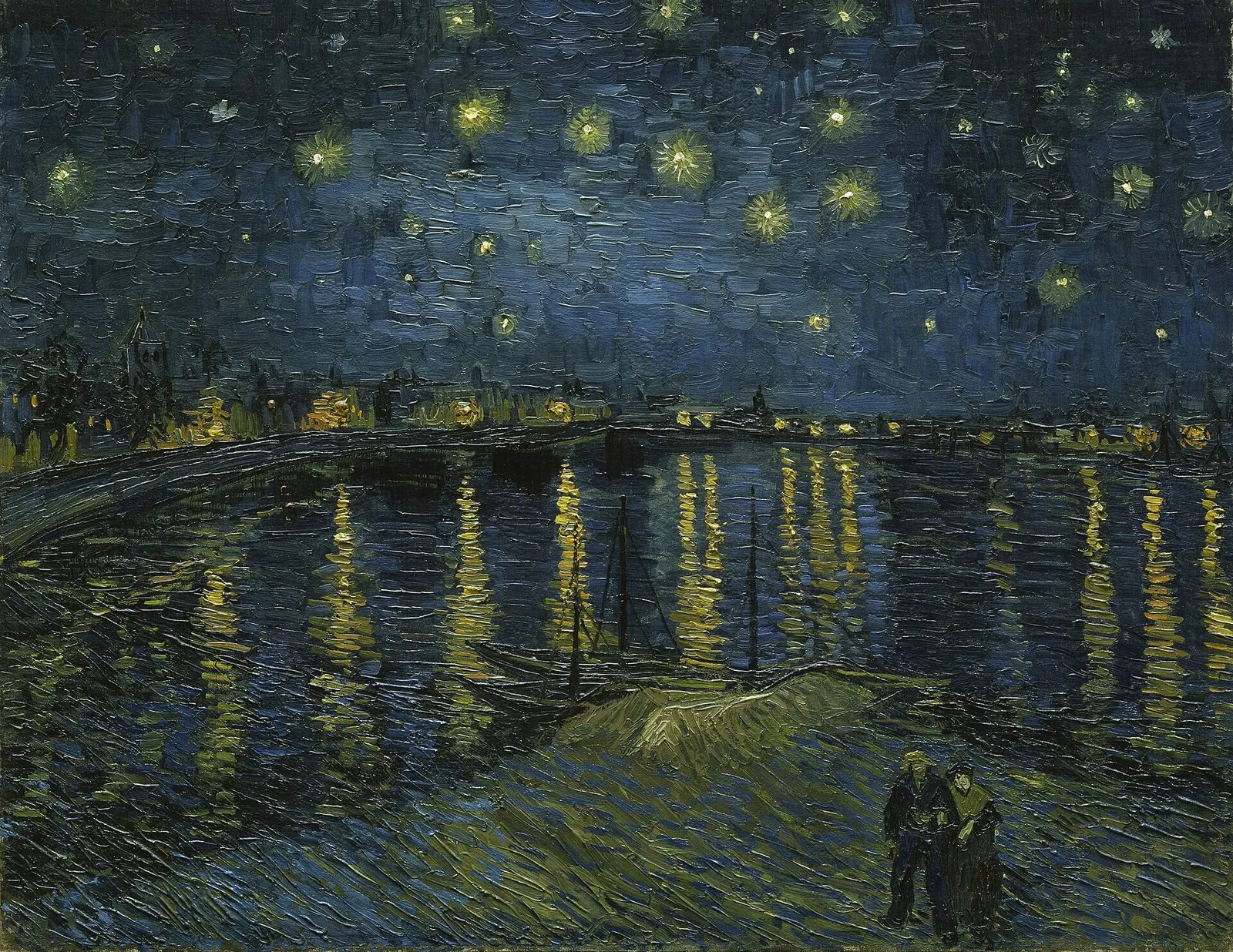
Vincent van Gogh painted Starry Night Over the Rhône in Arles in 1888, setting up his easel on the riverbank at night. The painting is held by the Musée d'Orsay in Paris, where visitors can study its flower-like stars, gaslit reflections and the small couple strolling along the shore.
Where to see it
Starry Night Over the Rhône is in the collection of the Musée d'Orsay in Paris. Works in museum collections can be moved, rehung or lent to other institutions, so check the Musée d'Orsay's official website for the painting's current display status before planning your visit.
What to look for in person
Flower-like stars and the Plough
Look up into the aquamarine sky and find the seven stars of the Plough, also known as the Big Dipper. Up close, each star is not a simple dot but a small disc ringed with short, petal-like strokes, so the stars read almost like flowers. The constellation is also a quiet piece of artistic licence. From where Van Gogh stood, facing southwest, the Plough would not have been visible, because it lay to the north. The picture therefore brings two different directions of view together into a single scene.
Gaslight on the water
Van Gogh painted this canvas at night, working by the light of a gas lamp. Follow the streaks of yellow and orange reflected in the river: these are the lights of Arles on the far side, drawn out into long strokes across the royal blue water. On the left you can pick out the towers of Saint-Julien and Saint-Trophime on the skyline, and on the right the iron bridge that leads to Trinquetaille. Notice how the warm light of the town differs from the cooler glow of the stars above.
The lovers and the reworked foreground
Lower your gaze to the riverbank. Two small, brightly coloured figures, a pair of lovers, walk near a heap of sand in the foreground; Van Gogh mentioned them himself in a letter to his brother Theo. This part of the canvas rewards a close look at the paint surface. After completing a first state of the picture, Van Gogh returned to the foreground and reworked it heavily, laying fresh paint into paint that was still wet. The dense, layered handling here contrasts with the more open treatment of the sky.
About the painting
Starry Night Over the Rhône is an oil on canvas that Vincent van Gogh painted in Arles in September 1888, toward the end of that month. At the time he was renting the Yellow House, and the spot where he worked on the bank of the Rhône was only a minute or two away on foot. The view looks southwest from the river's east bank toward the town, with church towers on the left and the iron bridge to Trinquetaille on the right.
Van Gogh described the picture in a letter to Theo. He called it a size 30 canvas, said it had been painted at night under a gas lamp, and summed up its colour scheme as an aquamarine sky, royal blue water and mauve ground, with two colourful small figures of lovers in the foreground. He also sent a sketch of the composition in a letter to the painter Eugène Boch, giving a glimpse of how he shared his ideas with fellow artists.
The painting was first shown publicly in Paris in 1889, at the annual exhibition of the Société des Artistes Indépendants, where it hung alongside his Irises. Theo chose this canvas for the show, even though Vincent had suggested one of his paintings of the public gardens in Arles instead. Today the work belongs to the Musée d'Orsay. When you stand before it, take time to move between a distant view of the whole night scene and a close look at the brushwork in the stars, the reflections and the reworked riverbank.
Key facts
| Artist | Vincent van Gogh |
|---|---|
| Date | 1888 |
| Size | 720 × 921 cm |
| Medium | oil paint, canvas |
| Collection | Musée d'Orsay |
How to visit: Musée d'Orsay
Paris, France · Museum guide
| Opening hours | Tue–Wed, Fri–Sun 09:30–18:00 (galleries close at 17:30) Thu 09:30–21:45 (late opening; galleries close at 21:15) |
|---|---|
| Closed | Every Monday, 1 May and 25 December. |
| Last entry | 17:00 (exhibitions 17:15); Thursdays 21:00 |
| Admission | Full rate, online EUR 16 Full rate, at the museum EUR 14 Reduced rate (on site only) EUR 11 Enfant & Cie, online EUR 13 Enfant & Cie, at the museum EUR 11 Night rate (Thursday), online EUR 12 Night rate (Thursday), at the museum EUR 10 Under 18s; EEA residents under 26 free |
| Free entry | Free for under 18s and residents of the European Economic Area under 26. Free on the first Sunday of the month, with booking required. |
| Booking | Booking is strongly recommended. Entry is by timed slot. |
The museum stays open and all collections and exhibitions remain accessible, but entrances have changed: timed-ticket holders use Entrance 1 (Quay); priority visitors, reseller voucher holders, visitors without tickets and groups use Entrance 2 (Forecourt). Arrive at least 15 minutes before your time slot.
Official ticket page
Official website
View on map
Hours and prices can change. Please check the official website before you go. (Checked on: 2026-11-11)
More by Vincent van Gogh
 Café Terrace at Night — Kröller-Müller Museum
 White House at Night
 The siesta (after Millet) — Musée d'Orsay
 The Church at Auvers — Musée d'Orsay
 Portrait of Père Tanguy
 The Potato Eaters — Van Gogh Museum
 The Red Vineyard
 The Yellow House — Van Gogh Museum
 Agostina Segatori Sitting in the Café du Tambourin — Van Gogh Museum
 Irises — J. Paul Getty Museum
 Langlois Bridge at Arles with Women Washing, The — Kröller-Müller Museum
 Blossoming chestnut trees — Kröller-Müller Museum
Sources
- Wikidata Q1464531
- Wikipedia (en) (CC BY-SA 4.0)
- Wikipedia (ja) (CC BY-SA 4.0)
- Wikipedia (fr) (CC BY-SA 4.0)
- billetterie.musee-orsay.fr
- www.musee-orsay.fr