Art! Art! Art! › Works
Blossoming chestnut trees
 Vincent van Gogh, 1890
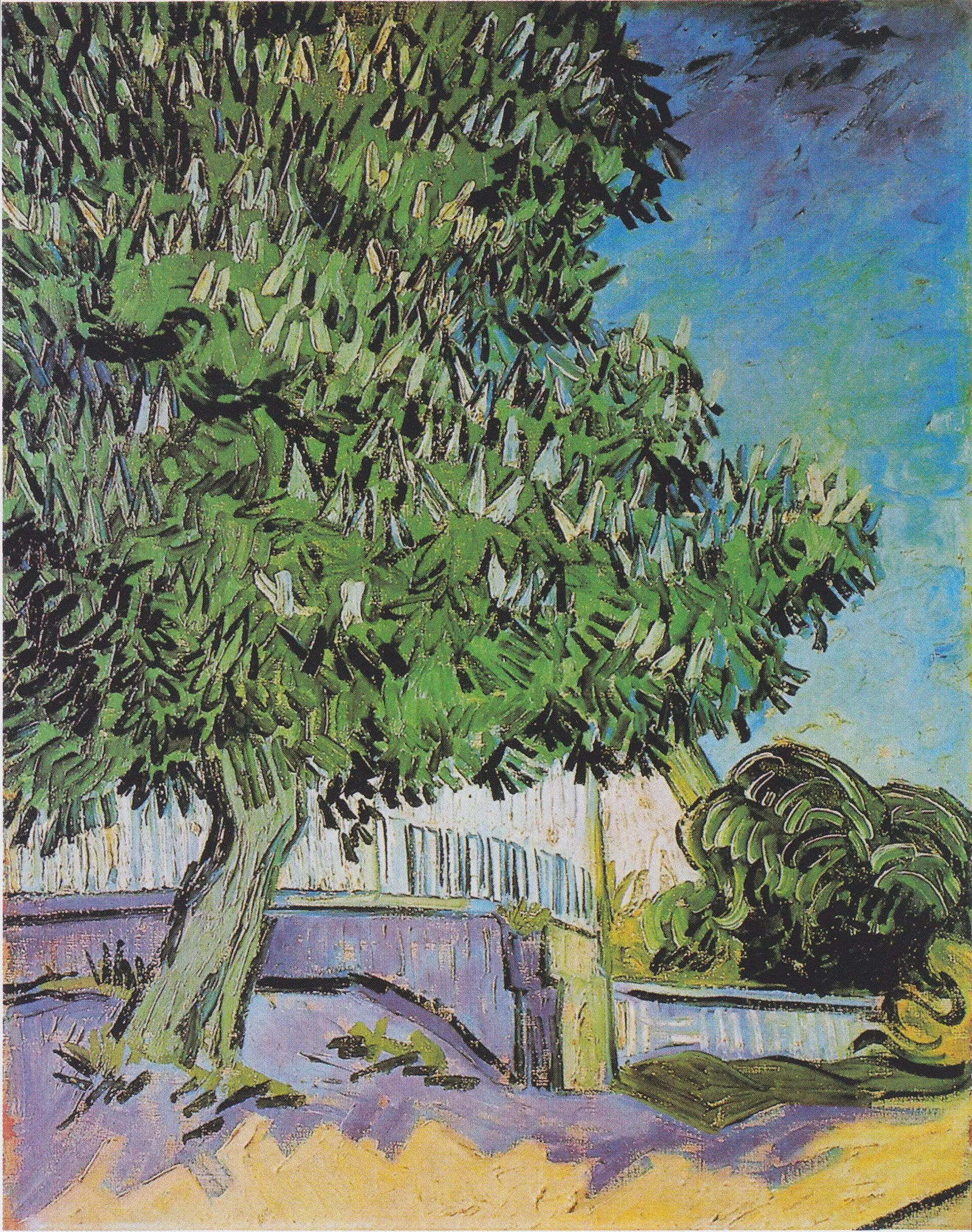
Blossoming chestnut trees is an oil on canvas that Vincent van Gogh painted in May 1890 at Auvers-sur-Oise, showing a chestnut tree heavy with white blossom. It belongs to the Kröller-Müller Museum near Otterlo in the Netherlands. In front of it, look for the house that is almost entirely hidden behind the flowering branches.
Where to see it
Blossoming chestnut trees is in the collection of the Kröller-Müller Museum, near Otterlo in the Netherlands. The canvas measures 63 x 50.5 cm, a fairly modest size, so give yourself time to stand close as well as step back. Works in museum collections are sometimes rotated, lent or temporarily removed for conservation, so check the Kröller-Müller Museum's official website for current display status before you plan your visit.
What to look for in person
A tree in white blossom
The subject is a chestnut tree in full flower, and the white blossoms are the heart of the picture. Look at how the flowering mass fills much of the canvas, leaving relatively little room for anything else. Notice how the white blooms stand out against the surrounding foliage and the background, and how the eye is drawn upward through the crown of the tree. At 63 x 50.5 cm the work is small enough to take in at once from a few steps away, but moving closer lets you study how the paint builds up the blossoms.
The house behind the branches
Search the composition carefully and you will find a white house, almost completely screened by the flowering tree. Van Gogh lets nature dominate, so the building becomes a partial glimpse rather than a subject in its own right. This is the same house that appears in his painting The White House at Night, where it takes centre stage. Comparing the two in your mind shows how the artist could return to one motif in Auvers and treat it in very different ways, here letting spring growth almost swallow the architecture.
One half of a pair
This canvas is one of two paintings of flowering chestnut trees. Its companion shows chestnut trees with pink blossoms, and the white version you see here is somewhat smaller in format. In a letter to his brother Theo dated 25 May 1890, Van Gogh mentioned that he had made one study of pink chestnut trees and one of white. Knowing this, you can view the painting as part of a deliberate exercise: the same kind of tree, the same season, explored through two different colours of bloom.
About the painting
Vincent van Gogh painted Blossoming chestnut trees in May 1890 at Auvers-sur-Oise, the village north of Paris where he spent the final months of his life. The work is an oil on canvas measuring 63 by 50.5 centimetres and is now in the collection of the Kröller-Müller Museum, near Otterlo in the Netherlands.
The picture belongs to a pair. Van Gogh painted chestnut trees in flower twice, once with pink blossoms and once with white. He referred to both in a letter to his brother Theo dated 25 May 1890, describing them as studies, one of pink chestnut trees and one of white. The white-blossom painting is the slightly smaller of the two.
What sets this version apart is the way the flowering tree almost completely conceals a white house. The building is the same one that Van Gogh depicted in The White House at Night, another of his Auvers paintings. Here, however, the house is reduced to a fragment behind the blossom, and the tree itself becomes the main subject.
For visitors, the painting offers a chance to see how Van Gogh responded to spring in his new surroundings: a single tree, its white flowers, and a familiar house glimpsed through the branches. It rewards both a distant view of the overall composition and a close look at the handling of the paint.
Key facts
| Artist | Vincent van Gogh |
|---|---|
| Date | 1890 |
| Size | 63 × 50.5 cm |
| Medium | oil paint, canvas |
| Collection | Kröller-Müller Museum |
How to visit: Kröller-Müller Museum
Ede, Netherlands · Museum guide
| Opening hours | Tue–Sun and public holidays 10:00–17:00 (museum and sculpture garden) Mon 21 Dec and Mon 28 Dec 2026 10:00–17:00 (special Christmas openings) |
|---|---|
| Closed | Mondays (except public holidays and announced exceptions); 1 January. Public holidays: Easter, Ascension Day, Pentecost, 25 and 26 December, King's Day 27 April, Liberation Day 5 May. |
| Admission | Adult (combined day ticket, museum + De Hoge Veluwe National Park) EUR 27.75 Youth 13–18 (combined day ticket) EUR 20.8 Child 6–12 (combined day ticket) EUR 6.95 Museumkaart / VriendenLoterij VIP-KAART holders (park only; museum free) EUR 13.85 (bring the card) Students / CJP / Cultuurkaart / EYCA (discounted museum ticket) EUR 6.95 (park ticket bought separately at the park entrance) Car / motorcycle in the park EUR 9.8 (parking at park entrance EUR 4.90) Audio tour (Podcatcher) EUR 2.5 (collection presentation only; max 90 minutes) |
| Free entry | Museum entry is free with a Museumkaart or VriendenLoterij VIP-KAART (park ticket still needed). Free with an ICOM or Vereniging Rembrandt card. One companion of a disabled-parking-permit holder enters the museum free. Park admission is required to reach the museum. |
| Booking | Booking is recommended; there is no timed entry. |
The exhibition “Van Gogh, All Our Paintings” (15 Sep 2026 – 3 Jan 2027) requires an additional free exhibition ticket with a start time. From 4 October the collection tour follows a different route. No closure has been announced.
Official ticket page
Official website
View on map
Hours and prices can change. Please check the official website before you go. (Checked on: 2026-11-09)
More by Vincent van Gogh
 Café Terrace at Night — Kröller-Müller Museum
 White House at Night
 The siesta (after Millet) — Musée d'Orsay
 The Church at Auvers — Musée d'Orsay
 Portrait of Père Tanguy
 Starry Night Over the Rhône — Musée d'Orsay
 The Potato Eaters — Van Gogh Museum
 The Red Vineyard
 The Yellow House — Van Gogh Museum
 Agostina Segatori Sitting in the Café du Tambourin — Van Gogh Museum
 Irises — J. Paul Getty Museum
 Langlois Bridge at Arles with Women Washing, The — Kröller-Müller Museum